

The one-handed helical PTrMA exhibited an unexpected high chiral recognition
when used as a CSP in liquid chromatography [16]. Because PTrMA with a degree
of polymerization (DP) above 100 is insoluble in solvents, the polymer was ground
into small particles and then packed into an HPLC column. The packed column
could resolve many racemates using methanol as the eluent [17]. However, the
column was unable to be used for a long time because the insoluble PTrMA was
brittle and caused clogging of the end filter of the HPLC column. This defect was
overcome by coating macroporous silica gel having rather large pores with a
soluble PTrMA with a lower DP of ca. 50 [18]. The PTrMA adsorbed on the silica
gel did not come off the silica gel and could be stably used as a CSP. In 1982, the
column was commercialized as the first synthetic polymer-based chiral column,
CHIRALPAC OT, from Daicel. The column could resolve many racemates, particularly stereochemically interesting aromatic compounds, as shown in Fig. 7.
One of the weak points of the PTrMA is the fact that the trityl ester is not strong
enough and slowly solvolized in methanol, which is often used as the eluent in
HPLC. The ability of the column gradually deteriorated and, therefore, it was
requested that the methanol be completely replaced with hexane. The one-handed
C
C O
O
C
CH 3
C
C O
O
C
CH 2
CH 3
CH 2
n
PTrMA
TrMA
toluene,
N
N
Li
Bu
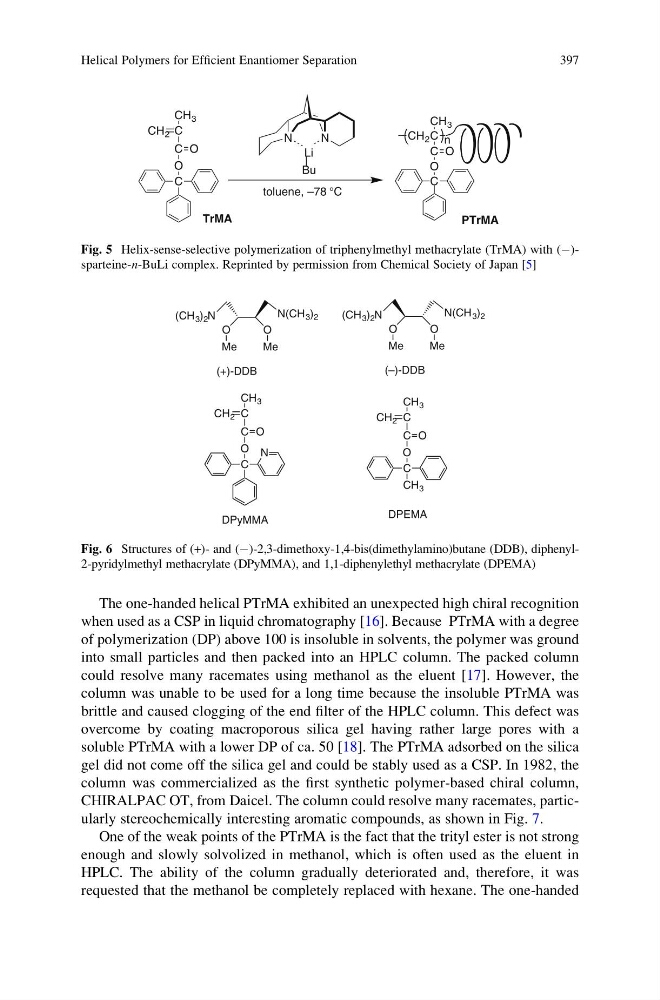
Fig. 5 Helix-sense-selective polymerization of triphenylmethyl methacrylate (TrMA) with (À)sparteine-n-BuLi complex. Reprinted by permission from Chemical Society of Japan [5]
(CH 3 ) 2 N
N(CH 3 ) 2
O
Me
O
Me
(CH 3 ) 2 N
N(CH 3 ) 2
O
Me
O
Me
(+)-DDB
C
C O
O
C
CH 3
CH 3
CH 2
C
C O
O
C
N
CH 3
CH 2
DPyMMA
DPEMA
Fig. 6 Structures of (+)- and (À)-2,3-dimethoxy-1,4-bis(dimethylamino)butane (DDB), diphenyl2-pyridylmethyl methacrylate (DPyMMA), and 1,1-diphenylethyl methacrylate (DPEMA)
Helical Polymers for Efficient Enantiomer Separation
397
when used as a CSP in liquid chromatography [16]. Because PTrMA with a degree
of polymerization (DP) above 100 is insoluble in solvents, the polymer was ground
into small particles and then packed into an HPLC column. The packed column
could resolve many racemates using methanol as the eluent [17]. However, the
column was unable to be used for a long time because the insoluble PTrMA was
brittle and caused clogging of the end filter of the HPLC column. This defect was
overcome by coating macroporous silica gel having rather large pores with a
soluble PTrMA with a lower DP of ca. 50 [18]. The PTrMA adsorbed on the silica
gel did not come off the silica gel and could be stably used as a CSP. In 1982, the
column was commercialized as the first synthetic polymer-based chiral column,
CHIRALPAC OT, from Daicel. The column could resolve many racemates, particularly stereochemically interesting aromatic compounds, as shown in Fig. 7.
One of the weak points of the PTrMA is the fact that the trityl ester is not strong
enough and slowly solvolized in methanol, which is often used as the eluent in
HPLC. The ability of the column gradually deteriorated and, therefore, it was
requested that the methanol be completely replaced with hexane. The one-handed
C
C O
O
C
CH 3
C
C O
O
C
CH 2
CH 3
CH 2
n
PTrMA
TrMA
toluene,
N
N
Li
Bu
Fig. 5 Helix-sense-selective polymerization of triphenylmethyl methacrylate (TrMA) with (À)sparteine-n-BuLi complex. Reprinted by permission from Chemical Society of Japan [5]
(CH 3 ) 2 N
N(CH 3 ) 2
O
Me
O
Me
(CH 3 ) 2 N
N(CH 3 ) 2
O
Me
O
Me
(+)-DDB
C
C O
O
C
CH 3
CH 3
CH 2
C
C O
O
C
N
CH 3
CH 2
DPyMMA
DPEMA
Fig. 6 Structures of (+)- and (À)-2,3-dimethoxy-1,4-bis(dimethylamino)butane (DDB), diphenyl2-pyridylmethyl methacrylate (DPyMMA), and 1,1-diphenylethyl methacrylate (DPEMA)
Helical Polymers for Efficient Enantiomer Separation
397