

6.6.3 A Library of Amphiphilic Dendron Self-Assembly Directed
by the CNDPs
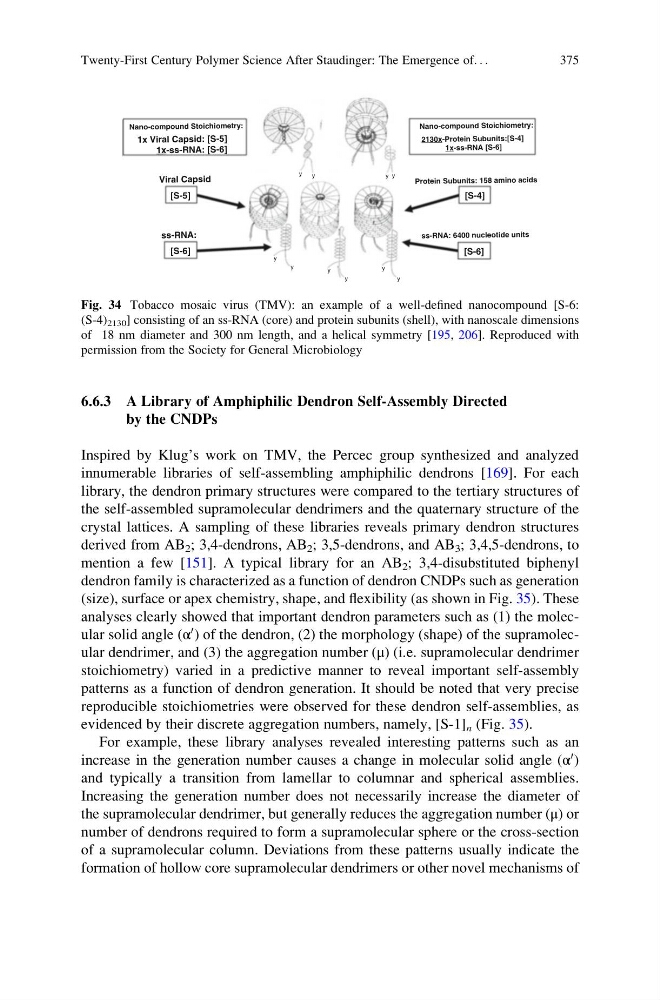
Inspired by Klug’s work on TMV, the Percec group synthesized and analyzed
innumerable libraries of self-assembling amphiphilic dendrons [169]. For each
library, the dendron primary structures were compared to the tertiary structures of
the self-assembled supramolecular dendrimers and the quaternary structure of the
crystal lattices. A sampling of these libraries reveals primary dendron structures
derived from AB 2 ; 3,4-dendrons, AB 2 ; 3,5-dendrons, and AB 3 ; 3,4,5-dendrons, to
mention a few [151]. A typical library for an AB 2 ; 3,4-disubstituted biphenyl
dendron family is characterized as a function of dendron CNDPs such as generation
(size), surface or apex chemistry, shape, and flexibility (as shown in Fig. 35). These
analyses clearly showed that important dendron parameters such as (1) the molecular solid angle (α
0 ) of the dendron, (2) the morphology (shape) of the supramolecular dendrimer, and (3) the aggregation number (μ) (i.e. supramolecular dendrimer
stoichiometry) varied in a predictive manner to reveal important self-assembly
patterns as a function of dendron generation. It should be noted that very precise
reproducible stoichiometries were observed for these dendron self-assemblies, as
evidenced by their discrete aggregation numbers, namely, [S-1] n (Fig. 35).
For example, these library analyses revealed interesting patterns such as an
increase in the generation number causes a change in molecular solid angle (α
0 )
and typically a transition from lamellar to columnar and spherical assemblies.
Increasing the generation number does not necessarily increase the diameter of
the supramolecular dendrimer, but generally reduces the aggregation number (μ) or
number of dendrons required to form a supramolecular sphere or the cross-section
of a supramolecular column. Deviations from these patterns usually indicate the
formation of hollow core supramolecular dendrimers or other novel mechanisms of
y
y
y y
y
y
y
y
y
y
[S-6]
[S-6]
[S-5]
[S-4]
ss-RNA:
Viral Capsid
1x Viral Capsid: [S-5]
2130x-Protein Subunits:[S-4]
Protein Subunits: 158 amino acids
ss-RNA: 6400 nucleotide units
1x-ss-RNA [S-6]
1x-ss-RNA: [S-6]
Nano-compound Stoichiometry:
Nano-compound Stoichiometry:
Fig. 34 Tobacco mosaic virus (TMV): an example of a well-defined nanocompound [S-6:
(S-4) 2130 ] consisting of an ss-RNA (core) and protein subunits (shell), with nanoscale dimensions
of 18 nm diameter and 300 nm length, and a helical symmetry [195, 206]. Reproduced with
permission from the Society for General Microbiology
Twenty-First Century Polymer Science After Staudinger: The Emergence of. . .
375
by the CNDPs
Inspired by Klug’s work on TMV, the Percec group synthesized and analyzed
innumerable libraries of self-assembling amphiphilic dendrons [169]. For each
library, the dendron primary structures were compared to the tertiary structures of
the self-assembled supramolecular dendrimers and the quaternary structure of the
crystal lattices. A sampling of these libraries reveals primary dendron structures
derived from AB 2 ; 3,4-dendrons, AB 2 ; 3,5-dendrons, and AB 3 ; 3,4,5-dendrons, to
mention a few [151]. A typical library for an AB 2 ; 3,4-disubstituted biphenyl
dendron family is characterized as a function of dendron CNDPs such as generation
(size), surface or apex chemistry, shape, and flexibility (as shown in Fig. 35). These
analyses clearly showed that important dendron parameters such as (1) the molecular solid angle (α
0 ) of the dendron, (2) the morphology (shape) of the supramolecular dendrimer, and (3) the aggregation number (μ) (i.e. supramolecular dendrimer
stoichiometry) varied in a predictive manner to reveal important self-assembly
patterns as a function of dendron generation. It should be noted that very precise
reproducible stoichiometries were observed for these dendron self-assemblies, as
evidenced by their discrete aggregation numbers, namely, [S-1] n (Fig. 35).
For example, these library analyses revealed interesting patterns such as an
increase in the generation number causes a change in molecular solid angle (α
0 )
and typically a transition from lamellar to columnar and spherical assemblies.
Increasing the generation number does not necessarily increase the diameter of
the supramolecular dendrimer, but generally reduces the aggregation number (μ) or
number of dendrons required to form a supramolecular sphere or the cross-section
of a supramolecular column. Deviations from these patterns usually indicate the
formation of hollow core supramolecular dendrimers or other novel mechanisms of
y
y
y y
y
y
y
y
y
y
[S-6]
[S-6]
[S-5]
[S-4]
ss-RNA:
Viral Capsid
1x Viral Capsid: [S-5]
2130x-Protein Subunits:[S-4]
Protein Subunits: 158 amino acids
ss-RNA: 6400 nucleotide units
1x-ss-RNA [S-6]
1x-ss-RNA: [S-6]
Nano-compound Stoichiometry:
Nano-compound Stoichiometry:
Fig. 34 Tobacco mosaic virus (TMV): an example of a well-defined nanocompound [S-6:
(S-4) 2130 ] consisting of an ss-RNA (core) and protein subunits (shell), with nanoscale dimensions
of 18 nm diameter and 300 nm length, and a helical symmetry [195, 206]. Reproduced with
permission from the Society for General Microbiology
Twenty-First Century Polymer Science After Staudinger: The Emergence of. . .
375