

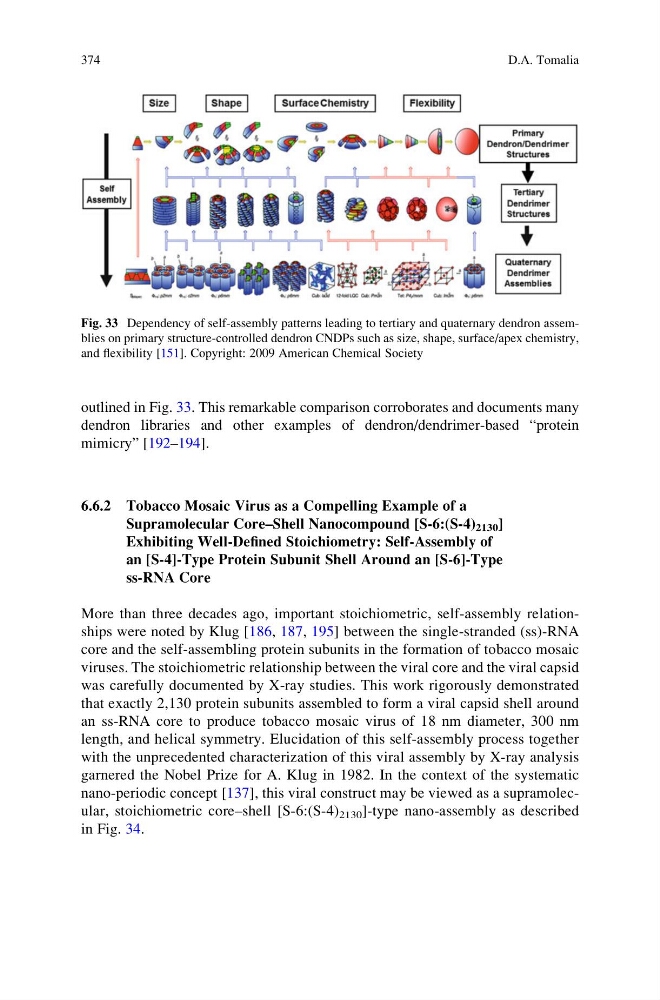
outlined in Fig. 33. This remarkable comparison corroborates and documents many
dendron libraries and other examples of dendron/dendrimer-based “protein
mimicry” [192–194].
6.6.2 Tobacco Mosaic Virus as a Compelling Example of a
Supramolecular Core–Shell Nanocompound [S-6:(S-4) 2130 ]
Exhibiting Well-Defined Stoichiometry: Self-Assembly of
an [S-4]-Type Protein Subunit Shell Around an [S-6]-Type
ss-RNA Core
More than three decades ago, important stoichiometric, self-assembly relationships were noted by Klug [186, 187, 195] between the single-stranded (ss)-RNA
core and the self-assembling protein subunits in the formation of tobacco mosaic
viruses. The stoichiometric relationship between the viral core and the viral capsid
was carefully documented by X-ray studies. This work rigorously demonstrated
that exactly 2,130 protein subunits assembled to form a viral capsid shell around
an ss-RNA core to produce tobacco mosaic virus of 18 nm diameter, 300 nm
length, and helical symmetry. Elucidation of this self-assembly process together
with the unprecedented characterization of this viral assembly by X-ray analysis
garnered the Nobel Prize for A. Klug in 1982. In the context of the systematic
nano-periodic concept [137], this viral construct may be viewed as a supramolecular, stoichiometric core–shell [S-6:(S-4) 2130 ]-type nano-assembly as described
in Fig. 34.
Fig. 33 Dependency of self-assembly patterns leading to tertiary and quaternary dendron assemblies on primary structure-controlled dendron CNDPs such as size, shape, surface/apex chemistry,
and flexibility [151]. Copyright: 2009 American Chemical Society
374
D.A. Tomalia
dendron libraries and other examples of dendron/dendrimer-based “protein
mimicry” [192–194].
6.6.2 Tobacco Mosaic Virus as a Compelling Example of a
Supramolecular Core–Shell Nanocompound [S-6:(S-4) 2130 ]
Exhibiting Well-Defined Stoichiometry: Self-Assembly of
an [S-4]-Type Protein Subunit Shell Around an [S-6]-Type
ss-RNA Core
More than three decades ago, important stoichiometric, self-assembly relationships were noted by Klug [186, 187, 195] between the single-stranded (ss)-RNA
core and the self-assembling protein subunits in the formation of tobacco mosaic
viruses. The stoichiometric relationship between the viral core and the viral capsid
was carefully documented by X-ray studies. This work rigorously demonstrated
that exactly 2,130 protein subunits assembled to form a viral capsid shell around
an ss-RNA core to produce tobacco mosaic virus of 18 nm diameter, 300 nm
length, and helical symmetry. Elucidation of this self-assembly process together
with the unprecedented characterization of this viral assembly by X-ray analysis
garnered the Nobel Prize for A. Klug in 1982. In the context of the systematic
nano-periodic concept [137], this viral construct may be viewed as a supramolecular, stoichiometric core–shell [S-6:(S-4) 2130 ]-type nano-assembly as described
in Fig. 34.
Fig. 33 Dependency of self-assembly patterns leading to tertiary and quaternary dendron assemblies on primary structure-controlled dendron CNDPs such as size, shape, surface/apex chemistry,
and flexibility [151]. Copyright: 2009 American Chemical Society
374
D.A. Tomalia