

Plots of intrinsic viscosity [η], density (d ), surface area per Z group (A z ) and
refractive index as a function of generation clearly show intrinsic maxima or
minima at G ¼ 3–5 for this Tomalia-type PAMAM dendrimer series. These data
corroborate computer-assisted molecular-simulation predictions [9, 180], as well as
extensive photochemical probe experiments reported by Turro et al, and others
[55, 105–108, 181].
Atomic force microscopy studies by Betley et al. [174] clearly demonstrated that
dendrimers exhibit well-defined, monodispersed molecular volumes as a function
of generation and pH, as shown in Fig. 29.
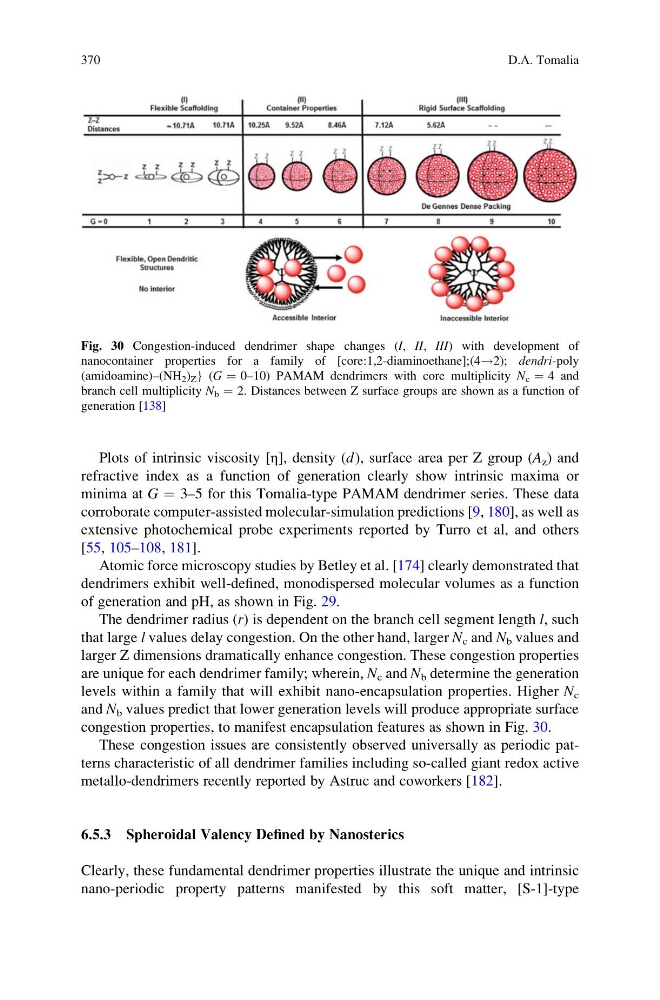
The dendrimer radius (r) is dependent on the branch cell segment length l, such
that large l values delay congestion. On the other hand, larger N c and N b values and
larger Z dimensions dramatically enhance congestion. These congestion properties
are unique for each dendrimer family; wherein, N c and N b determine the generation
levels within a family that will exhibit nano-encapsulation properties. Higher N c
and N b values predict that lower generation levels will produce appropriate surface
congestion properties, to manifest encapsulation features as shown in Fig. 30.
These congestion issues are consistently observed universally as periodic patterns characteristic of all dendrimer families including so-called giant redox active
metallo-dendrimers recently reported by Astruc and coworkers [182].
6.5.3 Spheroidal Valency Defined by Nanosterics
Clearly, these fundamental dendrimer properties illustrate the unique and intrinsic
nano-periodic property patterns manifested by this soft matter, [S-1]-type
Fig. 30 Congestion-induced dendrimer shape changes (I, II, III) with development of
nanocontainer properties for a family of [core:1,2-diaminoethane];(4!2); dendri-poly
(amidoamine)–(NH 2 ) Z } (G ¼ 0–10) PAMAM dendrimers with core multiplicity N c ¼ 4 and
branch cell multiplicity N b ¼ 2. Distances between Z surface groups are shown as a function of
generation [138]
370
D.A. Tomalia
refractive index as a function of generation clearly show intrinsic maxima or
minima at G ¼ 3–5 for this Tomalia-type PAMAM dendrimer series. These data
corroborate computer-assisted molecular-simulation predictions [9, 180], as well as
extensive photochemical probe experiments reported by Turro et al, and others
[55, 105–108, 181].
Atomic force microscopy studies by Betley et al. [174] clearly demonstrated that
dendrimers exhibit well-defined, monodispersed molecular volumes as a function
of generation and pH, as shown in Fig. 29.
The dendrimer radius (r) is dependent on the branch cell segment length l, such
that large l values delay congestion. On the other hand, larger N c and N b values and
larger Z dimensions dramatically enhance congestion. These congestion properties
are unique for each dendrimer family; wherein, N c and N b determine the generation
levels within a family that will exhibit nano-encapsulation properties. Higher N c
and N b values predict that lower generation levels will produce appropriate surface
congestion properties, to manifest encapsulation features as shown in Fig. 30.
These congestion issues are consistently observed universally as periodic patterns characteristic of all dendrimer families including so-called giant redox active
metallo-dendrimers recently reported by Astruc and coworkers [182].
6.5.3 Spheroidal Valency Defined by Nanosterics
Clearly, these fundamental dendrimer properties illustrate the unique and intrinsic
nano-periodic property patterns manifested by this soft matter, [S-1]-type
Fig. 30 Congestion-induced dendrimer shape changes (I, II, III) with development of
nanocontainer properties for a family of [core:1,2-diaminoethane];(4!2); dendri-poly
(amidoamine)–(NH 2 ) Z } (G ¼ 0–10) PAMAM dendrimers with core multiplicity N c ¼ 4 and
branch cell multiplicity N b ¼ 2. Distances between Z surface groups are shown as a function of
generation [138]
370
D.A. Tomalia