

isomeric traditional linear, crosslinked, or branched polymers. This is largely due to
the dendritic architecture that induces congestion properties. These properties
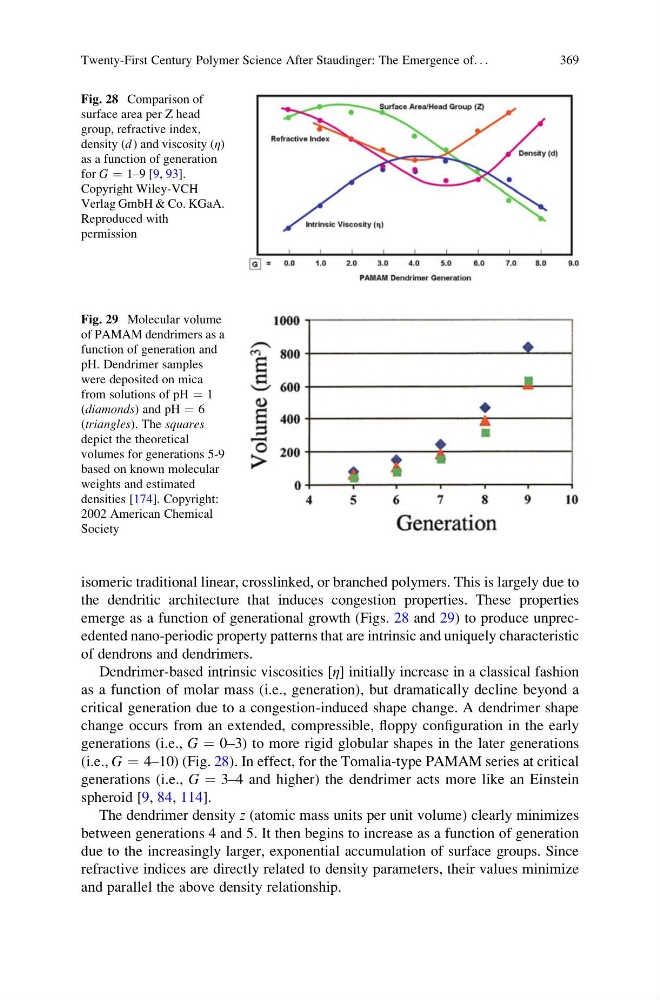
emerge as a function of generational growth (Figs. 28 and 29) to produce unprecedented nano-periodic property patterns that are intrinsic and uniquely characteristic
of dendrons and dendrimers.
Dendrimer-based intrinsic viscosities [η] initially increase in a classical fashion
as a function of molar mass (i.e., generation), but dramatically decline beyond a
critical generation due to a congestion-induced shape change. A dendrimer shape
change occurs from an extended, compressible, floppy configuration in the early
generations (i.e., G ¼ 0–3) to more rigid globular shapes in the later generations
(i.e., G ¼ 4–10) (Fig. 28). In effect, for the Tomalia-type PAMAM series at critical
generations (i.e., G ¼ 3–4 and higher) the dendrimer acts more like an Einstein
spheroid [9, 84, 114].
The dendrimer density z (atomic mass units per unit volume) clearly minimizes
between generations 4 and 5. It then begins to increase as a function of generation
due to the increasingly larger, exponential accumulation of surface groups. Since
refractive indices are directly related to density parameters, their values minimize
and parallel the above density relationship.
Fig. 28 Comparison of
surface area per Z head
group, refractive index,
density (d ) and viscosity (η)
as a function of generation
for G ¼ 1–9 [9, 93].
Copyright Wiley-VCH
Verlag GmbH & Co. KGaA.
Reproduced with
permission
Fig. 29 Molecular volume
of PAMAM dendrimers as a
function of generation and
pH. Dendrimer samples
were deposited on mica
from solutions of pH ¼ 1
(diamonds) and pH ¼ 6
(triangles). The squares
depict the theoretical
volumes for generations 5-9
based on known molecular
weights and estimated
densities [174]. Copyright:
2002 American Chemical
Society
Twenty-First Century Polymer Science After Staudinger: The Emergence of. . .
369
the dendritic architecture that induces congestion properties. These properties
emerge as a function of generational growth (Figs. 28 and 29) to produce unprecedented nano-periodic property patterns that are intrinsic and uniquely characteristic
of dendrons and dendrimers.
Dendrimer-based intrinsic viscosities [η] initially increase in a classical fashion
as a function of molar mass (i.e., generation), but dramatically decline beyond a
critical generation due to a congestion-induced shape change. A dendrimer shape
change occurs from an extended, compressible, floppy configuration in the early
generations (i.e., G ¼ 0–3) to more rigid globular shapes in the later generations
(i.e., G ¼ 4–10) (Fig. 28). In effect, for the Tomalia-type PAMAM series at critical
generations (i.e., G ¼ 3–4 and higher) the dendrimer acts more like an Einstein
spheroid [9, 84, 114].
The dendrimer density z (atomic mass units per unit volume) clearly minimizes
between generations 4 and 5. It then begins to increase as a function of generation
due to the increasingly larger, exponential accumulation of surface groups. Since
refractive indices are directly related to density parameters, their values minimize
and parallel the above density relationship.
Fig. 28 Comparison of
surface area per Z head
group, refractive index,
density (d ) and viscosity (η)
as a function of generation
for G ¼ 1–9 [9, 93].
Copyright Wiley-VCH
Verlag GmbH & Co. KGaA.
Reproduced with
permission
Fig. 29 Molecular volume
of PAMAM dendrimers as a
function of generation and
pH. Dendrimer samples
were deposited on mica
from solutions of pH ¼ 1
(diamonds) and pH ¼ 6
(triangles). The squares
depict the theoretical
volumes for generations 5-9
based on known molecular
weights and estimated
densities [174]. Copyright:
2002 American Chemical
Society
Twenty-First Century Polymer Science After Staudinger: The Emergence of. . .
369