

nano-element category. Many other nano-periodic property patterns have been
documented for the behavior, assembly, and reactions of dendrimers with other
dendrimers, as well as with other well-defined nano-element categories. For example, work on this soft matter, [S-1]-type nano-element category [121, 167, 175] has
demonstrated that mathematically defined, periodic size properties of spheroidal
dendrimers can determine the chemical reactivity patterns with other dendrimers.
These reactivity patterns, based on the relative sizes of a targeted dendrimer cores
and dendrimer shell components, strongly influence the assembly of precise
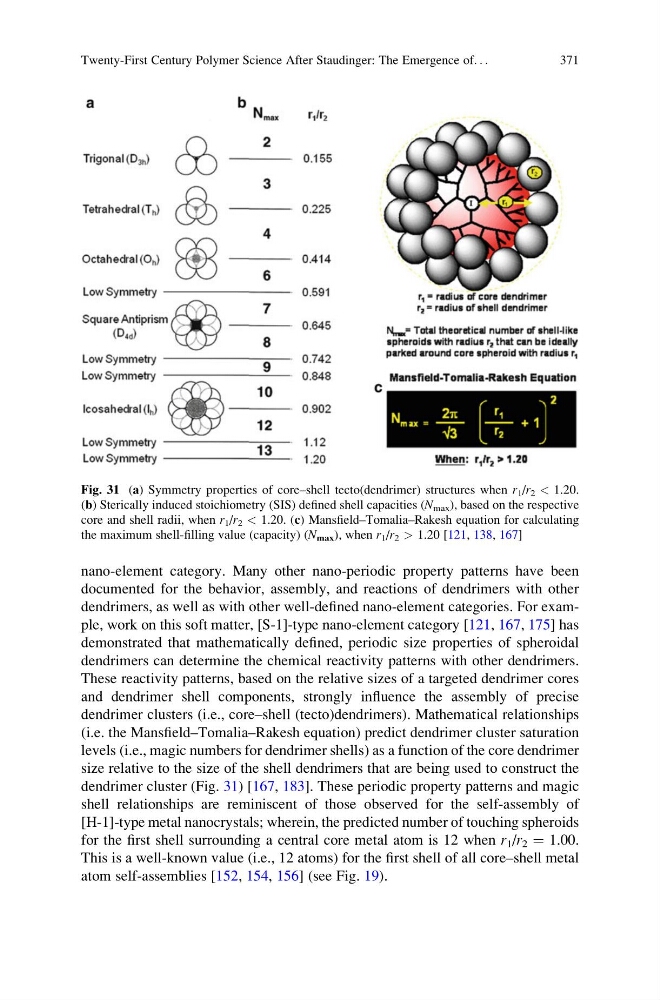
dendrimer clusters (i.e., core–shell (tecto)dendrimers). Mathematical relationships
(i.e. the Mansfield–Tomalia–Rakesh equation) predict dendrimer cluster saturation
levels (i.e., magic numbers for dendrimer shells) as a function of the core dendrimer
size relative to the size of the shell dendrimers that are being used to construct the
dendrimer cluster (Fig. 31) [167, 183]. These periodic property patterns and magic
shell relationships are reminiscent of those observed for the self-assembly of
[H-1]-type metal nanocrystals; wherein, the predicted number of touching spheroids
for the first shell surrounding a central core metal atom is 12 when r 1 /r 2 ¼ 1.00.
This is a well-known value (i.e., 12 atoms) for the first shell of all core–shell metal
atom self-assemblies [152, 154, 156] (see Fig. 19).
Fig. 31 (a) Symmetry properties of core–shell tecto(dendrimer) structures when r 1 /r 2 < 1.20.
(b) Sterically induced stoichiometry (SIS) defined shell capacities (N max ), based on the respective
core and shell radii, when r 1 /r 2 < 1.20. (c) Mansfield–Tomalia–Rakesh equation for calculating
the maximum shell-filling value (capacity) (N max ), when r 1 /r 2 > 1.20 [121, 138, 167]
Twenty-First Century Polymer Science After Staudinger: The Emergence of. . .
371
documented for the behavior, assembly, and reactions of dendrimers with other
dendrimers, as well as with other well-defined nano-element categories. For example, work on this soft matter, [S-1]-type nano-element category [121, 167, 175] has
demonstrated that mathematically defined, periodic size properties of spheroidal
dendrimers can determine the chemical reactivity patterns with other dendrimers.
These reactivity patterns, based on the relative sizes of a targeted dendrimer cores
and dendrimer shell components, strongly influence the assembly of precise
dendrimer clusters (i.e., core–shell (tecto)dendrimers). Mathematical relationships
(i.e. the Mansfield–Tomalia–Rakesh equation) predict dendrimer cluster saturation
levels (i.e., magic numbers for dendrimer shells) as a function of the core dendrimer
size relative to the size of the shell dendrimers that are being used to construct the
dendrimer cluster (Fig. 31) [167, 183]. These periodic property patterns and magic
shell relationships are reminiscent of those observed for the self-assembly of
[H-1]-type metal nanocrystals; wherein, the predicted number of touching spheroids
for the first shell surrounding a central core metal atom is 12 when r 1 /r 2 ¼ 1.00.
This is a well-known value (i.e., 12 atoms) for the first shell of all core–shell metal
atom self-assemblies [152, 154, 156] (see Fig. 19).
Fig. 31 (a) Symmetry properties of core–shell tecto(dendrimer) structures when r 1 /r 2 < 1.20.
(b) Sterically induced stoichiometry (SIS) defined shell capacities (N max ), based on the respective
core and shell radii, when r 1 /r 2 < 1.20. (c) Mansfield–Tomalia–Rakesh equation for calculating
the maximum shell-filling value (capacity) (N max ), when r 1 /r 2 > 1.20 [121, 138, 167]
Twenty-First Century Polymer Science After Staudinger: The Emergence of. . .
371