

concepts, applications, products, and activities, all of which have led to enhanced
new commercial markets, quality of life, and prosperity. Since Staudinger’s original discovery, a total of four major macromolecular architectures have evolved:
(I) linear, (II) crosslinked, (III) branched and now (IV) dendritic topologies, as
illustrated in Fig. 4.
2 Traditional Polymer Chemistry
Over the past 90 years, Staudinger’s macromolecular synthesis strategy has evolved
based on the catenation of reactive small molecular modules (monomers). Broadly
speaking, these catenations involve the use of reactive (AB-type) monomers that
may be engaged to produce large molecules with polydispersed masses. Such
multiple bond formation may be driven by (1) chain growth, (2) ring opening,
(3) step-growth condensation, or (4) enzyme-catalyzed processes. Staudinger first
introduced this paradigm in the 1920s [4, 5, 12–14] by demonstrating that reactive
monomers could be used to produce a statistical distribution of one-dimensional
(linear) molecules with very high molecular weights (i.e., >10
6 Da). As many as
10,000 or more covalent bonds may be formed in a single chain reaction of monomers. Although these macro- or megamolecules may possess nanoscale dimensions, structure control of critical macromolecular design parameters, such as size,
molecular shape, spatial positioning of atoms, or covalent connectivity – other than
those affording linear or crosslinked topologies – is difficult. However, substantial
progress has been made in controlling dispersity by using living polymerization
techniques that afford dramatic control over molecular weight and certain structural
elements, as described by Matyjaszewski, Grubbs, Schrock, and others [15–19].
n[AB] (monomers)
[AB] n
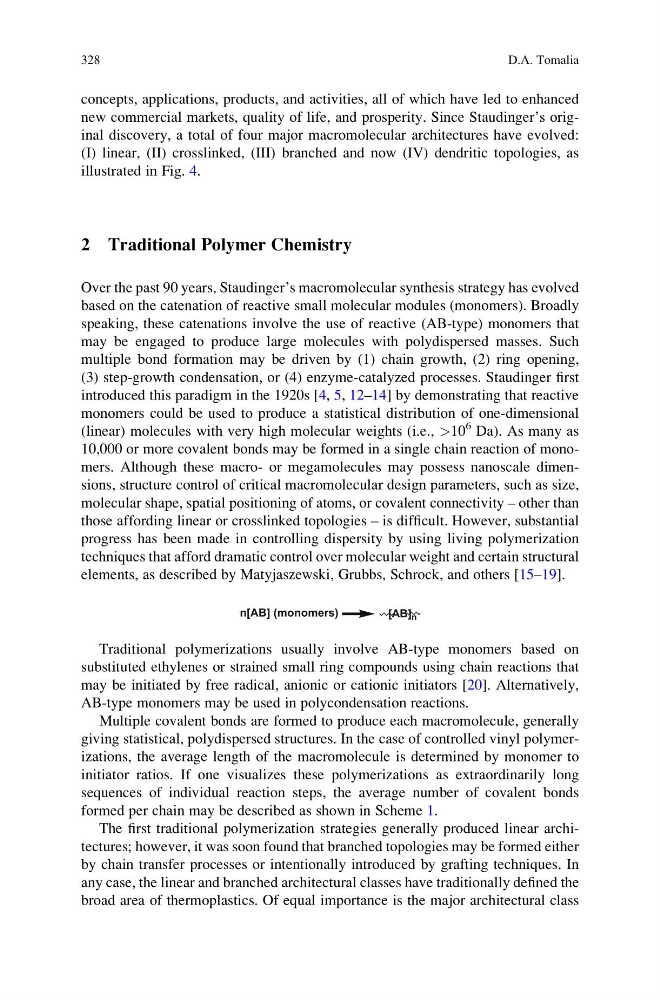
Traditional polymerizations usually involve AB-type monomers based on
substituted ethylenes or strained small ring compounds using chain reactions that
may be initiated by free radical, anionic or cationic initiators [20]. Alternatively,
AB-type monomers may be used in polycondensation reactions.
Multiple covalent bonds are formed to produce each macromolecule, generally
giving statistical, polydispersed structures. In the case of controlled vinyl polymerizations, the average length of the macromolecule is determined by monomer to
initiator ratios. If one visualizes these polymerizations as extraordinarily long
sequences of individual reaction steps, the average number of covalent bonds
formed per chain may be described as shown in Scheme 1.
The first traditional polymerization strategies generally produced linear architectures; however, it was soon found that branched topologies may be formed either
by chain transfer processes or intentionally introduced by grafting techniques. In
any case, the linear and branched architectural classes have traditionally defined the
broad area of thermoplastics. Of equal importance is the major architectural class
328
D.A. Tomalia
new commercial markets, quality of life, and prosperity. Since Staudinger’s original discovery, a total of four major macromolecular architectures have evolved:
(I) linear, (II) crosslinked, (III) branched and now (IV) dendritic topologies, as
illustrated in Fig. 4.
2 Traditional Polymer Chemistry
Over the past 90 years, Staudinger’s macromolecular synthesis strategy has evolved
based on the catenation of reactive small molecular modules (monomers). Broadly
speaking, these catenations involve the use of reactive (AB-type) monomers that
may be engaged to produce large molecules with polydispersed masses. Such
multiple bond formation may be driven by (1) chain growth, (2) ring opening,
(3) step-growth condensation, or (4) enzyme-catalyzed processes. Staudinger first
introduced this paradigm in the 1920s [4, 5, 12–14] by demonstrating that reactive
monomers could be used to produce a statistical distribution of one-dimensional
(linear) molecules with very high molecular weights (i.e., >10
6 Da). As many as
10,000 or more covalent bonds may be formed in a single chain reaction of monomers. Although these macro- or megamolecules may possess nanoscale dimensions, structure control of critical macromolecular design parameters, such as size,
molecular shape, spatial positioning of atoms, or covalent connectivity – other than
those affording linear or crosslinked topologies – is difficult. However, substantial
progress has been made in controlling dispersity by using living polymerization
techniques that afford dramatic control over molecular weight and certain structural
elements, as described by Matyjaszewski, Grubbs, Schrock, and others [15–19].
n[AB] (monomers)
[AB] n
Traditional polymerizations usually involve AB-type monomers based on
substituted ethylenes or strained small ring compounds using chain reactions that
may be initiated by free radical, anionic or cationic initiators [20]. Alternatively,
AB-type monomers may be used in polycondensation reactions.
Multiple covalent bonds are formed to produce each macromolecule, generally
giving statistical, polydispersed structures. In the case of controlled vinyl polymerizations, the average length of the macromolecule is determined by monomer to
initiator ratios. If one visualizes these polymerizations as extraordinarily long
sequences of individual reaction steps, the average number of covalent bonds
formed per chain may be described as shown in Scheme 1.
The first traditional polymerization strategies generally produced linear architectures; however, it was soon found that branched topologies may be formed either
by chain transfer processes or intentionally introduced by grafting techniques. In
any case, the linear and branched architectural classes have traditionally defined the
broad area of thermoplastics. Of equal importance is the major architectural class
328
D.A. Tomalia