

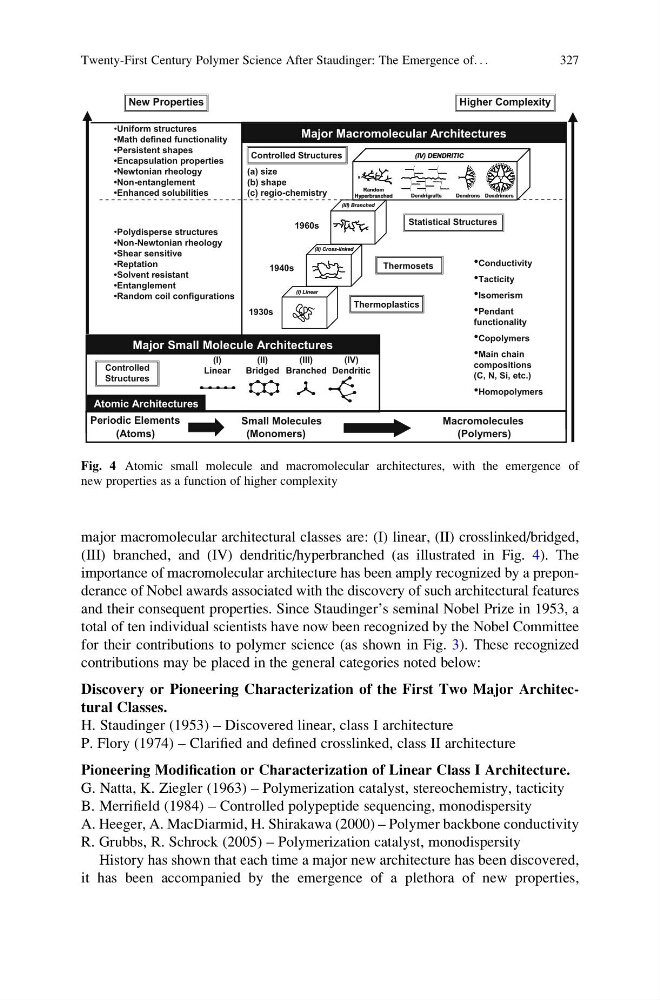
major macromolecular architectural classes are: (I) linear, (II) crosslinked/bridged,
(III) branched, and (IV) dendritic/hyperbranched (as illustrated in Fig. 4). The
importance of macromolecular architecture has been amply recognized by a preponderance of Nobel awards associated with the discovery of such architectural features
and their consequent properties. Since Staudinger’s seminal Nobel Prize in 1953, a
total of ten individual scientists have now been recognized by the Nobel Committee
for their contributions to polymer science (as shown in Fig. 3). These recognized
contributions may be placed in the general categories noted below:
Discovery or Pioneering Characterization of the First Two Major Architectural Classes.
H. Staudinger (1953) – Discovered linear, class I architecture
P. Flory (1974) – Clarified and defined crosslinked, class II architecture
Pioneering Modification or Characterization of Linear Class I Architecture.
G. Natta, K. Ziegler (1963) – Polymerization catalyst, stereochemistry, tacticity
B. Merrifield (1984) – Controlled polypeptide sequencing, monodispersity
A. Heeger, A. MacDiarmid, H. Shirakawa (2000) – Polymer backbone conductivity
R. Grubbs, R. Schrock (2005) – Polymerization catalyst, monodispersity
History has shown that each time a major new architecture has been discovered,
it has been accompanied by the emergence of a plethora of new properties,
Higher Complexity
Major Macromolecular Architectures
(a) size
(b) shape
(c) regio-chemistry
Major Small Molecule Architectures
Small Molecules
New Properties
Controlled
Structures
Atomic Architectures
Periodic Elements
Macromolecules
I
Z
Z Z
Z Z Z ZZZ Z Z Z
Z
Z
Z
ZZ
Z
Z
Z
Z
Z
Z
Z
Z
Z
Z
Z
Z
Z
Z
Z
Z Z
Z
Z
Z
Z
Z
Z
Z
Z
Z
Z
Z
Z
Z Z
Z Z Z Z Z
Z Z
Z
Z
Z
Z
Z
Z
Z
Z
X
Z
X
Random
Random
Hyperbranched
Hyperbranched
Dendrons
Dendrons
Dendrigrafts
Dendrigrafts
Dendrimers
Dendrimers
(IV)
(IV) DENDRITIC
DENDRITIC
(III) Branched
(III) Branched
(I) Linear
(I) Linear
(II) Cross
(II) Cross- -linked linked
I
Z
Z Z
Z Z Z ZZZ Z Z Z
Z
Z
Z
ZZ
Z
Z
Z
Z
Z
Z
Z
Z
Z
Z
Z
Z
Z
Z
Z
Z Z
Z
Z
Z
Z
Z
Z
Z
Z
Z
Z
Z
Z
Z Z
Z Z Z Z Z
Z Z
Z
Z
Z
Z
Z
Z
Z
Z
X
Z
X
Random
Random
Hyperbranched
Hyperbranched
Dendrons
Dendrons
Dendrigrafts
Dendrigrafts
Dendrimers
Dendrimers
(IV)
(IV) DENDRITIC
DENDRITIC
I
Z
Z Z
Z Z Z ZZZ Z Z Z
Z
Z
Z
ZZ
Z
Z
Z
Z
Z
Z
Z
Z
Z
Z
Z
Z
Z
Z
Z
Z Z
Z
Z
Z
Z
Z
Z
Z
Z
Z
Z
Z
Z
Z Z
I
Z
Z Z
Z Z Z ZZZ Z Z Z
Z
Z
Z
ZZ
Z
Z
Z
Z
Z
Z
Z
Z
Z
Z
Z
Z
Z
Z
Z
Z Z
Z
Z
Z
Z
Z
Z
Z
Z
Z
Z
Z
Z
Z Z
Z Z Z Z Z
Z Z
Z
Z
Z
Z
Z
Z
Z
Z
X
Z
Z Z Z Z Z
Z Z
Z
Z
Z
Z
Z
Z
Z
Z
X
Z
X X
Random
Random
Hyperbranched
Hyperbranched
Dendrons
Dendrons
Dendrigrafts
Dendrigrafts
Dendrimers
Dendrimers
(IV)
(IV) DENDRITIC
DENDRITIC
(III) Branched
(III) Branched
(I) Linear
(I) Linear
(II) Cross
(II) Cross- -linked linked
•Uniform structures
•Math defined functionality
•Persistent shapes
•Encapsulation properties
•Newtonian rheology
•Non-entanglement
•Enhanced solubilities
Thermoplastics
Thermosets
1940s
•Conductivity
•Tacticity
•Isomerism
•Pendant
functionality
•Copolymers
•Main chain
compositions
(C, N, Si, etc.)
•Homopolymers
1930s
1960s
(Atoms)
(Monomers)
(Polymers)
(I)
Linear
(II)
Bridged
(III)
Branched
(IV)
Dendritic
•Polydisperse structures
•Non-Newtonian rheology
•Shear sensitive
•Reptation
•Solvent resistant
•Entanglement
•Random coil configurations
Statistical Structures
Controlled Structures
Fig. 4 Atomic small molecule and macromolecular architectures, with the emergence of
new properties as a function of higher complexity
Twenty-First Century Polymer Science After Staudinger: The Emergence of. . .
327
(III) branched, and (IV) dendritic/hyperbranched (as illustrated in Fig. 4). The
importance of macromolecular architecture has been amply recognized by a preponderance of Nobel awards associated with the discovery of such architectural features
and their consequent properties. Since Staudinger’s seminal Nobel Prize in 1953, a
total of ten individual scientists have now been recognized by the Nobel Committee
for their contributions to polymer science (as shown in Fig. 3). These recognized
contributions may be placed in the general categories noted below:
Discovery or Pioneering Characterization of the First Two Major Architectural Classes.
H. Staudinger (1953) – Discovered linear, class I architecture
P. Flory (1974) – Clarified and defined crosslinked, class II architecture
Pioneering Modification or Characterization of Linear Class I Architecture.
G. Natta, K. Ziegler (1963) – Polymerization catalyst, stereochemistry, tacticity
B. Merrifield (1984) – Controlled polypeptide sequencing, monodispersity
A. Heeger, A. MacDiarmid, H. Shirakawa (2000) – Polymer backbone conductivity
R. Grubbs, R. Schrock (2005) – Polymerization catalyst, monodispersity
History has shown that each time a major new architecture has been discovered,
it has been accompanied by the emergence of a plethora of new properties,
Higher Complexity
Major Macromolecular Architectures
(a) size
(b) shape
(c) regio-chemistry
Major Small Molecule Architectures
Small Molecules
New Properties
Controlled
Structures
Atomic Architectures
Periodic Elements
Macromolecules
I
Z
Z Z
Z Z Z ZZZ Z Z Z
Z
Z
Z
ZZ
Z
Z
Z
Z
Z
Z
Z
Z
Z
Z
Z
Z
Z
Z
Z
Z Z
Z
Z
Z
Z
Z
Z
Z
Z
Z
Z
Z
Z
Z Z
Z Z Z Z Z
Z Z
Z
Z
Z
Z
Z
Z
Z
Z
X
Z
X
Random
Random
Hyperbranched
Hyperbranched
Dendrons
Dendrons
Dendrigrafts
Dendrigrafts
Dendrimers
Dendrimers
(IV)
(IV) DENDRITIC
DENDRITIC
(III) Branched
(III) Branched
(I) Linear
(I) Linear
(II) Cross
(II) Cross- -linked linked
I
Z
Z Z
Z Z Z ZZZ Z Z Z
Z
Z
Z
ZZ
Z
Z
Z
Z
Z
Z
Z
Z
Z
Z
Z
Z
Z
Z
Z
Z Z
Z
Z
Z
Z
Z
Z
Z
Z
Z
Z
Z
Z
Z Z
Z Z Z Z Z
Z Z
Z
Z
Z
Z
Z
Z
Z
Z
X
Z
X
Random
Random
Hyperbranched
Hyperbranched
Dendrons
Dendrons
Dendrigrafts
Dendrigrafts
Dendrimers
Dendrimers
(IV)
(IV) DENDRITIC
DENDRITIC
I
Z
Z Z
Z Z Z ZZZ Z Z Z
Z
Z
Z
ZZ
Z
Z
Z
Z
Z
Z
Z
Z
Z
Z
Z
Z
Z
Z
Z
Z Z
Z
Z
Z
Z
Z
Z
Z
Z
Z
Z
Z
Z
Z Z
I
Z
Z Z
Z Z Z ZZZ Z Z Z
Z
Z
Z
ZZ
Z
Z
Z
Z
Z
Z
Z
Z
Z
Z
Z
Z
Z
Z
Z
Z Z
Z
Z
Z
Z
Z
Z
Z
Z
Z
Z
Z
Z
Z Z
Z Z Z Z Z
Z Z
Z
Z
Z
Z
Z
Z
Z
Z
X
Z
Z Z Z Z Z
Z Z
Z
Z
Z
Z
Z
Z
Z
Z
X
Z
X X
Random
Random
Hyperbranched
Hyperbranched
Dendrons
Dendrons
Dendrigrafts
Dendrigrafts
Dendrimers
Dendrimers
(IV)
(IV) DENDRITIC
DENDRITIC
(III) Branched
(III) Branched
(I) Linear
(I) Linear
(II) Cross
(II) Cross- -linked linked
•Uniform structures
•Math defined functionality
•Persistent shapes
•Encapsulation properties
•Newtonian rheology
•Non-entanglement
•Enhanced solubilities
Thermoplastics
Thermosets
1940s
•Conductivity
•Tacticity
•Isomerism
•Pendant
functionality
•Copolymers
•Main chain
compositions
(C, N, Si, etc.)
•Homopolymers
1930s
1960s
(Atoms)
(Monomers)
(Polymers)
(I)
Linear
(II)
Bridged
(III)
Branched
(IV)
Dendritic
•Polydisperse structures
•Non-Newtonian rheology
•Shear sensitive
•Reptation
•Solvent resistant
•Entanglement
•Random coil configurations
Statistical Structures
Controlled Structures
Fig. 4 Atomic small molecule and macromolecular architectures, with the emergence of
new properties as a function of higher complexity
Twenty-First Century Polymer Science After Staudinger: The Emergence of. . .
327