

physico-chemical properties such as melting or boiling point, density, combustion
behavior, etc. Referred to as “molecular isomerism,” these isomeric states have
been widely recognized in traditional inorganic and organic chemistry as geometric/position isomerism, valence isomerism, optical stereoisomerism, tautomerism,
etc. In the polymer world, these analogous structural issues are referred to collectively as “macromolecular or architectural isomerism” [8]. Such macromolecular
structures derived from identical monomeric building blocks in the same stoichiometric proportions but in different architectural or spatial configurations may be
expected to manifest substantially different properties and macroscopic behavior.
Thus, it was not surprising that traditional polymer architectures such as crosslinked
(bridged) and simple branched polymers (after Staudinger’s first linear architectures) clearly manifested uniquely different as well as complementary properties
ideally suited for the emergence of a vast array of diverse commercial applications.
Early commercial polymer development usually involved the manipulation of three
key parameters: (1) architecture (i.e., thermoplastic versus thermoset configurations
and gels); (2) elemental composition (i.e., monomer or copolymer); and (3) molecular weight and molecular weight distribution. Ultimately, all macroscopic properties were determined, including process ability and performance. The advent of a
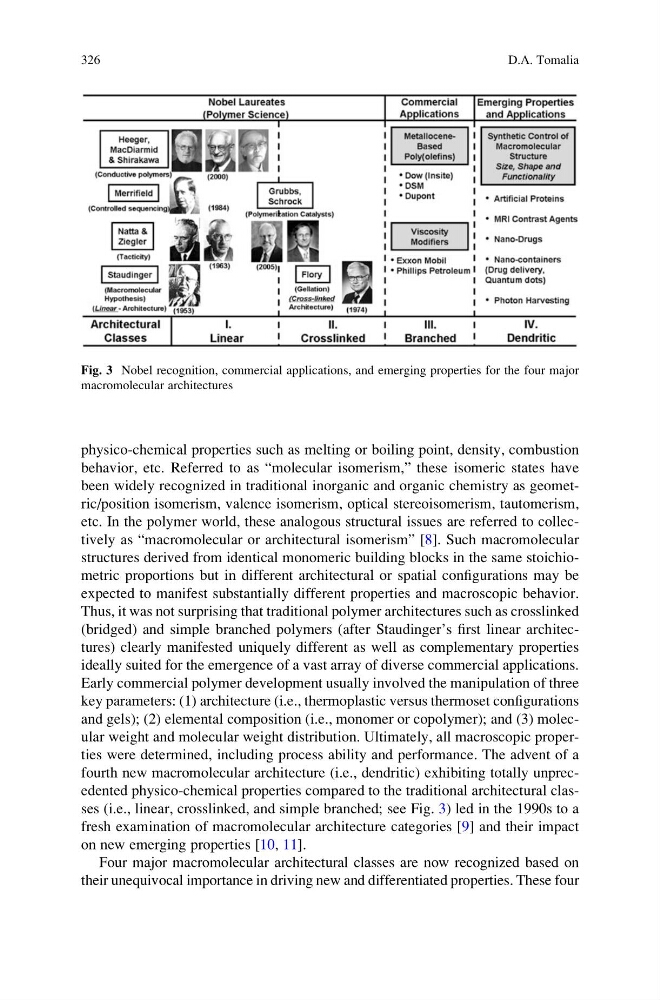
fourth new macromolecular architecture (i.e., dendritic) exhibiting totally unprecedented physico-chemical properties compared to the traditional architectural classes (i.e., linear, crosslinked, and simple branched; see Fig. 3) led in the 1990s to a
fresh examination of macromolecular architecture categories [9] and their impact
on new emerging properties [10, 11].
Four major macromolecular architectural classes are now recognized based on
their unequivocal importance in driving new and differentiated properties. These four
Fig. 3 Nobel recognition, commercial applications, and emerging properties for the four major
macromolecular architectures
326
D.A. Tomalia
behavior, etc. Referred to as “molecular isomerism,” these isomeric states have
been widely recognized in traditional inorganic and organic chemistry as geometric/position isomerism, valence isomerism, optical stereoisomerism, tautomerism,
etc. In the polymer world, these analogous structural issues are referred to collectively as “macromolecular or architectural isomerism” [8]. Such macromolecular
structures derived from identical monomeric building blocks in the same stoichiometric proportions but in different architectural or spatial configurations may be
expected to manifest substantially different properties and macroscopic behavior.
Thus, it was not surprising that traditional polymer architectures such as crosslinked
(bridged) and simple branched polymers (after Staudinger’s first linear architectures) clearly manifested uniquely different as well as complementary properties
ideally suited for the emergence of a vast array of diverse commercial applications.
Early commercial polymer development usually involved the manipulation of three
key parameters: (1) architecture (i.e., thermoplastic versus thermoset configurations
and gels); (2) elemental composition (i.e., monomer or copolymer); and (3) molecular weight and molecular weight distribution. Ultimately, all macroscopic properties were determined, including process ability and performance. The advent of a
fourth new macromolecular architecture (i.e., dendritic) exhibiting totally unprecedented physico-chemical properties compared to the traditional architectural classes (i.e., linear, crosslinked, and simple branched; see Fig. 3) led in the 1990s to a
fresh examination of macromolecular architecture categories [9] and their impact
on new emerging properties [10, 11].
Four major macromolecular architectural classes are now recognized based on
their unequivocal importance in driving new and differentiated properties. These four
Fig. 3 Nobel recognition, commercial applications, and emerging properties for the four major
macromolecular architectures
326
D.A. Tomalia