

Staudinger’s earlier macromolecular hypothesis. This work by Crick and Watson
was later recognized by the Nobel Prize committee in 1962 and initiated an equally
important scientific understanding of linear nucleotide biopolymers and their role in
storing and transferring critical genetic information as the basis for life. In spite of
that, during the first part of the twentieth century, there was an almost fanatical
opposition to the notion of Staudinger that atoms or their compounds could be
transformed into chemically bonded macromolecular structures. However, in an
abstract way, Staudinger’s concept may now be viewed as an elaborate continuation
of J. Dalton’s simple hypothesis (i.e., New System of Chemical Philosophy,
published in 1808). In essence, the theme of chemically connecting (n
0 ) multiples
of atomic modules to produce small molecular structures (e.g., monomers) could
simply be extended to include the chemical linking of monomers to produce
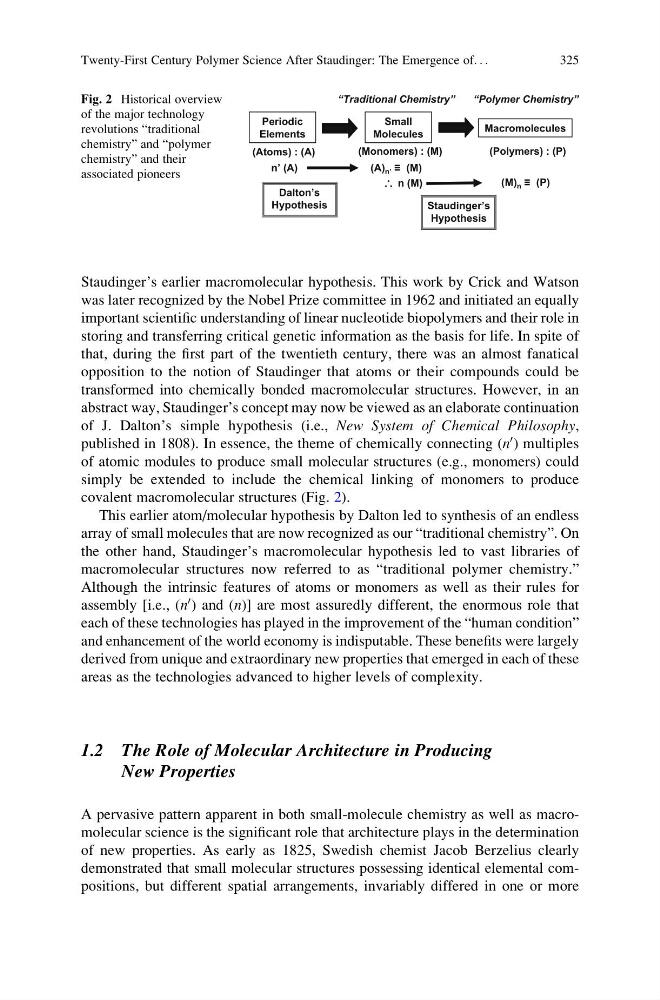
covalent macromolecular structures (Fig. 2).
This earlier atom/molecular hypothesis by Dalton led to synthesis of an endless
array of small molecules that are now recognized as our “traditional chemistry”. On
the other hand, Staudinger’s macromolecular hypothesis led to vast libraries of
macromolecular structures now referred to as “traditional polymer chemistry.”
Although the intrinsic features of atoms or monomers as well as their rules for
assembly [i.e., (n
0 ) and (n)] are most assuredly different, the enormous role that
each of these technologies has played in the improvement of the “human condition”
and enhancement of the world economy is indisputable. These benefits were largely
derived from unique and extraordinary new properties that emerged in each of these
areas as the technologies advanced to higher levels of complexity.
1.2 The Role of Molecular Architecture in Producing
New Properties
A pervasive pattern apparent in both small-molecule chemistry as well as macromolecular science is the significant role that architecture plays in the determination
of new properties. As early as 1825, Swedish chemist Jacob Berzelius clearly
demonstrated that small molecular structures possessing identical elemental compositions, but different spatial arrangements, invariably differed in one or more
Periodic
Elements
Small
Molecules
Macromolecules
Dalton’s
Hypothesis
Staudinger’s
Hypothesis
(Atoms) : (A)
(Monomers) : (M)
(Polymers) : (P)
n’ (A)
n (M)
(M) n ≡ (P)
(A) n’ ≡ (M)
“Traditional Chemistry”
“Polymer Chemistry”
\
Fig. 2 Historical overview
of the major technology
revolutions “traditional
chemistry” and “polymer
chemistry” and their
associated pioneers
Twenty-First Century Polymer Science After Staudinger: The Emergence of. . .
325
was later recognized by the Nobel Prize committee in 1962 and initiated an equally
important scientific understanding of linear nucleotide biopolymers and their role in
storing and transferring critical genetic information as the basis for life. In spite of
that, during the first part of the twentieth century, there was an almost fanatical
opposition to the notion of Staudinger that atoms or their compounds could be
transformed into chemically bonded macromolecular structures. However, in an
abstract way, Staudinger’s concept may now be viewed as an elaborate continuation
of J. Dalton’s simple hypothesis (i.e., New System of Chemical Philosophy,
published in 1808). In essence, the theme of chemically connecting (n
0 ) multiples
of atomic modules to produce small molecular structures (e.g., monomers) could
simply be extended to include the chemical linking of monomers to produce
covalent macromolecular structures (Fig. 2).
This earlier atom/molecular hypothesis by Dalton led to synthesis of an endless
array of small molecules that are now recognized as our “traditional chemistry”. On
the other hand, Staudinger’s macromolecular hypothesis led to vast libraries of
macromolecular structures now referred to as “traditional polymer chemistry.”
Although the intrinsic features of atoms or monomers as well as their rules for
assembly [i.e., (n
0 ) and (n)] are most assuredly different, the enormous role that
each of these technologies has played in the improvement of the “human condition”
and enhancement of the world economy is indisputable. These benefits were largely
derived from unique and extraordinary new properties that emerged in each of these
areas as the technologies advanced to higher levels of complexity.
1.2 The Role of Molecular Architecture in Producing
New Properties
A pervasive pattern apparent in both small-molecule chemistry as well as macromolecular science is the significant role that architecture plays in the determination
of new properties. As early as 1825, Swedish chemist Jacob Berzelius clearly
demonstrated that small molecular structures possessing identical elemental compositions, but different spatial arrangements, invariably differed in one or more
Periodic
Elements
Small
Molecules
Macromolecules
Dalton’s
Hypothesis
Staudinger’s
Hypothesis
(Atoms) : (A)
(Monomers) : (M)
(Polymers) : (P)
n’ (A)
n (M)
(M) n ≡ (P)
(A) n’ ≡ (M)
“Traditional Chemistry”
“Polymer Chemistry”
\
Fig. 2 Historical overview
of the major technology
revolutions “traditional
chemistry” and “polymer
chemistry” and their
associated pioneers
Twenty-First Century Polymer Science After Staudinger: The Emergence of. . .
325