

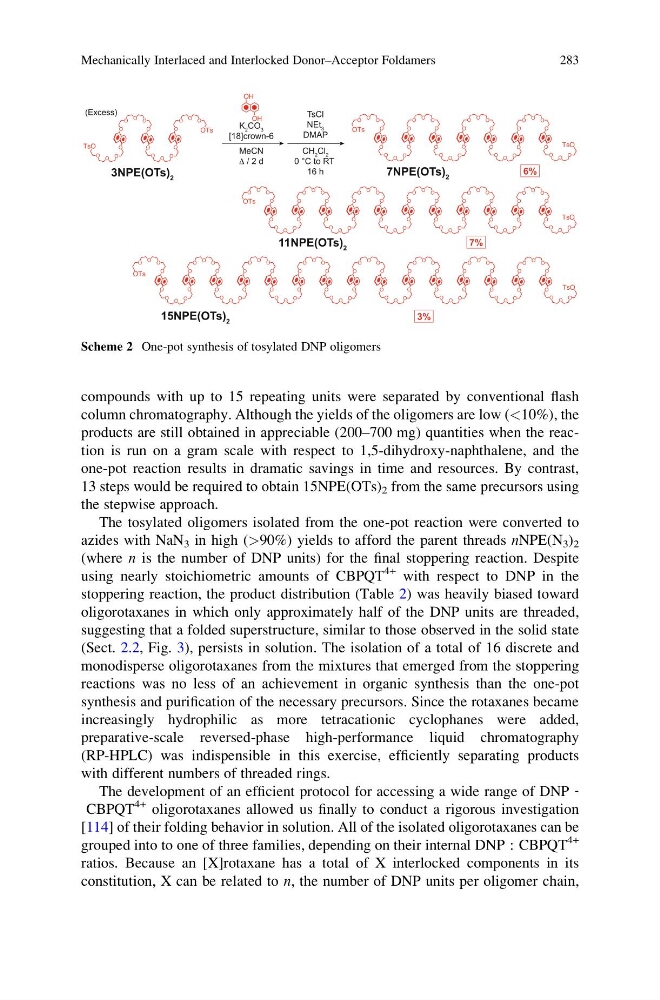
compounds with up to 15 repeating units were separated by conventional flash
column chromatography. Although the yields of the oligomers are low (<10%), the
products are still obtained in appreciable (200–700 mg) quantities when the reaction is run on a gram scale with respect to 1,5-dihydroxy-naphthalene, and the
one-pot reaction results in dramatic savings in time and resources. By contrast,
13 steps would be required to obtain 15NPE(OTs) 2 from the same precursors using
the stepwise approach.
The tosylated oligomers isolated from the one-pot reaction were converted to
azides with NaN 3 in high (>90%) yields to afford the parent threads nNPE(N 3 ) 2
(where n is the number of DNP units) for the final stoppering reaction. Despite
using nearly stoichiometric amounts of CBPQT
4+ with respect to DNP in the
stoppering reaction, the product distribution (Table 2) was heavily biased toward
oligorotaxanes in which only approximately half of the DNP units are threaded,
suggesting that a folded superstructure, similar to those observed in the solid state
(Sect. 2.2, Fig. 3), persists in solution. The isolation of a total of 16 discrete and
monodisperse oligorotaxanes from the mixtures that emerged from the stoppering
reactions was no less of an achievement in organic synthesis than the one-pot
synthesis and purification of the necessary precursors. Since the rotaxanes became
increasingly hydrophilic as more tetracationic cyclophanes were added,
preparative-scale reversed-phase high-performance liquid chromatography
(RP-HPLC) was indispensible in this exercise, efficiently separating products
with different numbers of threaded rings.
The development of an efficient protocol for accessing a wide range of DNP ‐
CBPQT
4+ oligorotaxanes allowed us finally to conduct a rigorous investigation
[114] of their folding behavior in solution. All of the isolated oligorotaxanes can be
grouped into to one of three families, depending on their internal DNP : CBPQT
4+
ratios. Because an [X]rotaxane has a total of X interlocked components in its
constitution, X can be related to n, the number of DNP units per oligomer chain,
Scheme 2 One-pot synthesis of tosylated DNP oligomers
Mechanically Interlaced and Interlocked Donor–Acceptor Foldamers
283
column chromatography. Although the yields of the oligomers are low (<10%), the
products are still obtained in appreciable (200–700 mg) quantities when the reaction is run on a gram scale with respect to 1,5-dihydroxy-naphthalene, and the
one-pot reaction results in dramatic savings in time and resources. By contrast,
13 steps would be required to obtain 15NPE(OTs) 2 from the same precursors using
the stepwise approach.
The tosylated oligomers isolated from the one-pot reaction were converted to
azides with NaN 3 in high (>90%) yields to afford the parent threads nNPE(N 3 ) 2
(where n is the number of DNP units) for the final stoppering reaction. Despite
using nearly stoichiometric amounts of CBPQT
4+ with respect to DNP in the
stoppering reaction, the product distribution (Table 2) was heavily biased toward
oligorotaxanes in which only approximately half of the DNP units are threaded,
suggesting that a folded superstructure, similar to those observed in the solid state
(Sect. 2.2, Fig. 3), persists in solution. The isolation of a total of 16 discrete and
monodisperse oligorotaxanes from the mixtures that emerged from the stoppering
reactions was no less of an achievement in organic synthesis than the one-pot
synthesis and purification of the necessary precursors. Since the rotaxanes became
increasingly hydrophilic as more tetracationic cyclophanes were added,
preparative-scale reversed-phase high-performance liquid chromatography
(RP-HPLC) was indispensible in this exercise, efficiently separating products
with different numbers of threaded rings.
The development of an efficient protocol for accessing a wide range of DNP ‐
CBPQT
4+ oligorotaxanes allowed us finally to conduct a rigorous investigation
[114] of their folding behavior in solution. All of the isolated oligorotaxanes can be
grouped into to one of three families, depending on their internal DNP : CBPQT
4+
ratios. Because an [X]rotaxane has a total of X interlocked components in its
constitution, X can be related to n, the number of DNP units per oligomer chain,
Scheme 2 One-pot synthesis of tosylated DNP oligomers
Mechanically Interlaced and Interlocked Donor–Acceptor Foldamers
283