

dynamics would help identify novel areas of research and applications for this new
class of rotaxane–foldamer hybrid. Whereas X-ray crystallography provides ample
structural information in the solid state, the structural features and dynamics of
molecules in solution can be examined in detail by high-field NMR spectroscopy.
Hodge and Owen [112] used
1 H NMR spectroscopy to estimate the loading capacity
of various hydroquinone-based polymers for threaded CBPQT
4+ rings in 1997, and
expanded on that work in 2000 to suggest [113] that these pseudorotaxanes can
adopt folded conformations in solution. It was not until very recently, however, that
we mustered the synthetic prowess to be able to access [107, 114] a large family of
monodisperse oligomeric threads of increasing chain length and their
corresponding D–A oligorotaxanes, which allowed us to perform more detailed
spectroscopic analysis and uncover trends that emerged in their collective
1 H NMR
spectra, providing new insights about their solution-state structures and dynamics.
The synthesis of discrete oligomers with high molecular weights is significantly
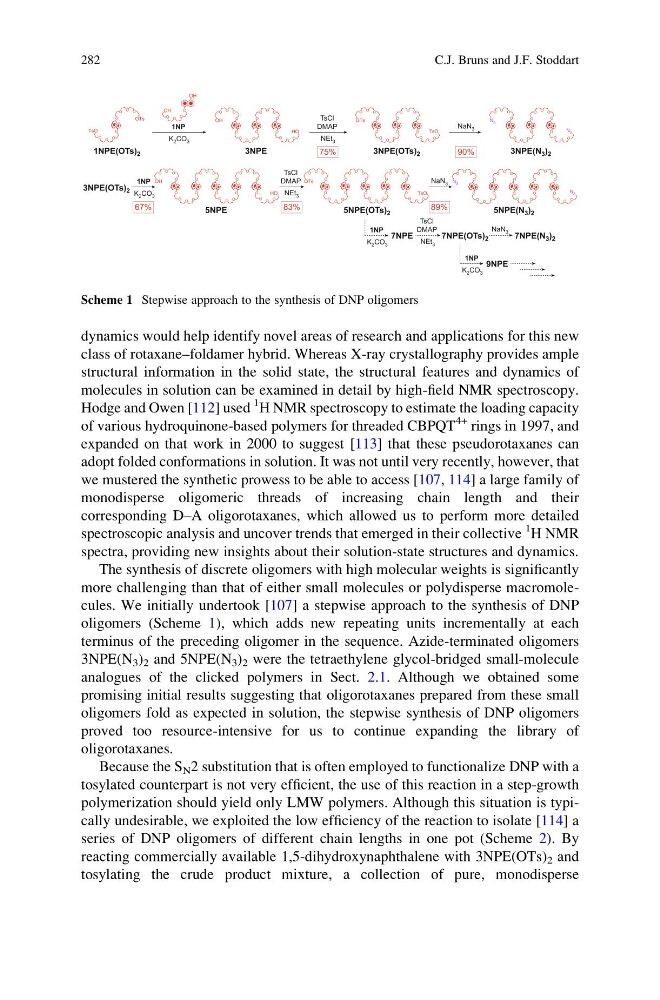
more challenging than that of either small molecules or polydisperse macromolecules. We initially undertook [107] a stepwise approach to the synthesis of DNP
oligomers (Scheme 1), which adds new repeating units incrementally at each
terminus of the preceding oligomer in the sequence. Azide-terminated oligomers
3NPE(N 3 ) 2 and 5NPE(N 3 ) 2 were the tetraethylene glycol-bridged small-molecule
analogues of the clicked polymers in Sect. 2.1. Although we obtained some
promising initial results suggesting that oligorotaxanes prepared from these small
oligomers fold as expected in solution, the stepwise synthesis of DNP oligomers
proved too resource-intensive for us to continue expanding the library of
oligorotaxanes.
Because the S N 2 substitution that is often employed to functionalize DNP with a
tosylated counterpart is not very efficient, the use of this reaction in a step-growth
polymerization should yield only LMW polymers. Although this situation is typically undesirable, we exploited the low efficiency of the reaction to isolate [114] a
series of DNP oligomers of different chain lengths in one pot (Scheme 2). By
reacting commercially available 1,5-dihydroxynaphthalene with 3NPE(OTs) 2 and
tosylating the crude product mixture, a collection of pure, monodisperse
Scheme 1 Stepwise approach to the synthesis of DNP oligomers
282
C.J. Bruns and J.F. Stoddart
class of rotaxane–foldamer hybrid. Whereas X-ray crystallography provides ample
structural information in the solid state, the structural features and dynamics of
molecules in solution can be examined in detail by high-field NMR spectroscopy.
Hodge and Owen [112] used
1 H NMR spectroscopy to estimate the loading capacity
of various hydroquinone-based polymers for threaded CBPQT
4+ rings in 1997, and
expanded on that work in 2000 to suggest [113] that these pseudorotaxanes can
adopt folded conformations in solution. It was not until very recently, however, that
we mustered the synthetic prowess to be able to access [107, 114] a large family of
monodisperse oligomeric threads of increasing chain length and their
corresponding D–A oligorotaxanes, which allowed us to perform more detailed
spectroscopic analysis and uncover trends that emerged in their collective
1 H NMR
spectra, providing new insights about their solution-state structures and dynamics.
The synthesis of discrete oligomers with high molecular weights is significantly
more challenging than that of either small molecules or polydisperse macromolecules. We initially undertook [107] a stepwise approach to the synthesis of DNP
oligomers (Scheme 1), which adds new repeating units incrementally at each
terminus of the preceding oligomer in the sequence. Azide-terminated oligomers
3NPE(N 3 ) 2 and 5NPE(N 3 ) 2 were the tetraethylene glycol-bridged small-molecule
analogues of the clicked polymers in Sect. 2.1. Although we obtained some
promising initial results suggesting that oligorotaxanes prepared from these small
oligomers fold as expected in solution, the stepwise synthesis of DNP oligomers
proved too resource-intensive for us to continue expanding the library of
oligorotaxanes.
Because the S N 2 substitution that is often employed to functionalize DNP with a
tosylated counterpart is not very efficient, the use of this reaction in a step-growth
polymerization should yield only LMW polymers. Although this situation is typically undesirable, we exploited the low efficiency of the reaction to isolate [114] a
series of DNP oligomers of different chain lengths in one pot (Scheme 2). By
reacting commercially available 1,5-dihydroxynaphthalene with 3NPE(OTs) 2 and
tosylating the crude product mixture, a collection of pure, monodisperse
Scheme 1 Stepwise approach to the synthesis of DNP oligomers
282
C.J. Bruns and J.F. Stoddart