

on poly(ethylene oxide)-b-poly(propylene oxide)-b-poly(ethylene oxide) triblock
copolymers (Pluronics), which physically incorporated haloperidol by hydrophobic
interaction with the poly(propylene oxide) backbone [27]. Our group developed
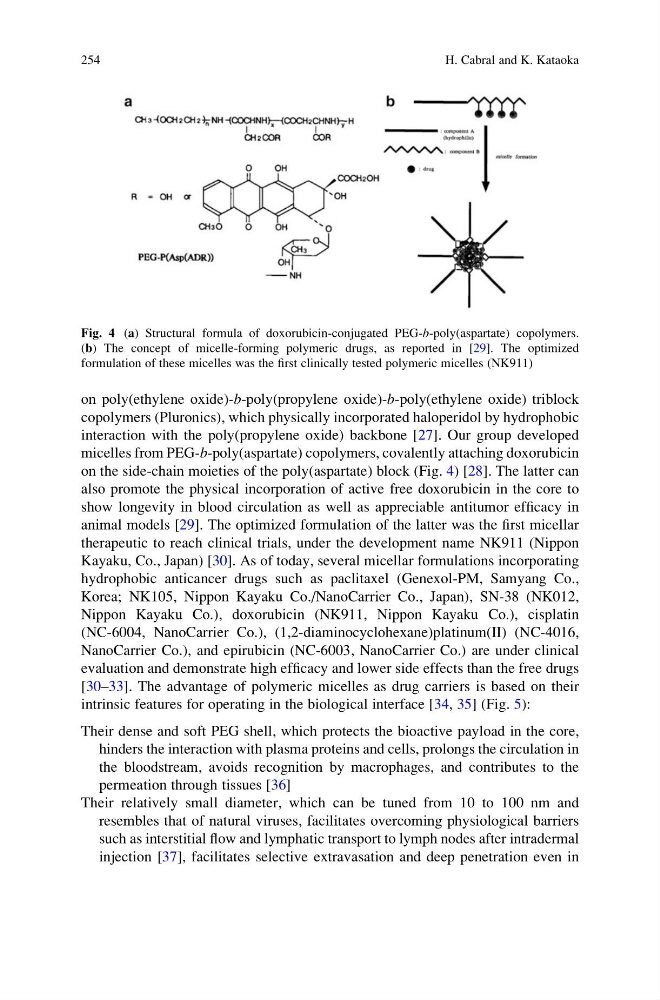
micelles from PEG-b-poly(aspartate) copolymers, covalently attaching doxorubicin
on the side-chain moieties of the poly(aspartate) block (Fig. 4) [28]. The latter can
also promote the physical incorporation of active free doxorubicin in the core to
show longevity in blood circulation as well as appreciable antitumor efficacy in
animal models [29]. The optimized formulation of the latter was the first micellar
therapeutic to reach clinical trials, under the development name NK911 (Nippon
Kayaku, Co., Japan) [30]. As of today, several micellar formulations incorporating
hydrophobic anticancer drugs such as paclitaxel (Genexol-PM, Samyang Co.,
Korea; NK105, Nippon Kayaku Co./NanoCarrier Co., Japan), SN-38 (NK012,
Nippon Kayaku Co.), doxorubicin (NK911, Nippon Kayaku Co.), cisplatin
(NC-6004, NanoCarrier Co.), (1,2-diaminocyclohexane)platinum(II) (NC-4016,
NanoCarrier Co.), and epirubicin (NC-6003, NanoCarrier Co.) are under clinical
evaluation and demonstrate high efficacy and lower side effects than the free drugs
[30–33]. The advantage of polymeric micelles as drug carriers is based on their
intrinsic features for operating in the biological interface [34, 35] (Fig. 5):
Their dense and soft PEG shell, which protects the bioactive payload in the core,
hinders the interaction with plasma proteins and cells, prolongs the circulation in
the bloodstream, avoids recognition by macrophages, and contributes to the
permeation through tissues [36]
Their relatively small diameter, which can be tuned from 10 to 100 nm and
resembles that of natural viruses, facilitates overcoming physiological barriers
such as interstitial flow and lymphatic transport to lymph nodes after intradermal
injection [37], facilitates selective extravasation and deep penetration even in
Fig. 4 (a) Structural formula of doxorubicin-conjugated PEG-b-poly(aspartate) copolymers.
(b) The concept of micelle-forming polymeric drugs, as reported in [29]. The optimized
formulation of these micelles was the first clinically tested polymeric micelles (NK911)
254
H. Cabral and K. Kataoka
copolymers (Pluronics), which physically incorporated haloperidol by hydrophobic
interaction with the poly(propylene oxide) backbone [27]. Our group developed
micelles from PEG-b-poly(aspartate) copolymers, covalently attaching doxorubicin
on the side-chain moieties of the poly(aspartate) block (Fig. 4) [28]. The latter can
also promote the physical incorporation of active free doxorubicin in the core to
show longevity in blood circulation as well as appreciable antitumor efficacy in
animal models [29]. The optimized formulation of the latter was the first micellar
therapeutic to reach clinical trials, under the development name NK911 (Nippon
Kayaku, Co., Japan) [30]. As of today, several micellar formulations incorporating
hydrophobic anticancer drugs such as paclitaxel (Genexol-PM, Samyang Co.,
Korea; NK105, Nippon Kayaku Co./NanoCarrier Co., Japan), SN-38 (NK012,
Nippon Kayaku Co.), doxorubicin (NK911, Nippon Kayaku Co.), cisplatin
(NC-6004, NanoCarrier Co.), (1,2-diaminocyclohexane)platinum(II) (NC-4016,
NanoCarrier Co.), and epirubicin (NC-6003, NanoCarrier Co.) are under clinical
evaluation and demonstrate high efficacy and lower side effects than the free drugs
[30–33]. The advantage of polymeric micelles as drug carriers is based on their
intrinsic features for operating in the biological interface [34, 35] (Fig. 5):
Their dense and soft PEG shell, which protects the bioactive payload in the core,
hinders the interaction with plasma proteins and cells, prolongs the circulation in
the bloodstream, avoids recognition by macrophages, and contributes to the
permeation through tissues [36]
Their relatively small diameter, which can be tuned from 10 to 100 nm and
resembles that of natural viruses, facilitates overcoming physiological barriers
such as interstitial flow and lymphatic transport to lymph nodes after intradermal
injection [37], facilitates selective extravasation and deep penetration even in
Fig. 4 (a) Structural formula of doxorubicin-conjugated PEG-b-poly(aspartate) copolymers.
(b) The concept of micelle-forming polymeric drugs, as reported in [29]. The optimized
formulation of these micelles was the first clinically tested polymeric micelles (NK911)
254
H. Cabral and K. Kataoka