

helix axis is usually perpendicular to the plane of the DX’s helix axes). The TX
motif contains three double helical domains. The DX and the TX motifs contain
crossover points formed by reciprocal exchange between strands of opposite polarity. Two other motifs are shown, the PX motif and a topological variant of it, the
JX 2 motif; these motifs are formed by reciprocal exchange between strands of the
same polarity. Note that the PX motif and the JX 2 have identical tops, but that their
bottoms are rotated by a half turn. As a practical matter, crossovers are placed in
motifs by sequence selection [2], i.e., choosing sequences that continue
Watson–Crick complementarity only if the backbone switches its pairing partners,
inducing crossovers.
The rigidity of the DX motif [9] enabled it to be used as the basis for the first 2D
array designed from DNA. Objects that do not entail repeating motifs can be rigid
or flexible, depending on the ultimate uses to which they will be put. However, if
one is building a repeating (periodic) array, it is necessary to incorporate sufficient
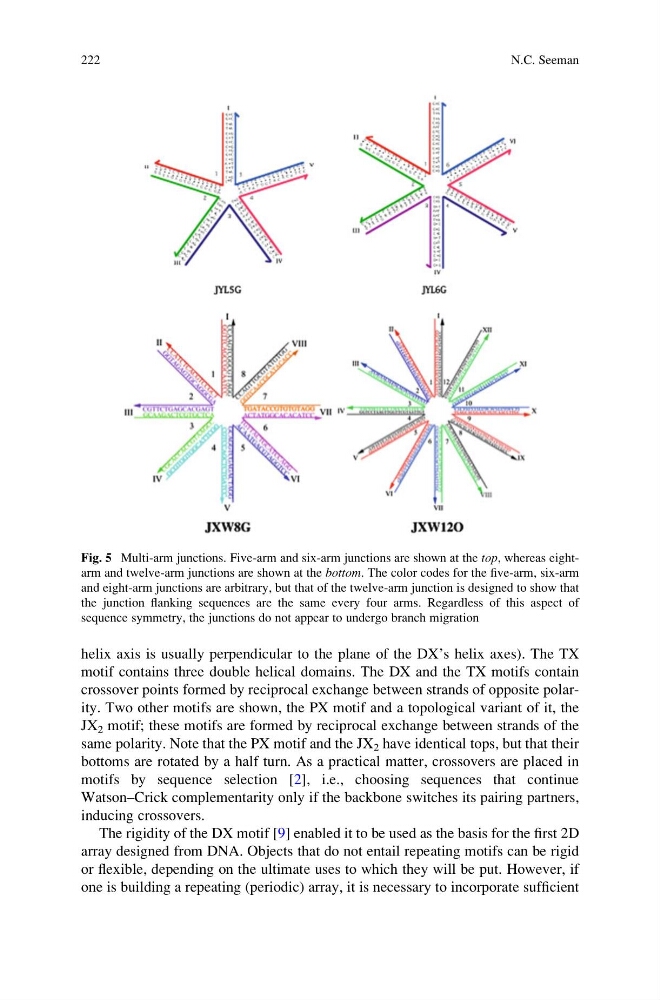
Fig. 5 Multi-arm junctions. Five-arm and six-arm junctions are shown at the top, whereas eightarm and twelve-arm junctions are shown at the bottom. The color codes for the five-arm, six-arm
and eight-arm junctions are arbitrary, but that of the twelve-arm junction is designed to show that
the junction flanking sequences are the same every four arms. Regardless of this aspect of
sequence symmetry, the junctions do not appear to undergo branch migration
222
N.C. Seeman
motif contains three double helical domains. The DX and the TX motifs contain
crossover points formed by reciprocal exchange between strands of opposite polarity. Two other motifs are shown, the PX motif and a topological variant of it, the
JX 2 motif; these motifs are formed by reciprocal exchange between strands of the
same polarity. Note that the PX motif and the JX 2 have identical tops, but that their
bottoms are rotated by a half turn. As a practical matter, crossovers are placed in
motifs by sequence selection [2], i.e., choosing sequences that continue
Watson–Crick complementarity only if the backbone switches its pairing partners,
inducing crossovers.
The rigidity of the DX motif [9] enabled it to be used as the basis for the first 2D
array designed from DNA. Objects that do not entail repeating motifs can be rigid
or flexible, depending on the ultimate uses to which they will be put. However, if
one is building a repeating (periodic) array, it is necessary to incorporate sufficient
Fig. 5 Multi-arm junctions. Five-arm and six-arm junctions are shown at the top, whereas eightarm and twelve-arm junctions are shown at the bottom. The color codes for the five-arm, six-arm
and eight-arm junctions are arbitrary, but that of the twelve-arm junction is designed to show that
the junction flanking sequences are the same every four arms. Regardless of this aspect of
sequence symmetry, the junctions do not appear to undergo branch migration
222
N.C. Seeman