

it is unbranched. Thinking about DNA as a road makes it easy to imagine an
intersection in the road, as illustrated in Fig. 1b. In this case, all of the traffic is
shown to turn right when it reaches the intersection. What we are showing is DNA
branched at the level of secondary structure. Synthetic strands of DNA can be
designed to produce branches like this simply by selecting their sequences to form
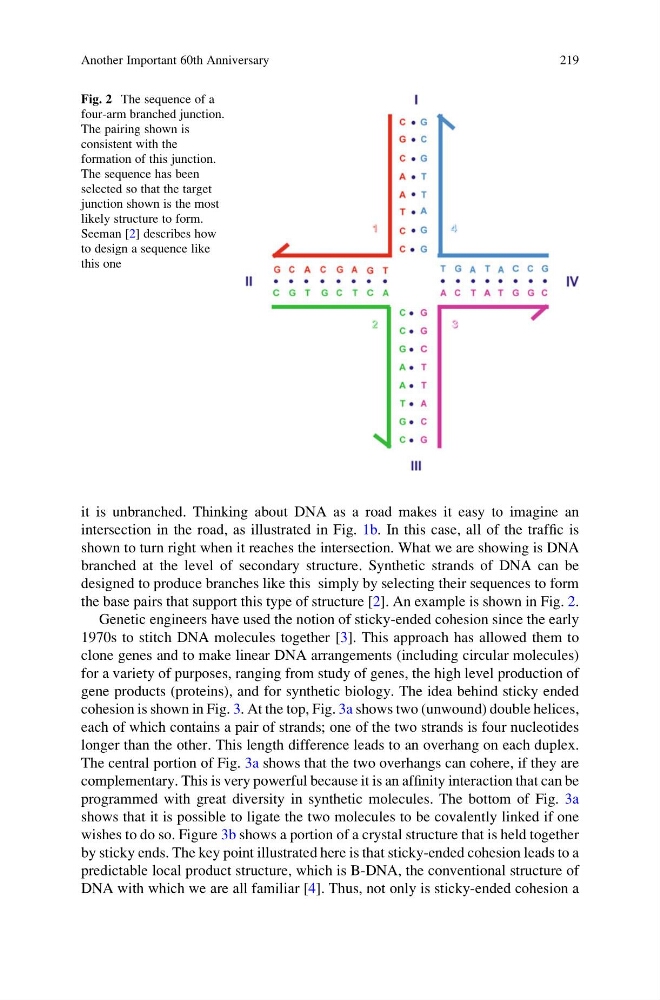
the base pairs that support this type of structure [2]. An example is shown in Fig. 2.
Genetic engineers have used the notion of sticky-ended cohesion since the early
1970s to stitch DNA molecules together [3]. This approach has allowed them to
clone genes and to make linear DNA arrangements (including circular molecules)
for a variety of purposes, ranging from study of genes, the high level production of
gene products (proteins), and for synthetic biology. The idea behind sticky ended
cohesion is shown in Fig. 3. At the top, Fig. 3a shows two (unwound) double helices,
each of which contains a pair of strands; one of the two strands is four nucleotides
longer than the other. This length difference leads to an overhang on each duplex.
The central portion of Fig. 3a shows that the two overhangs can cohere, if they are
complementary. This is very powerful because it is an affinity interaction that can be
programmed with great diversity in synthetic molecules. The bottom of Fig. 3a
shows that it is possible to ligate the two molecules to be covalently linked if one
wishes to do so. Figure 3b shows a portion of a crystal structure that is held together
by sticky ends. The key point illustrated here is that sticky-ended cohesion leads to a
predictable local product structure, which is B-DNA, the conventional structure of
DNA with which we are all familiar [4]. Thus, not only is sticky-ended cohesion a
Fig. 2 The sequence of a
four-arm branched junction.
The pairing shown is
consistent with the
formation of this junction.
The sequence has been
selected so that the target
junction shown is the most
likely structure to form.
Seeman [2] describes how
to design a sequence like
this one
Another Important 60th Anniversary
219
intersection in the road, as illustrated in Fig. 1b. In this case, all of the traffic is
shown to turn right when it reaches the intersection. What we are showing is DNA
branched at the level of secondary structure. Synthetic strands of DNA can be
designed to produce branches like this simply by selecting their sequences to form
the base pairs that support this type of structure [2]. An example is shown in Fig. 2.
Genetic engineers have used the notion of sticky-ended cohesion since the early
1970s to stitch DNA molecules together [3]. This approach has allowed them to
clone genes and to make linear DNA arrangements (including circular molecules)
for a variety of purposes, ranging from study of genes, the high level production of
gene products (proteins), and for synthetic biology. The idea behind sticky ended
cohesion is shown in Fig. 3. At the top, Fig. 3a shows two (unwound) double helices,
each of which contains a pair of strands; one of the two strands is four nucleotides
longer than the other. This length difference leads to an overhang on each duplex.
The central portion of Fig. 3a shows that the two overhangs can cohere, if they are
complementary. This is very powerful because it is an affinity interaction that can be
programmed with great diversity in synthetic molecules. The bottom of Fig. 3a
shows that it is possible to ligate the two molecules to be covalently linked if one
wishes to do so. Figure 3b shows a portion of a crystal structure that is held together
by sticky ends. The key point illustrated here is that sticky-ended cohesion leads to a
predictable local product structure, which is B-DNA, the conventional structure of
DNA with which we are all familiar [4]. Thus, not only is sticky-ended cohesion a
Fig. 2 The sequence of a
four-arm branched junction.
The pairing shown is
consistent with the
formation of this junction.
The sequence has been
selected so that the target
junction shown is the most
likely structure to form.
Seeman [2] describes how
to design a sequence like
this one
Another Important 60th Anniversary
219