

the side chains (called bases) in each residue (called a nucleotide). Its double helical
structure facilitates high fidelity recognition between the nucleotides of complementary molecules. The Watson–Crick pairing of the four DNA bases in pairs,
adenine (A) with thymine (T) and of guanine (G) with cytosine (C), is clearly the
favored type of interaction between polynucleotides. This form of molecular
recognition lies at the heart of our understanding of molecular biology, particularly
molecular genetics. Nevertheless, biology is no longer the only branch of science
where DNA is finding a significant role: It is now possible to exploit DNA
complementarity to control the structure of matter.
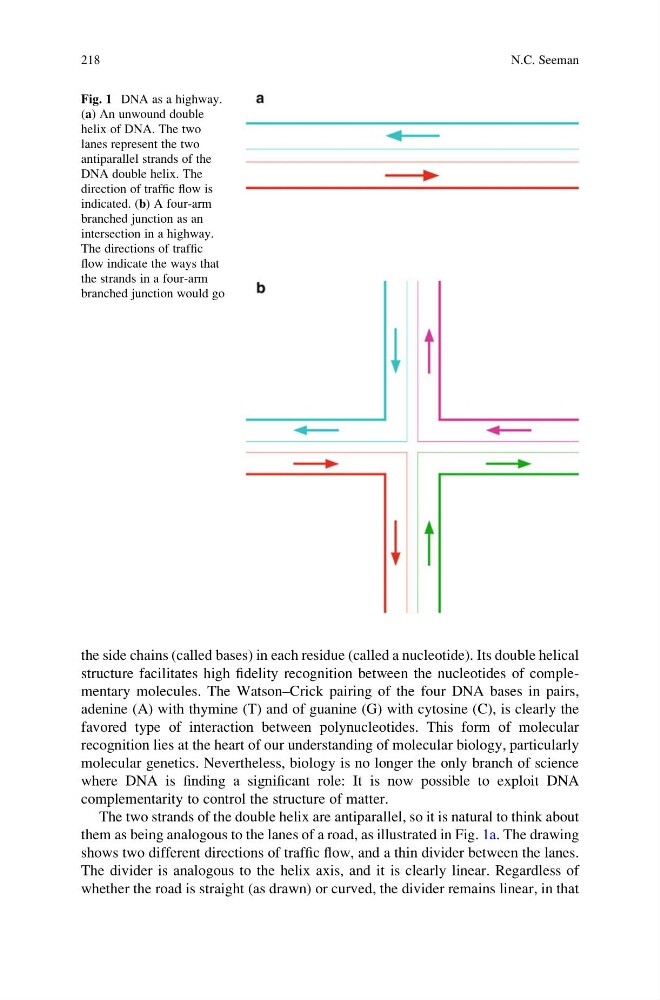
The two strands of the double helix are antiparallel, so it is natural to think about
them as being analogous to the lanes of a road, as illustrated in Fig. 1a. The drawing
shows two different directions of traffic flow, and a thin divider between the lanes.
The divider is analogous to the helix axis, and it is clearly linear. Regardless of
whether the road is straight (as drawn) or curved, the divider remains linear, in that
Fig. 1 DNA as a highway.
(a) An unwound double
helix of DNA. The two
lanes represent the two
antiparallel strands of the
DNA double helix. The
direction of traffic flow is
indicated. (b) A four-arm
branched junction as an
intersection in a highway.
The directions of traffic
flow indicate the ways that
the strands in a four-arm
branched junction would go
218
N.C. Seeman
structure facilitates high fidelity recognition between the nucleotides of complementary molecules. The Watson–Crick pairing of the four DNA bases in pairs,
adenine (A) with thymine (T) and of guanine (G) with cytosine (C), is clearly the
favored type of interaction between polynucleotides. This form of molecular
recognition lies at the heart of our understanding of molecular biology, particularly
molecular genetics. Nevertheless, biology is no longer the only branch of science
where DNA is finding a significant role: It is now possible to exploit DNA
complementarity to control the structure of matter.
The two strands of the double helix are antiparallel, so it is natural to think about
them as being analogous to the lanes of a road, as illustrated in Fig. 1a. The drawing
shows two different directions of traffic flow, and a thin divider between the lanes.
The divider is analogous to the helix axis, and it is clearly linear. Regardless of
whether the road is straight (as drawn) or curved, the divider remains linear, in that
Fig. 1 DNA as a highway.
(a) An unwound double
helix of DNA. The two
lanes represent the two
antiparallel strands of the
DNA double helix. The
direction of traffic flow is
indicated. (b) A four-arm
branched junction as an
intersection in a highway.
The directions of traffic
flow indicate the ways that
the strands in a four-arm
branched junction would go
218
N.C. Seeman