

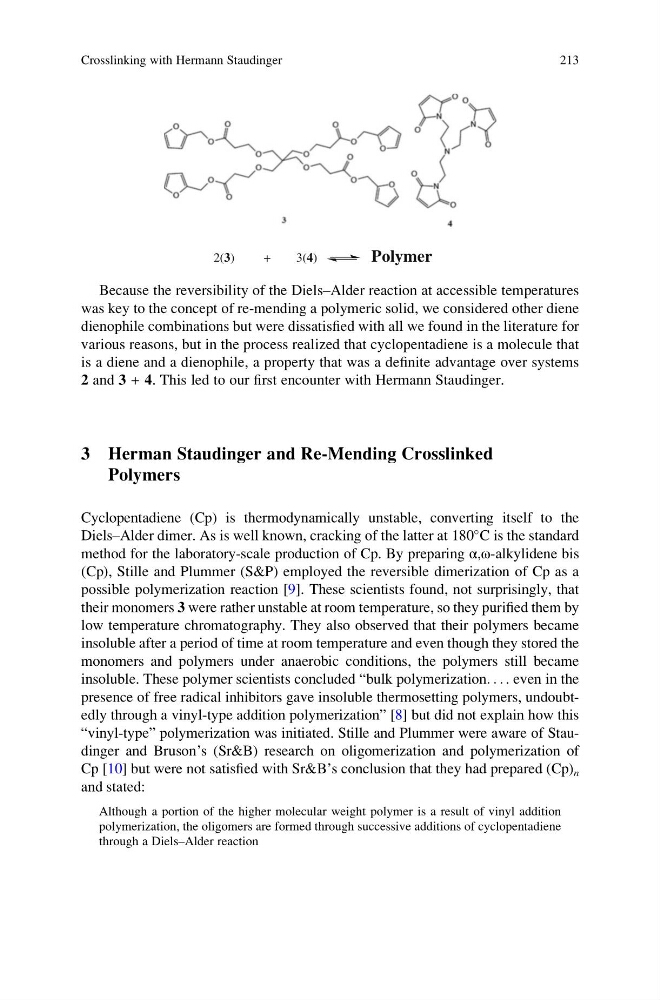
2(3)
+
3(4)
Polymer
Because the reversibility of the Diels–Alder reaction at accessible temperatures
was key to the concept of re-mending a polymeric solid, we considered other diene
dienophile combinations but were dissatisfied with all we found in the literature for
various reasons, but in the process realized that cyclopentadiene is a molecule that
is a diene and a dienophile, a property that was a definite advantage over systems
2 and 3 + 4. This led to our first encounter with Hermann Staudinger.
3 Herman Staudinger and Re-Mending Crosslinked
Polymers
Cyclopentadiene (Cp) is thermodynamically unstable, converting itself to the
Diels–Alder dimer. As is well known, cracking of the latter at 180
C is the standard
method for the laboratory-scale production of Cp. By preparing α,ω-alkylidene bis
(Cp), Stille and Plummer (S&P) employed the reversible dimerization of Cp as a
possible polymerization reaction [9]. These scientists found, not surprisingly, that
their monomers 3 were rather unstable at room temperature, so they purified them by
low temperature chromatography. They also observed that their polymers became
insoluble after a period of time at room temperature and even though they stored the
monomers and polymers under anaerobic conditions, the polymers still became
insoluble. These polymer scientists concluded “bulk polymerization. . . . even in the
presence of free radical inhibitors gave insoluble thermosetting polymers, undoubtedly through a vinyl-type addition polymerization” [8] but did not explain how this
“vinyl-type” polymerization was initiated. Stille and Plummer were aware of Staudinger and Bruson’s (Sr&B) research on oligomerization and polymerization of
Cp [10] but were not satisfied with Sr&B’s conclusion that they had prepared (Cp) n
and stated:
Although a portion of the higher molecular weight polymer is a result of vinyl addition
polymerization, the oligomers are formed through successive additions of cyclopentadiene
through a Diels–Alder reaction
Crosslinking with Hermann Staudinger
213
+
3(4)
Polymer
Because the reversibility of the Diels–Alder reaction at accessible temperatures
was key to the concept of re-mending a polymeric solid, we considered other diene
dienophile combinations but were dissatisfied with all we found in the literature for
various reasons, but in the process realized that cyclopentadiene is a molecule that
is a diene and a dienophile, a property that was a definite advantage over systems
2 and 3 + 4. This led to our first encounter with Hermann Staudinger.
3 Herman Staudinger and Re-Mending Crosslinked
Polymers
Cyclopentadiene (Cp) is thermodynamically unstable, converting itself to the
Diels–Alder dimer. As is well known, cracking of the latter at 180
C is the standard
method for the laboratory-scale production of Cp. By preparing α,ω-alkylidene bis
(Cp), Stille and Plummer (S&P) employed the reversible dimerization of Cp as a
possible polymerization reaction [9]. These scientists found, not surprisingly, that
their monomers 3 were rather unstable at room temperature, so they purified them by
low temperature chromatography. They also observed that their polymers became
insoluble after a period of time at room temperature and even though they stored the
monomers and polymers under anaerobic conditions, the polymers still became
insoluble. These polymer scientists concluded “bulk polymerization. . . . even in the
presence of free radical inhibitors gave insoluble thermosetting polymers, undoubtedly through a vinyl-type addition polymerization” [8] but did not explain how this
“vinyl-type” polymerization was initiated. Stille and Plummer were aware of Staudinger and Bruson’s (Sr&B) research on oligomerization and polymerization of
Cp [10] but were not satisfied with Sr&B’s conclusion that they had prepared (Cp) n
and stated:
Although a portion of the higher molecular weight polymer is a result of vinyl addition
polymerization, the oligomers are formed through successive additions of cyclopentadiene
through a Diels–Alder reaction
Crosslinking with Hermann Staudinger
213