

The statement that the higher molecular weight polymers of Sr&B were due to
vinyl addition polymerization was made without providing a reference nor their
own experimental results to support this assertion. Interestingly, Staudinger had a
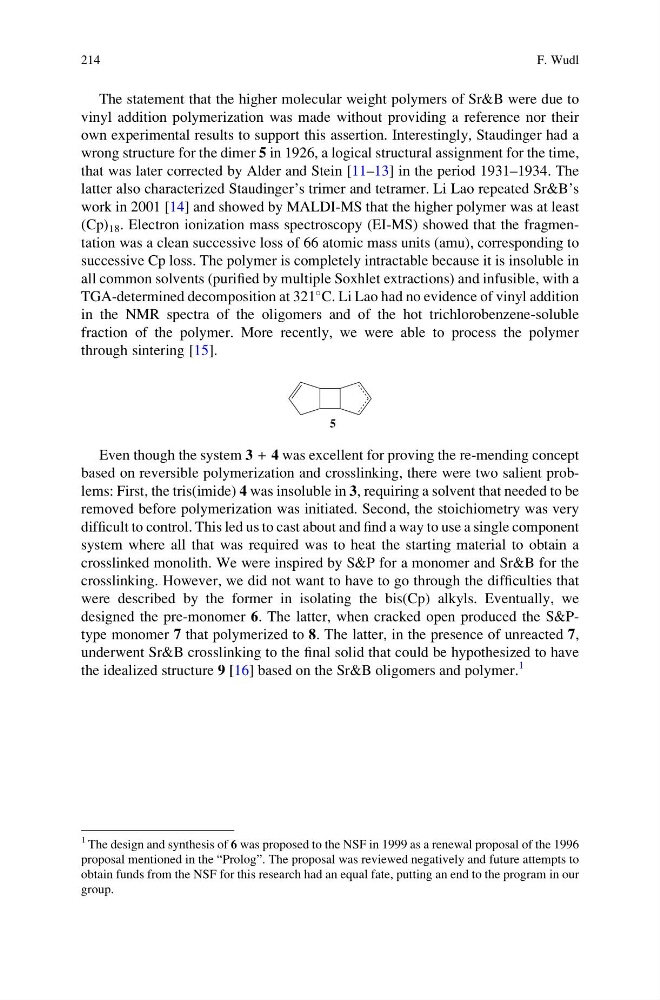
wrong structure for the dimer 5 in 1926, a logical structural assignment for the time,
that was later corrected by Alder and Stein [11–13] in the period 1931–1934. The
latter also characterized Staudinger’s trimer and tetramer. Li Lao repeated Sr&B’s
work in 2001 [14] and showed by MALDI-MS that the higher polymer was at least
(Cp) 18 . Electron ionization mass spectroscopy (EI-MS) showed that the fragmentation was a clean successive loss of 66 atomic mass units (amu), corresponding to
successive Cp loss. The polymer is completely intractable because it is insoluble in
all common solvents (purified by multiple Soxhlet extractions) and infusible, with a
TGA-determined decomposition at 321
C. Li Lao had no evidence of vinyl addition
in the NMR spectra of the oligomers and of the hot trichlorobenzene-soluble
fraction of the polymer. More recently, we were able to process the polymer
through sintering [15].
5
Even though the system 3 + 4 was excellent for proving the re-mending concept
based on reversible polymerization and crosslinking, there were two salient problems: First, the tris(imide) 4 was insoluble in 3, requiring a solvent that needed to be
removed before polymerization was initiated. Second, the stoichiometry was very
difficult to control. This led us to cast about and find a way to use a single component
system where all that was required was to heat the starting material to obtain a
crosslinked monolith. We were inspired by S&P for a monomer and Sr&B for the
crosslinking. However, we did not want to have to go through the difficulties that
were described by the former in isolating the bis(Cp) alkyls. Eventually, we
designed the pre-monomer 6. The latter, when cracked open produced the S&Ptype monomer 7 that polymerized to 8. The latter, in the presence of unreacted 7,
underwent Sr&B crosslinking to the final solid that could be hypothesized to have
the idealized structure 9 [16] based on the Sr&B oligomers and polymer.
1
1 The design and synthesis of 6 was proposed to the NSF in 1999 as a renewal proposal of the 1996
proposal mentioned in the “Prolog”. The proposal was reviewed negatively and future attempts to
obtain funds from the NSF for this research had an equal fate, putting an end to the program in our
group.
214
F. Wudl
vinyl addition polymerization was made without providing a reference nor their
own experimental results to support this assertion. Interestingly, Staudinger had a
wrong structure for the dimer 5 in 1926, a logical structural assignment for the time,
that was later corrected by Alder and Stein [11–13] in the period 1931–1934. The
latter also characterized Staudinger’s trimer and tetramer. Li Lao repeated Sr&B’s
work in 2001 [14] and showed by MALDI-MS that the higher polymer was at least
(Cp) 18 . Electron ionization mass spectroscopy (EI-MS) showed that the fragmentation was a clean successive loss of 66 atomic mass units (amu), corresponding to
successive Cp loss. The polymer is completely intractable because it is insoluble in
all common solvents (purified by multiple Soxhlet extractions) and infusible, with a
TGA-determined decomposition at 321
C. Li Lao had no evidence of vinyl addition
in the NMR spectra of the oligomers and of the hot trichlorobenzene-soluble
fraction of the polymer. More recently, we were able to process the polymer
through sintering [15].
5
Even though the system 3 + 4 was excellent for proving the re-mending concept
based on reversible polymerization and crosslinking, there were two salient problems: First, the tris(imide) 4 was insoluble in 3, requiring a solvent that needed to be
removed before polymerization was initiated. Second, the stoichiometry was very
difficult to control. This led us to cast about and find a way to use a single component
system where all that was required was to heat the starting material to obtain a
crosslinked monolith. We were inspired by S&P for a monomer and Sr&B for the
crosslinking. However, we did not want to have to go through the difficulties that
were described by the former in isolating the bis(Cp) alkyls. Eventually, we
designed the pre-monomer 6. The latter, when cracked open produced the S&Ptype monomer 7 that polymerized to 8. The latter, in the presence of unreacted 7,
underwent Sr&B crosslinking to the final solid that could be hypothesized to have
the idealized structure 9 [16] based on the Sr&B oligomers and polymer.
1
1 The design and synthesis of 6 was proposed to the NSF in 1999 as a renewal proposal of the 1996
proposal mentioned in the “Prolog”. The proposal was reviewed negatively and future attempts to
obtain funds from the NSF for this research had an equal fate, putting an end to the program in our
group.
214
F. Wudl