

2 Prolog
On October 1996, the research proposal “‘Duranes’: ultrahard high-strength organic
polymeric materials” was submitted to the National Science Foundation (NSF). The
summary page stated “We propose to develop a new approach to extended network,
very high strength organic polymeric materials. Some of these materials will have
ultrahard high-strength . . . .” and “. . . preparation of new extended network polymers based on reversible Diels Alder polymerizations. . .” The basic idea was that
by multiple equilibrating reversible steps, the crosslinked polymeric solid would
reach its lowest thermodynamic energy state with, possibly, concomitant maximum
strength. Whitesisdes [1], among others, approached the preparation of very strong
and very hard organic solids by exploring high degrees of sp
2 hybridized carbon
crosslinking. We reasoned that, because the high density of crosslinks in the
polymerization process leads to early gelation, the resulting material would be
inherently low molecular weight and highly disordered. We further rationalized
that fully reversible crosslinking and polymerization, first in the melt or solution
and ultimately in the solid state, should lead to higher crosslinking density as well
as higher degree of polymerization and hence strength. Although this would be
almost impossible with sp
2 hybridized carbon networks, it should be possible with a
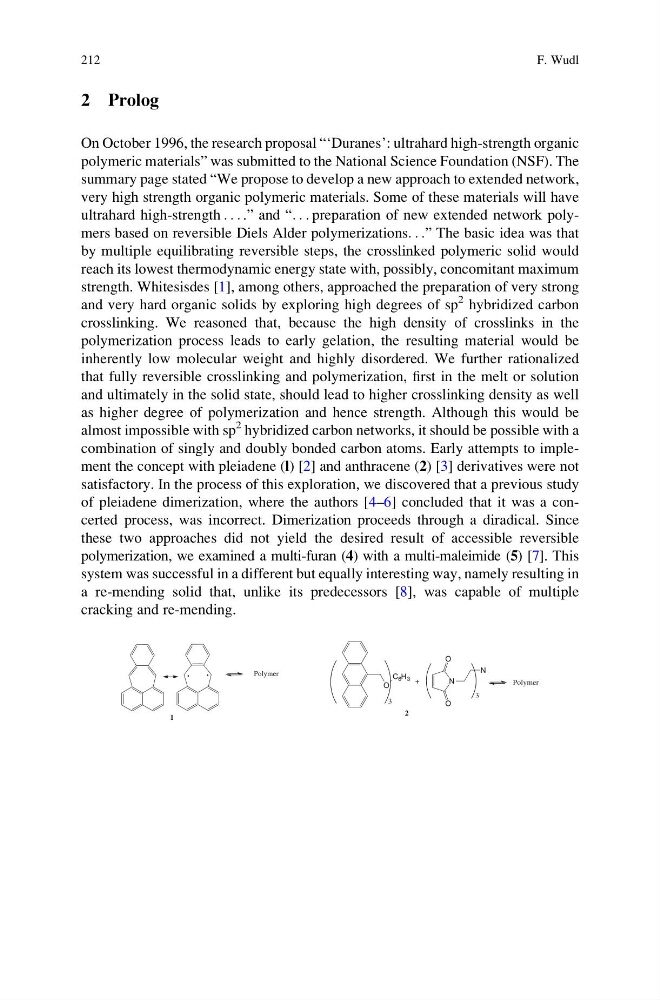
combination of singly and doubly bonded carbon atoms. Early attempts to implement the concept with pleiadene (l) [2] and anthracene (2) [3] derivatives were not
satisfactory. In the process of this exploration, we discovered that a previous study
of pleiadene dimerization, where the authors [4–6] concluded that it was a concerted process, was incorrect. Dimerization proceeds through a diradical. Since
these two approaches did not yield the desired result of accessible reversible
polymerization, we examined a multi-furan (4) with a multi-maleimide (5) [7]. This
system was successful in a different but equally interesting way, namely resulting in
a re-mending solid that, unlike its predecessors [8], was capable of multiple
cracking and re-mending.
1
Polymer
O
C 6 H 3
N
N
O
O
3
3
+
2
Polymer
212
F. Wudl
On October 1996, the research proposal “‘Duranes’: ultrahard high-strength organic
polymeric materials” was submitted to the National Science Foundation (NSF). The
summary page stated “We propose to develop a new approach to extended network,
very high strength organic polymeric materials. Some of these materials will have
ultrahard high-strength . . . .” and “. . . preparation of new extended network polymers based on reversible Diels Alder polymerizations. . .” The basic idea was that
by multiple equilibrating reversible steps, the crosslinked polymeric solid would
reach its lowest thermodynamic energy state with, possibly, concomitant maximum
strength. Whitesisdes [1], among others, approached the preparation of very strong
and very hard organic solids by exploring high degrees of sp
2 hybridized carbon
crosslinking. We reasoned that, because the high density of crosslinks in the
polymerization process leads to early gelation, the resulting material would be
inherently low molecular weight and highly disordered. We further rationalized
that fully reversible crosslinking and polymerization, first in the melt or solution
and ultimately in the solid state, should lead to higher crosslinking density as well
as higher degree of polymerization and hence strength. Although this would be
almost impossible with sp
2 hybridized carbon networks, it should be possible with a
combination of singly and doubly bonded carbon atoms. Early attempts to implement the concept with pleiadene (l) [2] and anthracene (2) [3] derivatives were not
satisfactory. In the process of this exploration, we discovered that a previous study
of pleiadene dimerization, where the authors [4–6] concluded that it was a concerted process, was incorrect. Dimerization proceeds through a diradical. Since
these two approaches did not yield the desired result of accessible reversible
polymerization, we examined a multi-furan (4) with a multi-maleimide (5) [7]. This
system was successful in a different but equally interesting way, namely resulting in
a re-mending solid that, unlike its predecessors [8], was capable of multiple
cracking and re-mending.
1
Polymer
O
C 6 H 3
N
N
O
O
3
3
+
2
Polymer
212
F. Wudl