

4 Mediating Chemical Reactivity and Backbone
Conformation with Spherical and Globular Visualizable
Macromolecules Generated from Quasi-Equivalent
Self-Assembling Dendrons
Figure 7 outlines the concept to be discussed here. It is expected that the attachment
to a polymer backbone of a tapered dendron that self-assembles into a supramolecular helical column will incorporate the polymer backbone in the center of the
column, and that the conformation of the polymer will become helical regardless of
the stereochemistry of its backbone.
The number of dendrons forming the cross-section of the column will determine
the helical pitch of the backbone. We can envision mediating the backbone conformations from helical to fully extended by using this process. Alternatively,
a conical dendron conformation will induce a random-coil backbone conformation
at low degrees of polymerization, whereas a non-dendronized polymer usually
adopts an extended conformation. We expect that quasi-equivalent dendrons will
change their shape from conical to tapered via temperature and degree of polymerization and, subsequently, the shape of the polymer will change from globular to
rod-like and its conformation from random-coil to extended. Will this process affect
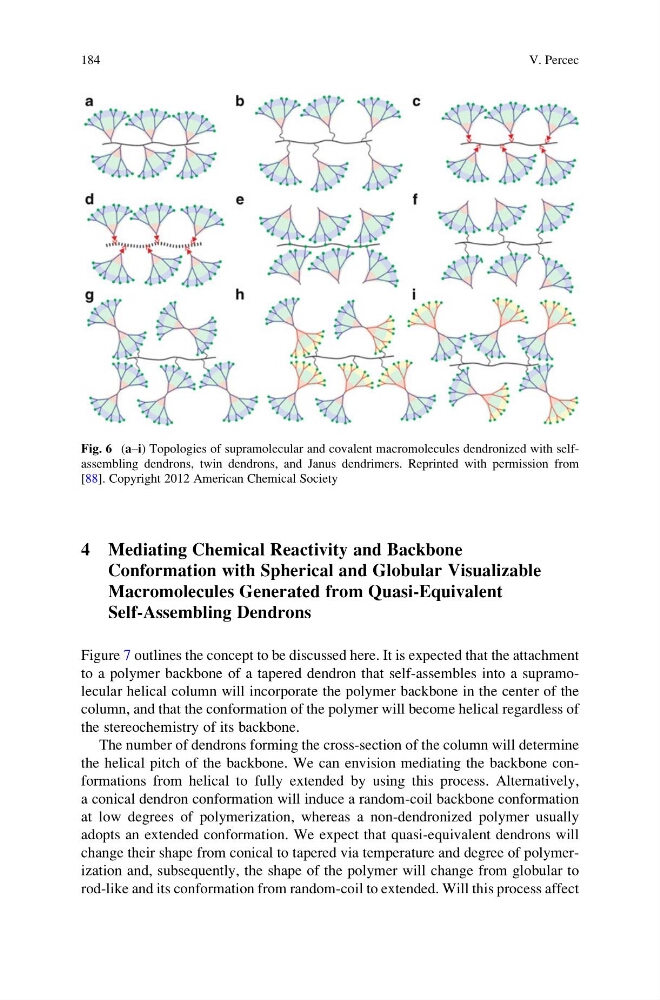
Fig. 6 (a–i) Topologies of supramolecular and covalent macromolecules dendronized with selfassembling dendrons, twin dendrons, and Janus dendrimers. Reprinted with permission from
[88]. Copyright 2012 American Chemical Society
184
V. Percec
Conformation with Spherical and Globular Visualizable
Macromolecules Generated from Quasi-Equivalent
Self-Assembling Dendrons
Figure 7 outlines the concept to be discussed here. It is expected that the attachment
to a polymer backbone of a tapered dendron that self-assembles into a supramolecular helical column will incorporate the polymer backbone in the center of the
column, and that the conformation of the polymer will become helical regardless of
the stereochemistry of its backbone.
The number of dendrons forming the cross-section of the column will determine
the helical pitch of the backbone. We can envision mediating the backbone conformations from helical to fully extended by using this process. Alternatively,
a conical dendron conformation will induce a random-coil backbone conformation
at low degrees of polymerization, whereas a non-dendronized polymer usually
adopts an extended conformation. We expect that quasi-equivalent dendrons will
change their shape from conical to tapered via temperature and degree of polymerization and, subsequently, the shape of the polymer will change from globular to
rod-like and its conformation from random-coil to extended. Will this process affect
Fig. 6 (a–i) Topologies of supramolecular and covalent macromolecules dendronized with selfassembling dendrons, twin dendrons, and Janus dendrimers. Reprinted with permission from
[88]. Copyright 2012 American Chemical Society
184
V. Percec