

the chemical reactivity of the growing active species, the rate of polymerization,
and the polydisperity of the resulting polymer?
Figure 8 summarizes a series of experimental results generated during conventional radical polymerization in dilute solution and in the self-assembled state [62,
89]. Due to steric constraints, in dilute solution the rate constants and rates of
bimolecular termination and chain transfer are reduced or even eliminated while the
rate constant and rate of propagation decrease with the increase in chain length and
become equal to zero when the polymer adopts a globular shape [62, 89]. As a
result, globular polymers with an extremely narrow molecular weight distribution
and predetermined molecular weight, just like in living polymerization processes,
are obtained by conventional radical polymerization. When the polymerization
takes place in self-assembled state, the polymerizable groups are part of a selfassembled nanoreactor. This provides an extremely fast polymerization that yields
cylindrical macromolecules with molar mass up to 4,000,000 in several minutes
[90, 91].
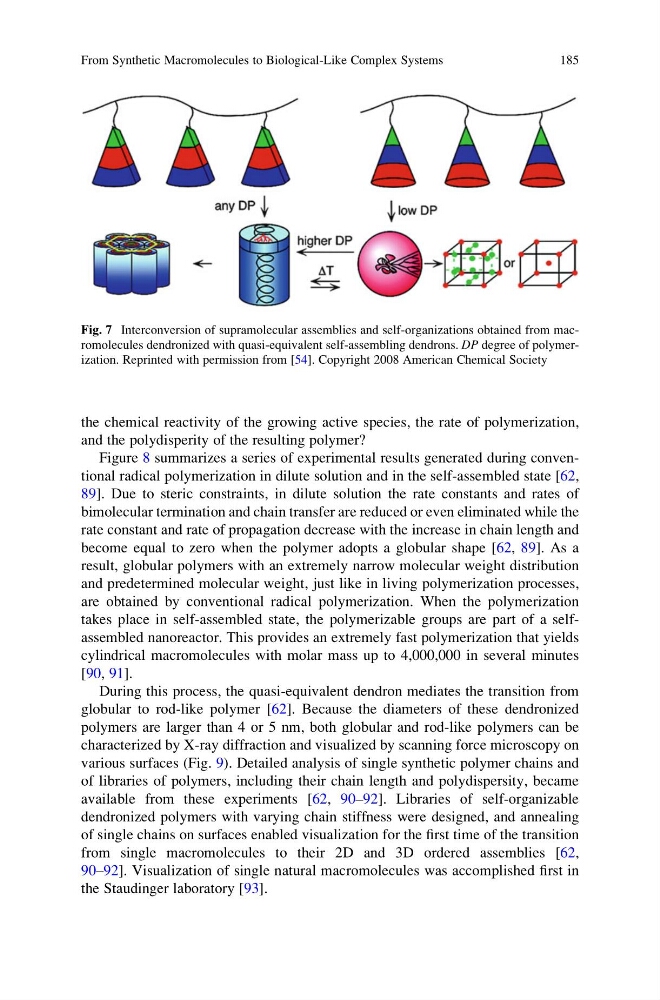
During this process, the quasi-equivalent dendron mediates the transition from
globular to rod-like polymer [62]. Because the diameters of these dendronized
polymers are larger than 4 or 5 nm, both globular and rod-like polymers can be
characterized by X-ray diffraction and visualized by scanning force microscopy on
various surfaces (Fig. 9). Detailed analysis of single synthetic polymer chains and
of libraries of polymers, including their chain length and polydispersity, became
available from these experiments [62, 90–92]. Libraries of self-organizable
dendronized polymers with varying chain stiffness were designed, and annealing
of single chains on surfaces enabled visualization for the first time of the transition
from single macromolecules to their 2D and 3D ordered assemblies [62,
90–92]. Visualization of single natural macromolecules was accomplished first in
the Staudinger laboratory [93].
Fig. 7 Interconversion of supramolecular assemblies and self-organizations obtained from macromolecules dendronized with quasi-equivalent self-assembling dendrons. DP degree of polymerization. Reprinted with permission from [54]. Copyright 2008 American Chemical Society
From Synthetic Macromolecules to Biological-Like Complex Systems
185
and the polydisperity of the resulting polymer?
Figure 8 summarizes a series of experimental results generated during conventional radical polymerization in dilute solution and in the self-assembled state [62,
89]. Due to steric constraints, in dilute solution the rate constants and rates of
bimolecular termination and chain transfer are reduced or even eliminated while the
rate constant and rate of propagation decrease with the increase in chain length and
become equal to zero when the polymer adopts a globular shape [62, 89]. As a
result, globular polymers with an extremely narrow molecular weight distribution
and predetermined molecular weight, just like in living polymerization processes,
are obtained by conventional radical polymerization. When the polymerization
takes place in self-assembled state, the polymerizable groups are part of a selfassembled nanoreactor. This provides an extremely fast polymerization that yields
cylindrical macromolecules with molar mass up to 4,000,000 in several minutes
[90, 91].
During this process, the quasi-equivalent dendron mediates the transition from
globular to rod-like polymer [62]. Because the diameters of these dendronized
polymers are larger than 4 or 5 nm, both globular and rod-like polymers can be
characterized by X-ray diffraction and visualized by scanning force microscopy on
various surfaces (Fig. 9). Detailed analysis of single synthetic polymer chains and
of libraries of polymers, including their chain length and polydispersity, became
available from these experiments [62, 90–92]. Libraries of self-organizable
dendronized polymers with varying chain stiffness were designed, and annealing
of single chains on surfaces enabled visualization for the first time of the transition
from single macromolecules to their 2D and 3D ordered assemblies [62,
90–92]. Visualization of single natural macromolecules was accomplished first in
the Staudinger laboratory [93].
Fig. 7 Interconversion of supramolecular assemblies and self-organizations obtained from macromolecules dendronized with quasi-equivalent self-assembling dendrons. DP degree of polymerization. Reprinted with permission from [54]. Copyright 2008 American Chemical Society
From Synthetic Macromolecules to Biological-Like Complex Systems
185