

“generational” approach to libraries did not provide additional discoveries, a novel
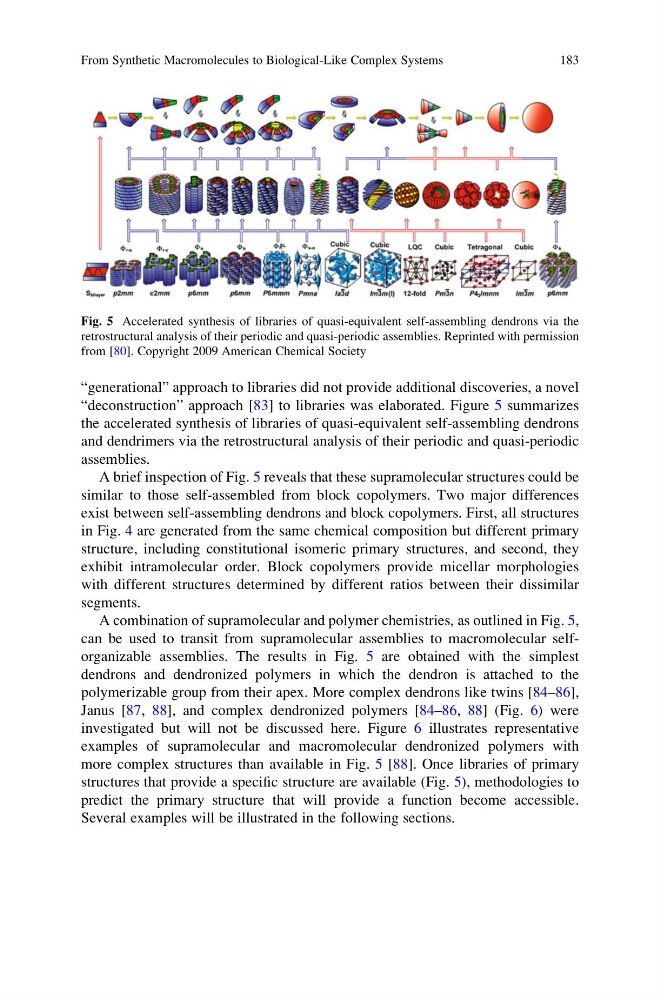
“deconstruction” approach [83] to libraries was elaborated. Figure 5 summarizes
the accelerated synthesis of libraries of quasi-equivalent self-assembling dendrons
and dendrimers via the retrostructural analysis of their periodic and quasi-periodic
assemblies.
A brief inspection of Fig. 5 reveals that these supramolecular structures could be
similar to those self-assembled from block copolymers. Two major differences
exist between self-assembling dendrons and block copolymers. First, all structures
in Fig. 4 are generated from the same chemical composition but different primary
structure, including constitutional isomeric primary structures, and second, they
exhibit intramolecular order. Block copolymers provide micellar morphologies
with different structures determined by different ratios between their dissimilar
segments.
A combination of supramolecular and polymer chemistries, as outlined in Fig. 5,
can be used to transit from supramolecular assemblies to macromolecular selforganizable assemblies. The results in Fig. 5 are obtained with the simplest
dendrons and dendronized polymers in which the dendron is attached to the
polymerizable group from their apex. More complex dendrons like twins [84–86],
Janus [87, 88], and complex dendronized polymers [84–86, 88] (Fig. 6) were
investigated but will not be discussed here. Figure 6 illustrates representative
examples of supramolecular and macromolecular dendronized polymers with
more complex structures than available in Fig. 5 [88]. Once libraries of primary
structures that provide a specific structure are available (Fig. 5), methodologies to
predict the primary structure that will provide a function become accessible.
Several examples will be illustrated in the following sections.
Fig. 5 Accelerated synthesis of libraries of quasi-equivalent self-assembling dendrons via the
retrostructural analysis of their periodic and quasi-periodic assemblies. Reprinted with permission
from [80]. Copyright 2009 American Chemical Society
From Synthetic Macromolecules to Biological-Like Complex Systems
183
“deconstruction” approach [83] to libraries was elaborated. Figure 5 summarizes
the accelerated synthesis of libraries of quasi-equivalent self-assembling dendrons
and dendrimers via the retrostructural analysis of their periodic and quasi-periodic
assemblies.
A brief inspection of Fig. 5 reveals that these supramolecular structures could be
similar to those self-assembled from block copolymers. Two major differences
exist between self-assembling dendrons and block copolymers. First, all structures
in Fig. 4 are generated from the same chemical composition but different primary
structure, including constitutional isomeric primary structures, and second, they
exhibit intramolecular order. Block copolymers provide micellar morphologies
with different structures determined by different ratios between their dissimilar
segments.
A combination of supramolecular and polymer chemistries, as outlined in Fig. 5,
can be used to transit from supramolecular assemblies to macromolecular selforganizable assemblies. The results in Fig. 5 are obtained with the simplest
dendrons and dendronized polymers in which the dendron is attached to the
polymerizable group from their apex. More complex dendrons like twins [84–86],
Janus [87, 88], and complex dendronized polymers [84–86, 88] (Fig. 6) were
investigated but will not be discussed here. Figure 6 illustrates representative
examples of supramolecular and macromolecular dendronized polymers with
more complex structures than available in Fig. 5 [88]. Once libraries of primary
structures that provide a specific structure are available (Fig. 5), methodologies to
predict the primary structure that will provide a function become accessible.
Several examples will be illustrated in the following sections.
Fig. 5 Accelerated synthesis of libraries of quasi-equivalent self-assembling dendrons via the
retrostructural analysis of their periodic and quasi-periodic assemblies. Reprinted with permission
from [80]. Copyright 2009 American Chemical Society
From Synthetic Macromolecules to Biological-Like Complex Systems
183