

The low molar components were the first examples of first generation selfassembling dendrons, and their polymerized structures were the first examples of
self-organizable dendronized polymers [23–42]. However, once time-consuming
crystallographic studies were involved, the publication of this work was delayed by
many years [26–42]. A series of invited reviews of this early and later work were
published [24, 25] (for early and more recent reviews on this topic see [43–58]). In
addition, these initial “research failures” were not published in prestigious journals.
By using the disc-like fragment of the repeat unit from Fig. 2, Heck wanted to
prepare even higher generation dendrimers. I was not enthusiastic because
dendrimers were already known, even if these molecules were made by the reverse
process of that elaborated by Tomalia [59]. Nevertheless, higher generations of
these AB 3 -based self-assembling dendrons and dendrimers were ultimately synthesized by Jim Heck, resynthesized by Gary Johansson, and after many years of
X-ray, electron diffraction combined with molecular models, simulation and electron density map studies they demonstrated globular [60] or icosahedral, rather than
rod-like, structures that were self-organizable into new periodic and quasi-periodic
lattices [60–68] including the first organic quasi-crystals [65]. In order to elucidate
the correlation between the primary structure of the self-assembling dendrimer and
its supramolecular structure, a “generational” approach to libraries of selfassembling dendrons based on constitutional isomeric AB 2 and AB 3 selfassembling dendrons was elaborated [69–71]. As expected, constitutional isomeric
libraries provided different supramolecular structures and, therefore, different
functions [71]. The amphiphilic benzyl ether dendrons were considered by us to
be the simplest self-assembling synthetic “mimics” of peptides, in which the
peptide bond derived from α-amino acids was replaced with the more flexible
benzyl ether and the linear topology was replaced with a branched one in order to
increase the probability of the discovery process. Were these supramolecular
structures micellar or did they display internal order like biological assemblies?
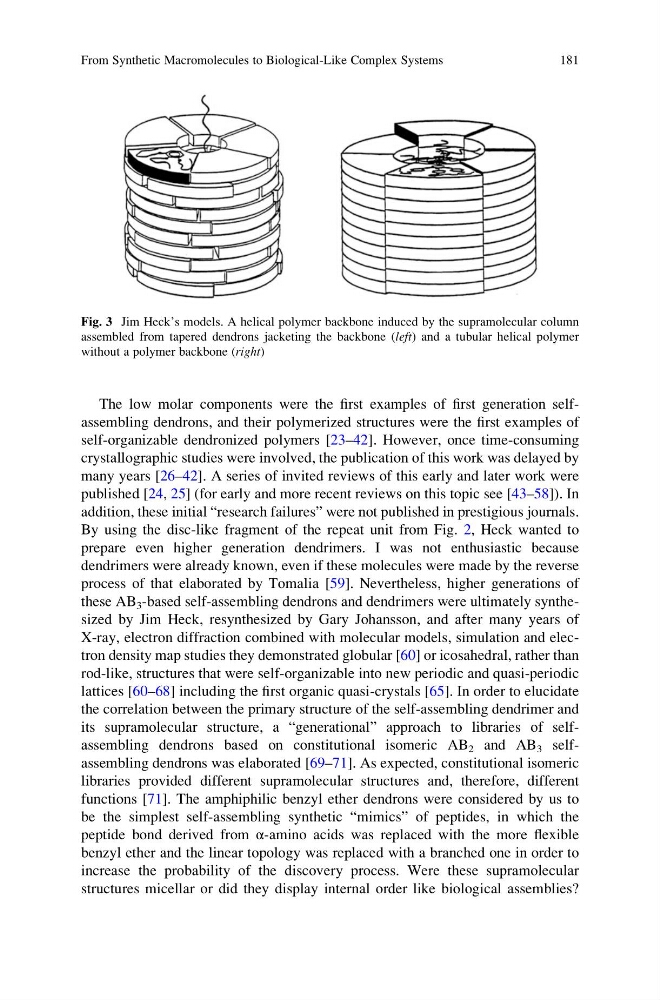
Fig. 3 Jim Heck’s models. A helical polymer backbone induced by the supramolecular column
assembled from tapered dendrons jacketing the backbone (left) and a tubular helical polymer
without a polymer backbone (right)
From Synthetic Macromolecules to Biological-Like Complex Systems
181
self-organizable dendronized polymers [23–42]. However, once time-consuming
crystallographic studies were involved, the publication of this work was delayed by
many years [26–42]. A series of invited reviews of this early and later work were
published [24, 25] (for early and more recent reviews on this topic see [43–58]). In
addition, these initial “research failures” were not published in prestigious journals.
By using the disc-like fragment of the repeat unit from Fig. 2, Heck wanted to
prepare even higher generation dendrimers. I was not enthusiastic because
dendrimers were already known, even if these molecules were made by the reverse
process of that elaborated by Tomalia [59]. Nevertheless, higher generations of
these AB 3 -based self-assembling dendrons and dendrimers were ultimately synthesized by Jim Heck, resynthesized by Gary Johansson, and after many years of
X-ray, electron diffraction combined with molecular models, simulation and electron density map studies they demonstrated globular [60] or icosahedral, rather than
rod-like, structures that were self-organizable into new periodic and quasi-periodic
lattices [60–68] including the first organic quasi-crystals [65]. In order to elucidate
the correlation between the primary structure of the self-assembling dendrimer and
its supramolecular structure, a “generational” approach to libraries of selfassembling dendrons based on constitutional isomeric AB 2 and AB 3 selfassembling dendrons was elaborated [69–71]. As expected, constitutional isomeric
libraries provided different supramolecular structures and, therefore, different
functions [71]. The amphiphilic benzyl ether dendrons were considered by us to
be the simplest self-assembling synthetic “mimics” of peptides, in which the
peptide bond derived from α-amino acids was replaced with the more flexible
benzyl ether and the linear topology was replaced with a branched one in order to
increase the probability of the discovery process. Were these supramolecular
structures micellar or did they display internal order like biological assemblies?
Fig. 3 Jim Heck’s models. A helical polymer backbone induced by the supramolecular column
assembled from tapered dendrons jacketing the backbone (left) and a tubular helical polymer
without a polymer backbone (right)
From Synthetic Macromolecules to Biological-Like Complex Systems
181