

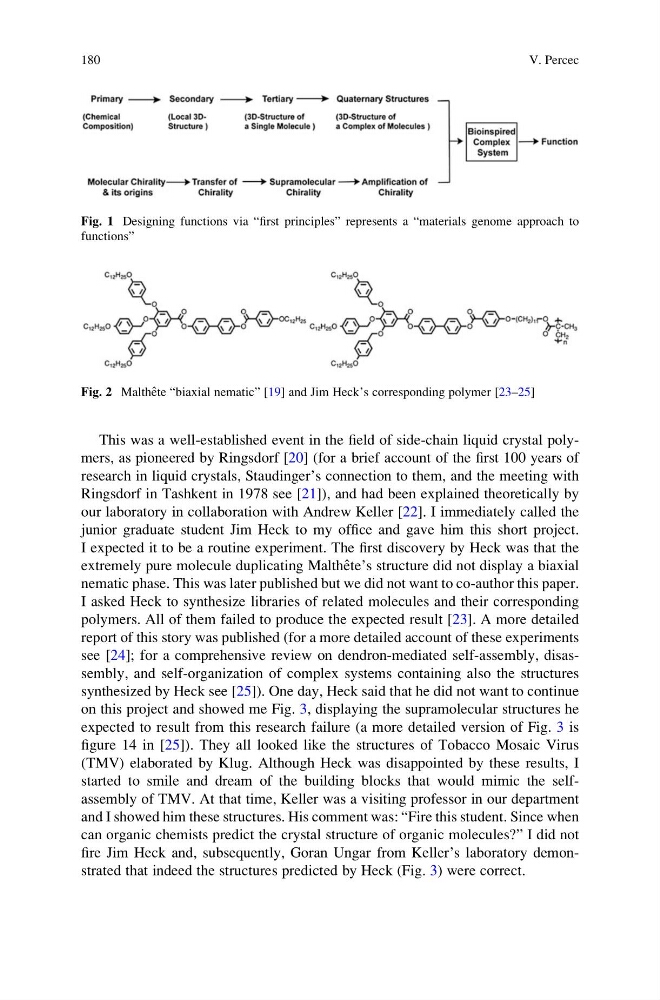
This was a well-established event in the field of side-chain liquid crystal polymers, as pioneered by Ringsdorf [20] (for a brief account of the first 100 years of
research in liquid crystals, Staudinger’s connection to them, and the meeting with
Ringsdorf in Tashkent in 1978 see [21]), and had been explained theoretically by
our laboratory in collaboration with Andrew Keller [22]. I immediately called the
junior graduate student Jim Heck to my office and gave him this short project.
I expected it to be a routine experiment. The first discovery by Heck was that the
extremely pure molecule duplicating Malthe ˆte’s structure did not display a biaxial
nematic phase. This was later published but we did not want to co-author this paper.
I asked Heck to synthesize libraries of related molecules and their corresponding
polymers. All of them failed to produce the expected result [23]. A more detailed
report of this story was published (for a more detailed account of these experiments
see [24]; for a comprehensive review on dendron-mediated self-assembly, disassembly, and self-organization of complex systems containing also the structures
synthesized by Heck see [25]). One day, Heck said that he did not want to continue
on this project and showed me Fig. 3, displaying the supramolecular structures he
expected to result from this research failure (a more detailed version of Fig. 3 is
figure 14 in [25]). They all looked like the structures of Tobacco Mosaic Virus
(TMV) elaborated by Klug. Although Heck was disappointed by these results, I
started to smile and dream of the building blocks that would mimic the selfassembly of TMV. At that time, Keller was a visiting professor in our department
and I showed him these structures. His comment was: “Fire this student. Since when
can organic chemists predict the crystal structure of organic molecules?” I did not
fire Jim Heck and, subsequently, Goran Ungar from Keller’s laboratory demonstrated that indeed the structures predicted by Heck (Fig. 3) were correct.
Fig. 1 Designing functions via “first principles” represents a “materials genome approach to
functions”
Fig. 2 Malthe ˆte “biaxial nematic” [19] and Jim Heck’s corresponding polymer [23–25]
180
V. Percec
research in liquid crystals, Staudinger’s connection to them, and the meeting with
Ringsdorf in Tashkent in 1978 see [21]), and had been explained theoretically by
our laboratory in collaboration with Andrew Keller [22]. I immediately called the
junior graduate student Jim Heck to my office and gave him this short project.
I expected it to be a routine experiment. The first discovery by Heck was that the
extremely pure molecule duplicating Malthe ˆte’s structure did not display a biaxial
nematic phase. This was later published but we did not want to co-author this paper.
I asked Heck to synthesize libraries of related molecules and their corresponding
polymers. All of them failed to produce the expected result [23]. A more detailed
report of this story was published (for a more detailed account of these experiments
see [24]; for a comprehensive review on dendron-mediated self-assembly, disassembly, and self-organization of complex systems containing also the structures
synthesized by Heck see [25]). One day, Heck said that he did not want to continue
on this project and showed me Fig. 3, displaying the supramolecular structures he
expected to result from this research failure (a more detailed version of Fig. 3 is
figure 14 in [25]). They all looked like the structures of Tobacco Mosaic Virus
(TMV) elaborated by Klug. Although Heck was disappointed by these results, I
started to smile and dream of the building blocks that would mimic the selfassembly of TMV. At that time, Keller was a visiting professor in our department
and I showed him these structures. His comment was: “Fire this student. Since when
can organic chemists predict the crystal structure of organic molecules?” I did not
fire Jim Heck and, subsequently, Goran Ungar from Keller’s laboratory demonstrated that indeed the structures predicted by Heck (Fig. 3) were correct.
Fig. 1 Designing functions via “first principles” represents a “materials genome approach to
functions”
Fig. 2 Malthe ˆte “biaxial nematic” [19] and Jim Heck’s corresponding polymer [23–25]
180
V. Percec