

towards adaptive chemistry [41, 43]. Thus, supramolecular as well as molecular
dynamers may undergo adaptation in response to physical stimuli such as temperature [100, 101], light, pressure, phase change (for crystallization-driven constitutional change of metallodynamers in response to neat/solution conditions, see
[102]), or electric field (for the response of a dynamic library of liquid crystalline
compounds to an electric field, see [103]) as well as to chemical effectors such as
protons [100] and metal cations [104–107]. In general terms, a library of dynamers
built on a sufficiently diverse set (a sort of “complete” set!) of monomeric components should in principle be able to respond to various stimuli or effectors and
undergo component rearrangement by recombination of interactions or bonds. This
would enable the generation of a dynamer whose constitution would be best
adapted to respond to a particular stimulus on the basis of the set of components
available. In addition, a given dynamer thus formed may express or induce a
specific functional property (Fig. 8).
Thus, the cooperative, bottom-up polycondensation of amphiphilic monomeric
components driven by hydrophobic effects generates rigid-rod nanostructures [108]
and yields thermoresponsive dynamers presenting thermally induced, reversible
chain elongation with a change in physicochemical behavior from a soluble polymer
at low temperature to aggregation into large bundles or fibers at higher temperatures
Change of Fluorescence from BLUE to GREEN
+
OPTO-Dynamics : COMPONENT EXCHANGE in a GLYCODYNAMER
Excitation 419nm
0
20000
40000
60000
80000
100000
120000
140000
Wavelength/nm
0
7min
12min
22min
32min
42min
62min
102min
122min
142min
Excitation at 393 nm
0
10000
20000
30000
40000
50000
60000
70000
80000
400
450
500
550
600
650
700
410
460
510
560
610
660
710
wavelength/nm
T=0
2min
7min
17min
27min
37min
57min
67min
87min
107min
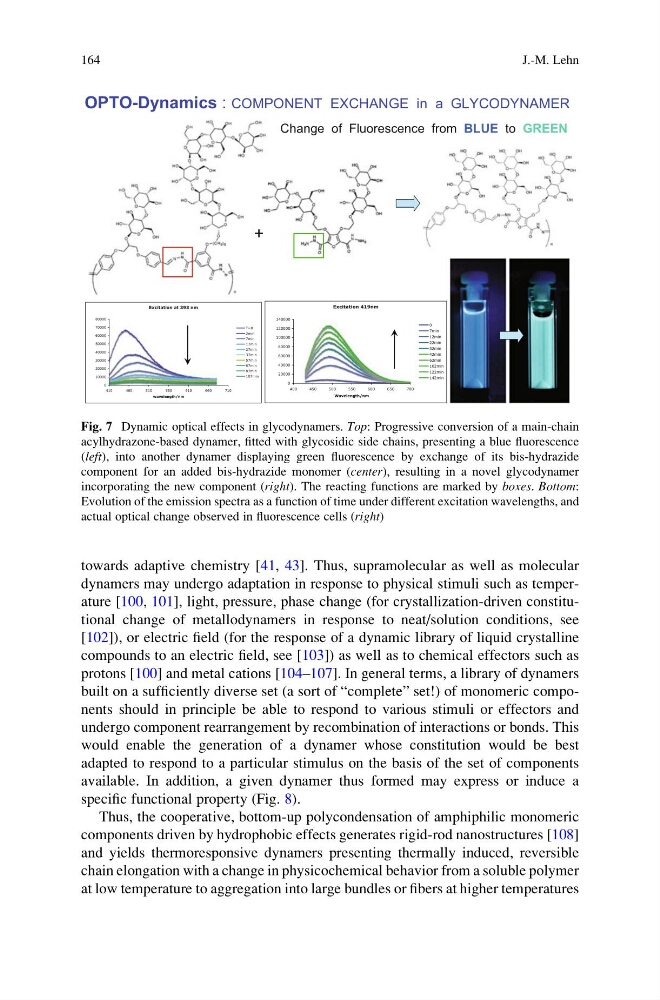
Fig. 7 Dynamic optical effects in glycodynamers. Top: Progressive conversion of a main-chain
acylhydrazone-based dynamer, fitted with glycosidic side chains, presenting a blue fluorescence
(left), into another dynamer displaying green fluorescence by exchange of its bis-hydrazide
component for an added bis-hydrazide monomer (center), resulting in a novel glycodynamer
incorporating the new component (right). The reacting functions are marked by boxes. Bottom:
Evolution of the emission spectra as a function of time under different excitation wavelengths, and
actual optical change observed in fluorescence cells (right)
164
J.-M. Lehn
dynamers may undergo adaptation in response to physical stimuli such as temperature [100, 101], light, pressure, phase change (for crystallization-driven constitutional change of metallodynamers in response to neat/solution conditions, see
[102]), or electric field (for the response of a dynamic library of liquid crystalline
compounds to an electric field, see [103]) as well as to chemical effectors such as
protons [100] and metal cations [104–107]. In general terms, a library of dynamers
built on a sufficiently diverse set (a sort of “complete” set!) of monomeric components should in principle be able to respond to various stimuli or effectors and
undergo component rearrangement by recombination of interactions or bonds. This
would enable the generation of a dynamer whose constitution would be best
adapted to respond to a particular stimulus on the basis of the set of components
available. In addition, a given dynamer thus formed may express or induce a
specific functional property (Fig. 8).
Thus, the cooperative, bottom-up polycondensation of amphiphilic monomeric
components driven by hydrophobic effects generates rigid-rod nanostructures [108]
and yields thermoresponsive dynamers presenting thermally induced, reversible
chain elongation with a change in physicochemical behavior from a soluble polymer
at low temperature to aggregation into large bundles or fibers at higher temperatures
Change of Fluorescence from BLUE to GREEN
+
OPTO-Dynamics : COMPONENT EXCHANGE in a GLYCODYNAMER
Excitation 419nm
0
20000
40000
60000
80000
100000
120000
140000
Wavelength/nm
0
7min
12min
22min
32min
42min
62min
102min
122min
142min
Excitation at 393 nm
0
10000
20000
30000
40000
50000
60000
70000
80000
400
450
500
550
600
650
700
410
460
510
560
610
660
710
wavelength/nm
T=0
2min
7min
17min
27min
37min
57min
67min
87min
107min
Fig. 7 Dynamic optical effects in glycodynamers. Top: Progressive conversion of a main-chain
acylhydrazone-based dynamer, fitted with glycosidic side chains, presenting a blue fluorescence
(left), into another dynamer displaying green fluorescence by exchange of its bis-hydrazide
component for an added bis-hydrazide monomer (center), resulting in a novel glycodynamer
incorporating the new component (right). The reacting functions are marked by boxes. Bottom:
Evolution of the emission spectra as a function of time under different excitation wavelengths, and
actual optical change observed in fluorescence cells (right)
164
J.-M. Lehn