

3.3 Dynamers with Multiple Dynamic Processes
A marked widening of the field is offered by dynamic polymers that incorporate
several, preferentially orthogonal, dynamic processes. For instance, there could be
two different covalent processes (e.g., based on disulfide and hydrazone groups)
[93], two different non-covalent processes (hydrogen bonds and metal ion coordination) [94–97], a covalent together with a non-covalent process (e.g., imine groups
and hydrogen bonding or metal ion coordination) [53–55, 98], or three types of
dynamics (disulfide, imine, and coordination) [99]. Such features are presented by
double dynamic supramolecular polymers whose main chain is built on H-bonding
and imine groups [98] as well as by the neutral metallodynamers incorporating
metal coordination centers and imine groups [53–55].
4 Dynamers: Adaptive Features
The most far-reaching general feature of CDC is that it gives access to the next step
in complex matter behavior, that is to systems capable of adaptation through
constitutional variation by dynamic selection of components, which is on the road
N
O
CHO
OHC
6
H 2 N
CONHNH 2
R
+
NH
N
R
O
N
O
N
H
N
O
N
N
O
N
O
HN NH 2
R
R
n
6
6
H 2 N
pH ca 5
H 2 O
HO
N
H
O
CONHNH 2
OH
R
N
N
H
O
N
H
O
H
N
O
H
N
O
N
HO
OH
H
N
O
N
H
NH 2
O
R
R
R
n
pH ca 5
H 2 O
Dynamic Hybrid PROTEOIDS
Dynamic Main-Chain PROTEOIDS
n=10-14
Mw=1600-2200
n
Main-Chain GLYCODYNAMERS
Dynamic Oligo-arabinofuranose Analogues
+
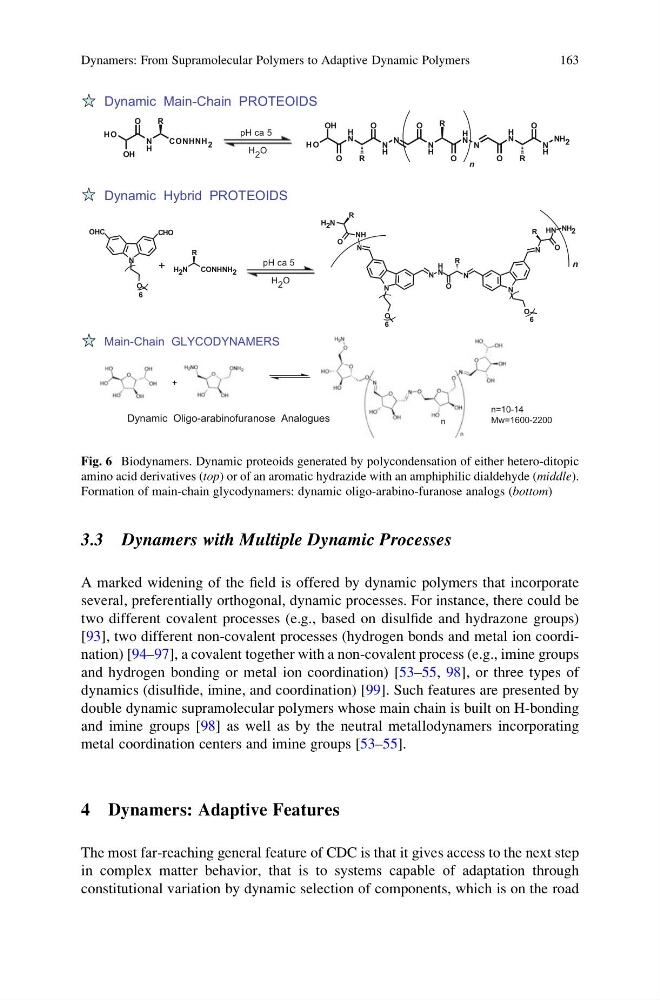
Fig. 6 Biodynamers. Dynamic proteoids generated by polycondensation of either hetero-ditopic
amino acid derivatives (top) or of an aromatic hydrazide with an amphiphilic dialdehyde (middle).
Formation of main-chain glycodynamers: dynamic oligo-arabino-furanose analogs (bottom)
Dynamers: From Supramolecular Polymers to Adaptive Dynamic Polymers
163
A marked widening of the field is offered by dynamic polymers that incorporate
several, preferentially orthogonal, dynamic processes. For instance, there could be
two different covalent processes (e.g., based on disulfide and hydrazone groups)
[93], two different non-covalent processes (hydrogen bonds and metal ion coordination) [94–97], a covalent together with a non-covalent process (e.g., imine groups
and hydrogen bonding or metal ion coordination) [53–55, 98], or three types of
dynamics (disulfide, imine, and coordination) [99]. Such features are presented by
double dynamic supramolecular polymers whose main chain is built on H-bonding
and imine groups [98] as well as by the neutral metallodynamers incorporating
metal coordination centers and imine groups [53–55].
4 Dynamers: Adaptive Features
The most far-reaching general feature of CDC is that it gives access to the next step
in complex matter behavior, that is to systems capable of adaptation through
constitutional variation by dynamic selection of components, which is on the road
N
O
CHO
OHC
6
H 2 N
CONHNH 2
R
+
NH
N
R
O
N
O
N
H
N
O
N
N
O
N
O
HN NH 2
R
R
n
6
6
H 2 N
pH ca 5
H 2 O
HO
N
H
O
CONHNH 2
OH
R
N
N
H
O
N
H
O
H
N
O
H
N
O
N
HO
OH
H
N
O
N
H
NH 2
O
R
R
R
n
pH ca 5
H 2 O
Dynamic Hybrid PROTEOIDS
Dynamic Main-Chain PROTEOIDS
n=10-14
Mw=1600-2200
n
Main-Chain GLYCODYNAMERS
Dynamic Oligo-arabinofuranose Analogues
+
Fig. 6 Biodynamers. Dynamic proteoids generated by polycondensation of either hetero-ditopic
amino acid derivatives (top) or of an aromatic hydrazide with an amphiphilic dialdehyde (middle).
Formation of main-chain glycodynamers: dynamic oligo-arabino-furanose analogs (bottom)
Dynamers: From Supramolecular Polymers to Adaptive Dynamic Polymers
163