

high order parameter and they look adequate for the orientation of large elongated
fluorescent dyes. Now, such cholesteric phases from chiral polymers are known and
opalescent films have been described [111–114]. However, their optical properties
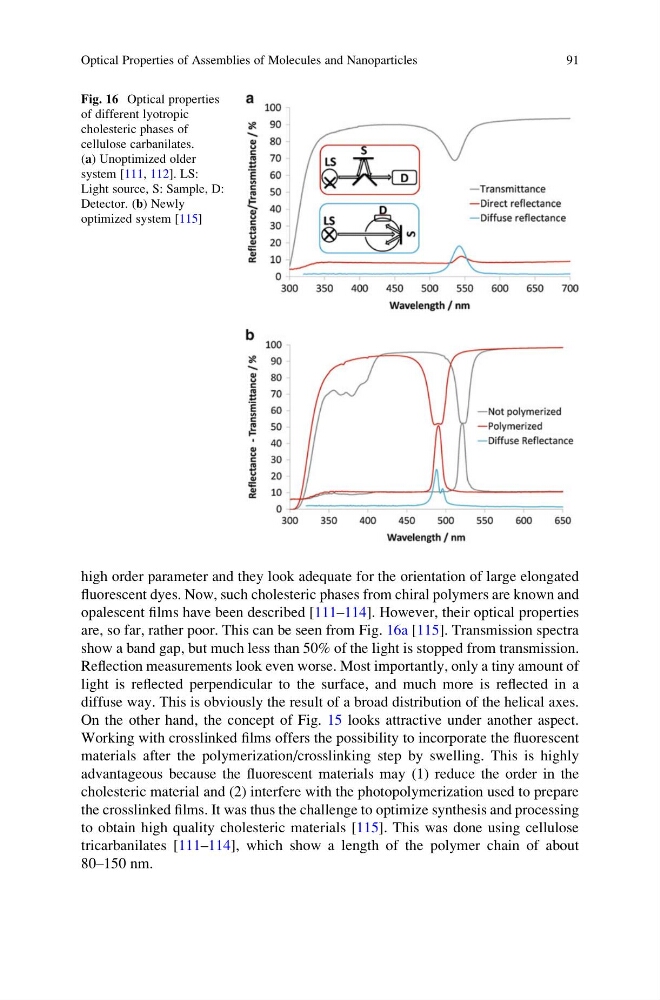
are, so far, rather poor. This can be seen from Fig. 16a [115]. Transmission spectra
show a band gap, but much less than 50% of the light is stopped from transmission.
Reflection measurements look even worse. Most importantly, only a tiny amount of
light is reflected perpendicular to the surface, and much more is reflected in a
diffuse way. This is obviously the result of a broad distribution of the helical axes.
On the other hand, the concept of Fig. 15 looks attractive under another aspect.
Working with crosslinked films offers the possibility to incorporate the fluorescent
materials after the polymerization/crosslinking step by swelling. This is highly
advantageous because the fluorescent materials may (1) reduce the order in the
cholesteric material and (2) interfere with the photopolymerization used to prepare
the crosslinked films. It was thus the challenge to optimize synthesis and processing
to obtain high quality cholesteric materials [115]. This was done using cellulose
tricarbanilates [111–114], which show a length of the polymer chain of about
80–150 nm.
Fig. 16 Optical properties
of different lyotropic
cholesteric phases of
cellulose carbanilates.
(a) Unoptimized older
system [111, 112]. LS:
Light source, S: Sample, D:
Detector. (b) Newly
optimized system [115]
Optical Properties of Assemblies of Molecules and Nanoparticles
91
fluorescent dyes. Now, such cholesteric phases from chiral polymers are known and
opalescent films have been described [111–114]. However, their optical properties
are, so far, rather poor. This can be seen from Fig. 16a [115]. Transmission spectra
show a band gap, but much less than 50% of the light is stopped from transmission.
Reflection measurements look even worse. Most importantly, only a tiny amount of
light is reflected perpendicular to the surface, and much more is reflected in a
diffuse way. This is obviously the result of a broad distribution of the helical axes.
On the other hand, the concept of Fig. 15 looks attractive under another aspect.
Working with crosslinked films offers the possibility to incorporate the fluorescent
materials after the polymerization/crosslinking step by swelling. This is highly
advantageous because the fluorescent materials may (1) reduce the order in the
cholesteric material and (2) interfere with the photopolymerization used to prepare
the crosslinked films. It was thus the challenge to optimize synthesis and processing
to obtain high quality cholesteric materials [115]. This was done using cellulose
tricarbanilates [111–114], which show a length of the polymer chain of about
80–150 nm.
Fig. 16 Optical properties
of different lyotropic
cholesteric phases of
cellulose carbanilates.
(a) Unoptimized older
system [111, 112]. LS:
Light source, S: Sample, D:
Detector. (b) Newly
optimized system [115]
Optical Properties of Assemblies of Molecules and Nanoparticles
91