

By careful choice of the polymerizable solvent, by hydrogen bond influencing
additives, but especially by the synthetic realization of a very high degree of
substitution of the cellulose based polymer, we succeeded in reducing the viscosity
of the lyotropic solution considerably [115]. The proper use of mechanical stirring
in combination with a tuned substrate treatment and film preparation method and
subsequent polymerization allowed, finally, the preparation for the first time of
free-standing cholesteric films of a high optical quality such as known from low
molar mass systems (see Fig. 16b). They showed selective reflection with a half
width of only 20 nm, 50% of transmission, nearly no scattering and nearly 50%
perpendicular reflection.
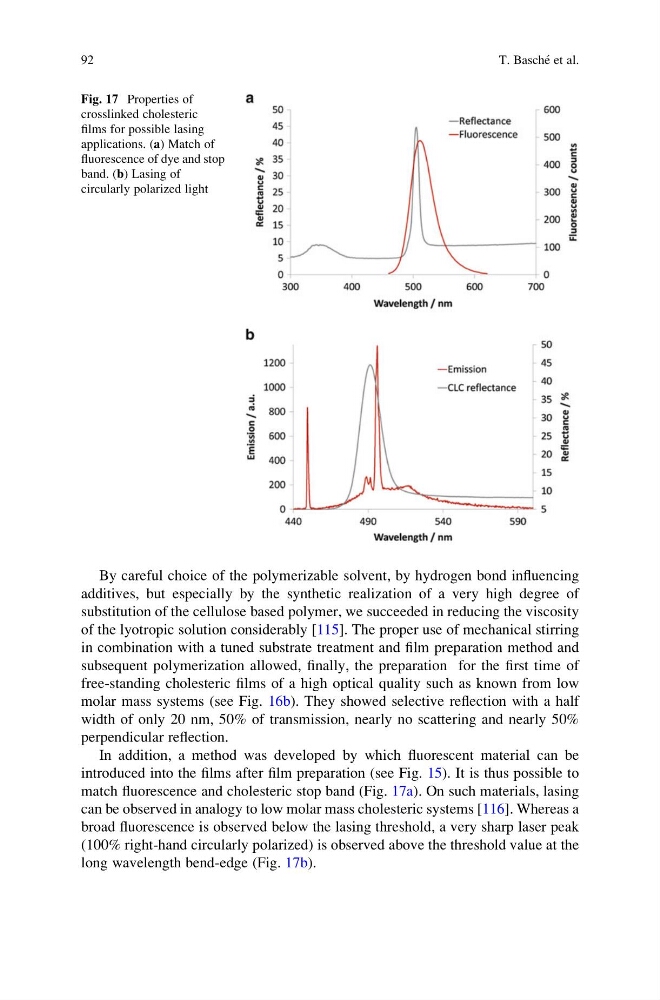
In addition, a method was developed by which fluorescent material can be
introduced into the films after film preparation (see Fig. 15). It is thus possible to
match fluorescence and cholesteric stop band (Fig. 17a). On such materials, lasing
can be observed in analogy to low molar mass cholesteric systems [116]. Whereas a
broad fluorescence is observed below the lasing threshold, a very sharp laser peak
(100% right-hand circularly polarized) is observed above the threshold value at the
long wavelength bend-edge (Fig. 17b).
Fig. 17 Properties of
crosslinked cholesteric
films for possible lasing
applications. (a) Match of
fluorescence of dye and stop
band. (b) Lasing of
circularly polarized light
92
T. Basche ´ et al.
additives, but especially by the synthetic realization of a very high degree of
substitution of the cellulose based polymer, we succeeded in reducing the viscosity
of the lyotropic solution considerably [115]. The proper use of mechanical stirring
in combination with a tuned substrate treatment and film preparation method and
subsequent polymerization allowed, finally, the preparation for the first time of
free-standing cholesteric films of a high optical quality such as known from low
molar mass systems (see Fig. 16b). They showed selective reflection with a half
width of only 20 nm, 50% of transmission, nearly no scattering and nearly 50%
perpendicular reflection.
In addition, a method was developed by which fluorescent material can be
introduced into the films after film preparation (see Fig. 15). It is thus possible to
match fluorescence and cholesteric stop band (Fig. 17a). On such materials, lasing
can be observed in analogy to low molar mass cholesteric systems [116]. Whereas a
broad fluorescence is observed below the lasing threshold, a very sharp laser peak
(100% right-hand circularly polarized) is observed above the threshold value at the
long wavelength bend-edge (Fig. 17b).
Fig. 17 Properties of
crosslinked cholesteric
films for possible lasing
applications. (a) Match of
fluorescence of dye and stop
band. (b) Lasing of
circularly polarized light
92
T. Basche ´ et al.