

possible, and low molar mass liquid crystals are easy to orient. This is necessary to
obtain optimal optical properties, which include maximal reflection perpendicular
to the substrate and very little scattering.
On the other hand, polymerized (or even crosslinked) cholesteric films would
also be very interesting. At first, polymerization/crosslinking allows the permanent
stabilization of any selective reflection adjusted beforehand. Thus the cholesteric
material can be used afterwards independent of the environmental temperature. But,
more importantly, crosslinking stabilizes the helical structure against disturbance
by temperature fluctuations during pumping. It thereby strongly increases the
maximal tolerable pumping power. In addition, crosslinked systems give flexible
films [111, 112] and they make it easy to prepare samples for working in the defect
mode. But, it is only possible to benefit from these advantages if a high quality of
orientation can be obtained.
There is another reason for being interested in the use of cholesteric phases
prepared by large mesogens. This is related to the use of large, highly fluorescent
structures like oligomers optimized for organic LEDs or fluorescent quantum rods.
To obtain a low threshold value for lasing, these structures have to be oriented well
in the cholesteric phase, with their dipole transition moments parallel to the local
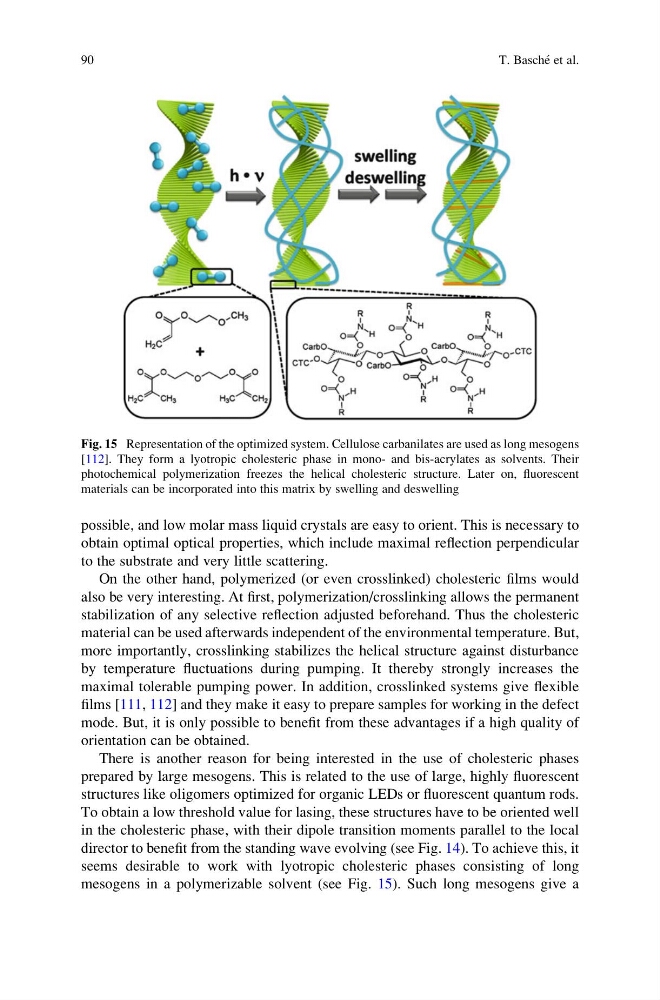
director to benefit from the standing wave evolving (see Fig. 14). To achieve this, it
seems desirable to work with lyotropic cholesteric phases consisting of long
mesogens in a polymerizable solvent (see Fig. 15). Such long mesogens give a
Fig. 15 Representation of the optimized system. Cellulose carbanilates are used as long mesogens
[112]. They form a lyotropic cholesteric phase in mono- and bis-acrylates as solvents. Their
photochemical polymerization freezes the helical cholesteric structure. Later on, fluorescent
materials can be incorporated into this matrix by swelling and deswelling
90
T. Basche ´ et al.
obtain optimal optical properties, which include maximal reflection perpendicular
to the substrate and very little scattering.
On the other hand, polymerized (or even crosslinked) cholesteric films would
also be very interesting. At first, polymerization/crosslinking allows the permanent
stabilization of any selective reflection adjusted beforehand. Thus the cholesteric
material can be used afterwards independent of the environmental temperature. But,
more importantly, crosslinking stabilizes the helical structure against disturbance
by temperature fluctuations during pumping. It thereby strongly increases the
maximal tolerable pumping power. In addition, crosslinked systems give flexible
films [111, 112] and they make it easy to prepare samples for working in the defect
mode. But, it is only possible to benefit from these advantages if a high quality of
orientation can be obtained.
There is another reason for being interested in the use of cholesteric phases
prepared by large mesogens. This is related to the use of large, highly fluorescent
structures like oligomers optimized for organic LEDs or fluorescent quantum rods.
To obtain a low threshold value for lasing, these structures have to be oriented well
in the cholesteric phase, with their dipole transition moments parallel to the local
director to benefit from the standing wave evolving (see Fig. 14). To achieve this, it
seems desirable to work with lyotropic cholesteric phases consisting of long
mesogens in a polymerizable solvent (see Fig. 15). Such long mesogens give a
Fig. 15 Representation of the optimized system. Cellulose carbanilates are used as long mesogens
[112]. They form a lyotropic cholesteric phase in mono- and bis-acrylates as solvents. Their
photochemical polymerization freezes the helical cholesteric structure. Later on, fluorescent
materials can be incorporated into this matrix by swelling and deswelling
90
T. Basche ´ et al.