

created. External cavities have been decreased in size or replaced by other
structures. In this context, periodic dielectric structures (photonic crystals) become
essential. The most common type of miniature laser is, however, still the laser diode
utilized in all types of disk drives. It is similar to an LED, in which the inner
surfaces of the diode housing are metallized to creating a resonator, resulting in
laser emission. For high power output laser diodes, many of these cells are
combined to bars achieving demands up to 70 W [84].
Although many diode lasers work as multimode lasers, the distributed feedback
(DFB) and distributed Bragg reflector (DBR) lasers show a mode selection because
of their periodic structure. The mode selectivity is generated by the optical
properties of the periodic structures because only the modes that are associated
with a standing wave/stop band are amplified. DFB structures are photonic
structures, which are doped throughout the volume with chromophores (in an
optimal case at the maxima of the standing waves), whereas DBR lasers have a
miniature Fabry–Perot cavity in which the dye is localized, and the mirrors are
replaced by periodic gratings [85].
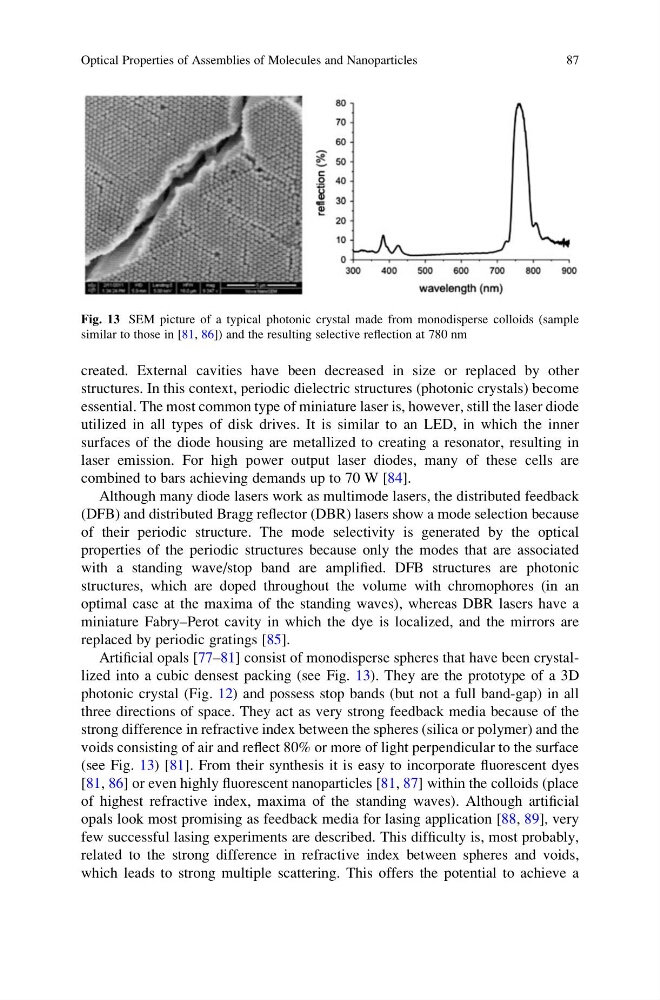
Artificial opals [77–81] consist of monodisperse spheres that have been crystallized into a cubic densest packing (see Fig. 13). They are the prototype of a 3D
photonic crystal (Fig. 12) and possess stop bands (but not a full band-gap) in all
three directions of space. They act as very strong feedback media because of the
strong difference in refractive index between the spheres (silica or polymer) and the
voids consisting of air and reflect 80% or more of light perpendicular to the surface
(see Fig. 13) [81]. From their synthesis it is easy to incorporate fluorescent dyes
[81, 86] or even highly fluorescent nanoparticles [81, 87] within the colloids (place
of highest refractive index, maxima of the standing waves). Although artificial
opals look most promising as feedback media for lasing application [88, 89], very
few successful lasing experiments are described. This difficulty is, most probably,
related to the strong difference in refractive index between spheres and voids,
which leads to strong multiple scattering. This offers the potential to achieve a
Fig. 13 SEM picture of a typical photonic crystal made from monodisperse colloids (sample
similar to those in [81, 86]) and the resulting selective reflection at 780 nm
Optical Properties of Assemblies of Molecules and Nanoparticles
87
structures. In this context, periodic dielectric structures (photonic crystals) become
essential. The most common type of miniature laser is, however, still the laser diode
utilized in all types of disk drives. It is similar to an LED, in which the inner
surfaces of the diode housing are metallized to creating a resonator, resulting in
laser emission. For high power output laser diodes, many of these cells are
combined to bars achieving demands up to 70 W [84].
Although many diode lasers work as multimode lasers, the distributed feedback
(DFB) and distributed Bragg reflector (DBR) lasers show a mode selection because
of their periodic structure. The mode selectivity is generated by the optical
properties of the periodic structures because only the modes that are associated
with a standing wave/stop band are amplified. DFB structures are photonic
structures, which are doped throughout the volume with chromophores (in an
optimal case at the maxima of the standing waves), whereas DBR lasers have a
miniature Fabry–Perot cavity in which the dye is localized, and the mirrors are
replaced by periodic gratings [85].
Artificial opals [77–81] consist of monodisperse spheres that have been crystallized into a cubic densest packing (see Fig. 13). They are the prototype of a 3D
photonic crystal (Fig. 12) and possess stop bands (but not a full band-gap) in all
three directions of space. They act as very strong feedback media because of the
strong difference in refractive index between the spheres (silica or polymer) and the
voids consisting of air and reflect 80% or more of light perpendicular to the surface
(see Fig. 13) [81]. From their synthesis it is easy to incorporate fluorescent dyes
[81, 86] or even highly fluorescent nanoparticles [81, 87] within the colloids (place
of highest refractive index, maxima of the standing waves). Although artificial
opals look most promising as feedback media for lasing application [88, 89], very
few successful lasing experiments are described. This difficulty is, most probably,
related to the strong difference in refractive index between spheres and voids,
which leads to strong multiple scattering. This offers the potential to achieve a
Fig. 13 SEM picture of a typical photonic crystal made from monodisperse colloids (sample
similar to those in [81, 86]) and the resulting selective reflection at 780 nm
Optical Properties of Assemblies of Molecules and Nanoparticles
87