

2.4 Dye Molecules in Cholesteric Phases: Towards Lasing
Applications.
As shown in the previous sections, the optical emission of complex dye and QD
aggregates can be tuned by arranging donor and acceptor in close proximity
(distances up to 10 nm). It can, however, also be manipulated by feedback
mechanisms, which scatter photons back to the emitting center, create standing
waves in the material and thus lead to enhanced stimulated emission or even lasing.
Such materials are called “photonic crystals” [77–81].
Photonic crystals, in general, are materials with a periodic variation of the
refractive index, whereby the wavelength of the photons, to be manipulated,
determines the periodicity of the refractive index modulation. They offer the
possibility to influence light emission by structures in the 100 nm range. Such
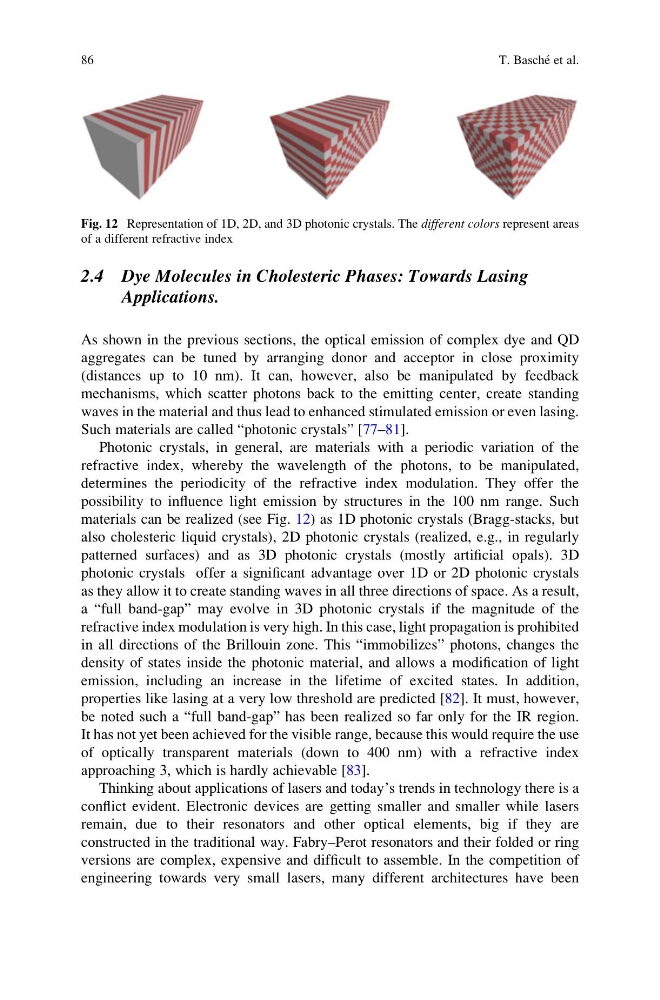
materials can be realized (see Fig. 12) as 1D photonic crystals (Bragg-stacks, but
also cholesteric liquid crystals), 2D photonic crystals (realized, e.g., in regularly
patterned surfaces) and as 3D photonic crystals (mostly artificial opals). 3D
photonic crystals offer a significant advantage over 1D or 2D photonic crystals
as they allow it to create standing waves in all three directions of space. As a result,
a “full band-gap” may evolve in 3D photonic crystals if the magnitude of the
refractive index modulation is very high. In this case, light propagation is prohibited
in all directions of the Brillouin zone. This “immobilizes” photons, changes the
density of states inside the photonic material, and allows a modification of light
emission, including an increase in the lifetime of excited states. In addition,
properties like lasing at a very low threshold are predicted [82]. It must, however,
be noted such a “full band-gap” has been realized so far only for the IR region.
It has not yet been achieved for the visible range, because this would require the use
of optically transparent materials (down to 400 nm) with a refractive index
approaching 3, which is hardly achievable [83].
Thinking about applications of lasers and today’s trends in technology there is a
conflict evident. Electronic devices are getting smaller and smaller while lasers
remain, due to their resonators and other optical elements, big if they are
constructed in the traditional way. Fabry–Perot resonators and their folded or ring
versions are complex, expensive and difficult to assemble. In the competition of
engineering towards very small lasers, many different architectures have been
Fig. 12 Representation of 1D, 2D, and 3D photonic crystals. The different colors represent areas
of a different refractive index
86
T. Basche ´ et al.
Applications.
As shown in the previous sections, the optical emission of complex dye and QD
aggregates can be tuned by arranging donor and acceptor in close proximity
(distances up to 10 nm). It can, however, also be manipulated by feedback
mechanisms, which scatter photons back to the emitting center, create standing
waves in the material and thus lead to enhanced stimulated emission or even lasing.
Such materials are called “photonic crystals” [77–81].
Photonic crystals, in general, are materials with a periodic variation of the
refractive index, whereby the wavelength of the photons, to be manipulated,
determines the periodicity of the refractive index modulation. They offer the
possibility to influence light emission by structures in the 100 nm range. Such
materials can be realized (see Fig. 12) as 1D photonic crystals (Bragg-stacks, but
also cholesteric liquid crystals), 2D photonic crystals (realized, e.g., in regularly
patterned surfaces) and as 3D photonic crystals (mostly artificial opals). 3D
photonic crystals offer a significant advantage over 1D or 2D photonic crystals
as they allow it to create standing waves in all three directions of space. As a result,
a “full band-gap” may evolve in 3D photonic crystals if the magnitude of the
refractive index modulation is very high. In this case, light propagation is prohibited
in all directions of the Brillouin zone. This “immobilizes” photons, changes the
density of states inside the photonic material, and allows a modification of light
emission, including an increase in the lifetime of excited states. In addition,
properties like lasing at a very low threshold are predicted [82]. It must, however,
be noted such a “full band-gap” has been realized so far only for the IR region.
It has not yet been achieved for the visible range, because this would require the use
of optically transparent materials (down to 400 nm) with a refractive index
approaching 3, which is hardly achievable [83].
Thinking about applications of lasers and today’s trends in technology there is a
conflict evident. Electronic devices are getting smaller and smaller while lasers
remain, due to their resonators and other optical elements, big if they are
constructed in the traditional way. Fabry–Perot resonators and their folded or ring
versions are complex, expensive and difficult to assemble. In the competition of
engineering towards very small lasers, many different architectures have been
Fig. 12 Representation of 1D, 2D, and 3D photonic crystals. The different colors represent areas
of a different refractive index
86
T. Basche ´ et al.