

and trimerized without loss of function. With a labeling efficiency of almost 100%,
the energy transfer efficiency was only 24% (data not shown), possibly also due to
efficient back transfer of the excitation energy. In contrast to TMIMA, TDI-mal
does not contain an anhydride or other functional group that helps to attach the dye
to semiconductor materials such as TiO 2 in photovoltaic applications. Therefore, a
glutamic acid-functionalized rylene dye (TDI-GS, 49) with an absorption
maximum at around 673 nm was synthesized (Fig. 4). In comparison to the
TDI-mal (ε 666nm ¼ 16,630 M
À1 cm
À1 in THF), the extinction coefficient of
TDI-GS is much higher (ε 666nm ¼ 77,000 M
À1 cm
À1 in THF) and according to
Fo ¨rster theory the expected energy transfer in hybrid complexes with LHCII and
TDI-GS should be higher than in hybrid complexes of LHCII and TDI-mal. On the
other hand, the TDI-GS cannot be covalently attached to the LHCII. To test the
energy transfer between LHCII and TDI-mal at least qualitatively, measurements
were made with the protein complex and the dye colocalized in detergent micelles.
The dye was solubilized under sonication in an aqueous solution of 10% (w/v) of
lauryl maltoside (LM) and then added to LHCII at a ratio of 5 dye molecules per
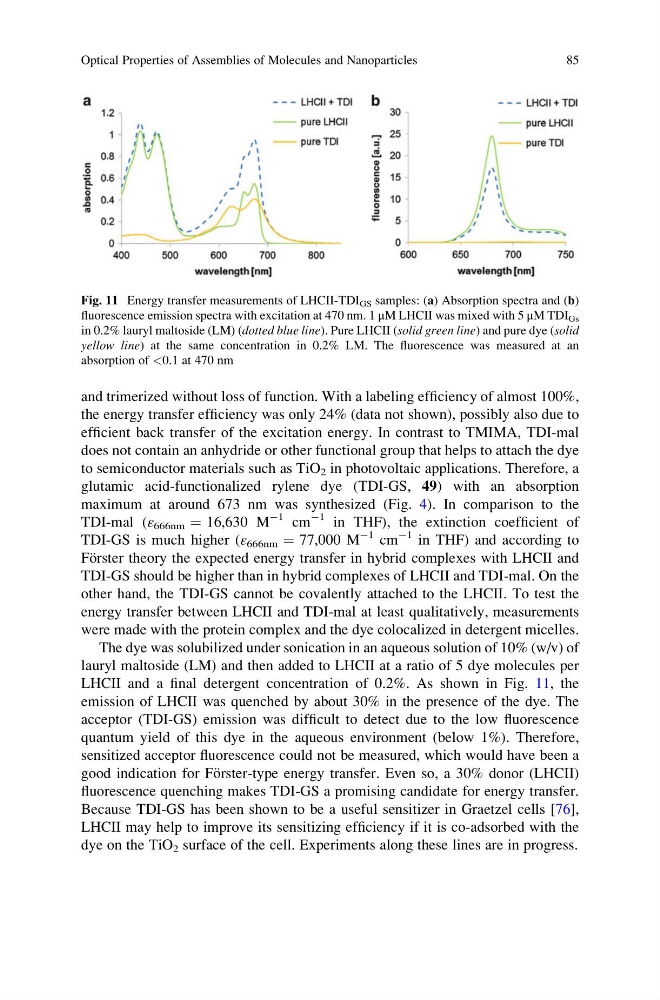
LHCII and a final detergent concentration of 0.2%. As shown in Fig. 11, the
emission of LHCII was quenched by about 30% in the presence of the dye. The
acceptor (TDI-GS) emission was difficult to detect due to the low fluorescence
quantum yield of this dye in the aqueous environment (below 1%). Therefore,
sensitized acceptor fluorescence could not be measured, which would have been a
good indication for Fo ¨rster-type energy transfer. Even so, a 30% donor (LHCII)
fluorescence quenching makes TDI-GS a promising candidate for energy transfer.
Because TDI-GS has been shown to be a useful sensitizer in Graetzel cells [76],
LHCII may help to improve its sensitizing efficiency if it is co-adsorbed with the
dye on the TiO 2 surface of the cell. Experiments along these lines are in progress.
Fig. 11 Energy transfer measurements of LHCII-TDI GS samples: (a) Absorption spectra and (b)
fluorescence emission spectra with excitation at 470 nm. 1 μM LHCII was mixed with 5 μM TDI Gs
in 0.2% lauryl maltoside (LM) (dotted blue line). Pure LHCII (solid green line) and pure dye (solid
yellow line) at the same concentration in 0.2% LM. The fluorescence was measured at an
absorption of <0.1 at 470 nm
Optical Properties of Assemblies of Molecules and Nanoparticles
85
the energy transfer efficiency was only 24% (data not shown), possibly also due to
efficient back transfer of the excitation energy. In contrast to TMIMA, TDI-mal
does not contain an anhydride or other functional group that helps to attach the dye
to semiconductor materials such as TiO 2 in photovoltaic applications. Therefore, a
glutamic acid-functionalized rylene dye (TDI-GS, 49) with an absorption
maximum at around 673 nm was synthesized (Fig. 4). In comparison to the
TDI-mal (ε 666nm ¼ 16,630 M
À1 cm
À1 in THF), the extinction coefficient of
TDI-GS is much higher (ε 666nm ¼ 77,000 M
À1 cm
À1 in THF) and according to
Fo ¨rster theory the expected energy transfer in hybrid complexes with LHCII and
TDI-GS should be higher than in hybrid complexes of LHCII and TDI-mal. On the
other hand, the TDI-GS cannot be covalently attached to the LHCII. To test the
energy transfer between LHCII and TDI-mal at least qualitatively, measurements
were made with the protein complex and the dye colocalized in detergent micelles.
The dye was solubilized under sonication in an aqueous solution of 10% (w/v) of
lauryl maltoside (LM) and then added to LHCII at a ratio of 5 dye molecules per
LHCII and a final detergent concentration of 0.2%. As shown in Fig. 11, the
emission of LHCII was quenched by about 30% in the presence of the dye. The
acceptor (TDI-GS) emission was difficult to detect due to the low fluorescence
quantum yield of this dye in the aqueous environment (below 1%). Therefore,
sensitized acceptor fluorescence could not be measured, which would have been a
good indication for Fo ¨rster-type energy transfer. Even so, a 30% donor (LHCII)
fluorescence quenching makes TDI-GS a promising candidate for energy transfer.
Because TDI-GS has been shown to be a useful sensitizer in Graetzel cells [76],
LHCII may help to improve its sensitizing efficiency if it is co-adsorbed with the
dye on the TiO 2 surface of the cell. Experiments along these lines are in progress.
Fig. 11 Energy transfer measurements of LHCII-TDI GS samples: (a) Absorption spectra and (b)
fluorescence emission spectra with excitation at 470 nm. 1 μM LHCII was mixed with 5 μM TDI Gs
in 0.2% lauryl maltoside (LM) (dotted blue line). Pure LHCII (solid green line) and pure dye (solid
yellow line) at the same concentration in 0.2% LM. The fluorescence was measured at an
absorption of <0.1 at 470 nm
Optical Properties of Assemblies of Molecules and Nanoparticles
85