

presumable due to efficient back transfer from BTI to LHCII. Based on this result,
efforts have been made in two directions: (1) to design energy acceptor dyes that
undergo even more efficient energy transfer with LHCII as a donor than BTI, and
(2) find acceptor dyes that are capable of charge separation and thus would make,
together with LHCII, efficient sensitizers in Graetzel-type photovoltaic cells. To
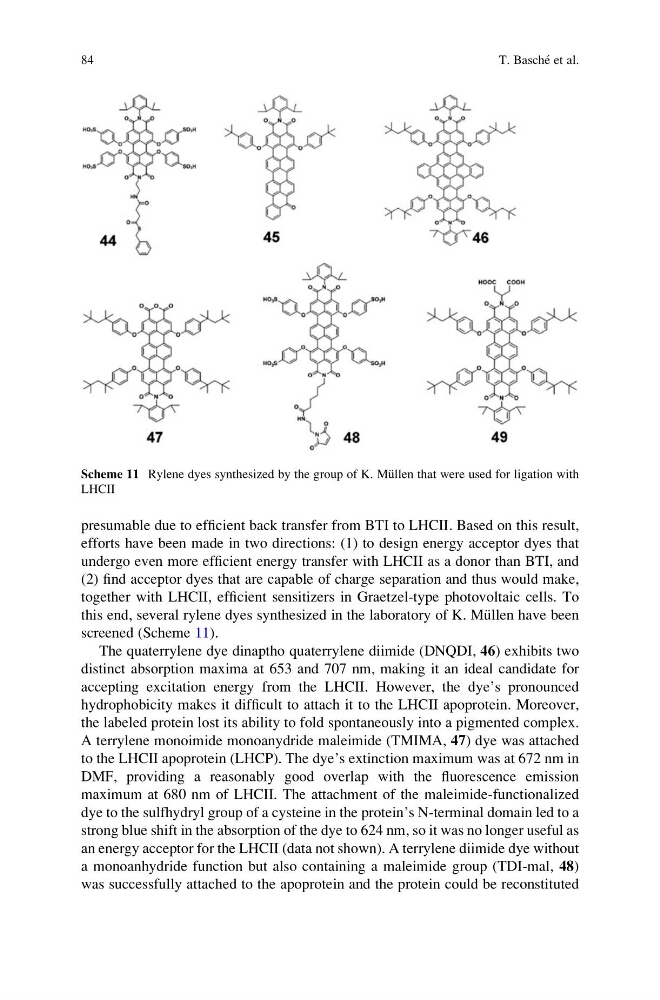
this end, several rylene dyes synthesized in the laboratory of K. Mu ¨llen have been
screened (Scheme 11).
The quaterrylene dye dinaptho quaterrylene diimide (DNQDI, 46) exhibits two
distinct absorption maxima at 653 and 707 nm, making it an ideal candidate for
accepting excitation energy from the LHCII. However, the dye’s pronounced
hydrophobicity makes it difficult to attach it to the LHCII apoprotein. Moreover,
the labeled protein lost its ability to fold spontaneously into a pigmented complex.
A terrylene monoimide monoanydride maleimide (TMIMA, 47) dye was attached
to the LHCII apoprotein (LHCP). The dye’s extinction maximum was at 672 nm in
DMF, providing a reasonably good overlap with the fluorescence emission
maximum at 680 nm of LHCII. The attachment of the maleimide-functionalized
dye to the sulfhydryl group of a cysteine in the protein’s N-terminal domain led to a
strong blue shift in the absorption of the dye to 624 nm, so it was no longer useful as
an energy acceptor for the LHCII (data not shown). A terrylene diimide dye without
a monoanhydride function but also containing a maleimide group (TDI-mal, 48)
was successfully attached to the apoprotein and the protein could be reconstituted
Scheme 11 Rylene dyes synthesized by the group of K. Mu ¨llen that were used for ligation with
LHCII
84
T. Basche ´ et al.
efforts have been made in two directions: (1) to design energy acceptor dyes that
undergo even more efficient energy transfer with LHCII as a donor than BTI, and
(2) find acceptor dyes that are capable of charge separation and thus would make,
together with LHCII, efficient sensitizers in Graetzel-type photovoltaic cells. To
this end, several rylene dyes synthesized in the laboratory of K. Mu ¨llen have been
screened (Scheme 11).
The quaterrylene dye dinaptho quaterrylene diimide (DNQDI, 46) exhibits two
distinct absorption maxima at 653 and 707 nm, making it an ideal candidate for
accepting excitation energy from the LHCII. However, the dye’s pronounced
hydrophobicity makes it difficult to attach it to the LHCII apoprotein. Moreover,
the labeled protein lost its ability to fold spontaneously into a pigmented complex.
A terrylene monoimide monoanydride maleimide (TMIMA, 47) dye was attached
to the LHCII apoprotein (LHCP). The dye’s extinction maximum was at 672 nm in
DMF, providing a reasonably good overlap with the fluorescence emission
maximum at 680 nm of LHCII. The attachment of the maleimide-functionalized
dye to the sulfhydryl group of a cysteine in the protein’s N-terminal domain led to a
strong blue shift in the absorption of the dye to 624 nm, so it was no longer useful as
an energy acceptor for the LHCII (data not shown). A terrylene diimide dye without
a monoanhydride function but also containing a maleimide group (TDI-mal, 48)
was successfully attached to the apoprotein and the protein could be reconstituted
Scheme 11 Rylene dyes synthesized by the group of K. Mu ¨llen that were used for ligation with
LHCII
84
T. Basche ´ et al.