

“full band-gap”, but only for a “perfectly crystallized” opal. In real opals, defects
exist and they cause very strong diffuse scattering, which is detrimental for lasing.
As a result of this problem, two types of lasers have mostly been realized with opals
so far. One type consists of “opaline gels”, in which the voids are filled with a liquid
[90]. This reduces the difference in refractive index and thereby reduces diffuse
scattering from the defects. Alternatively, defect lasing is reported. This relies on
the use of an optimized (dye-containing) isotropic polymer film within the opal,
which creates a defect state within the band-gap [91, 92]. Amplified spontaneous
emission [92] and lasing [93] from this mode has been reported.
2.4.1 Liquid Crystal Lasers
The cholesteric liquid crystalline phase is the chiral modification of the nematic
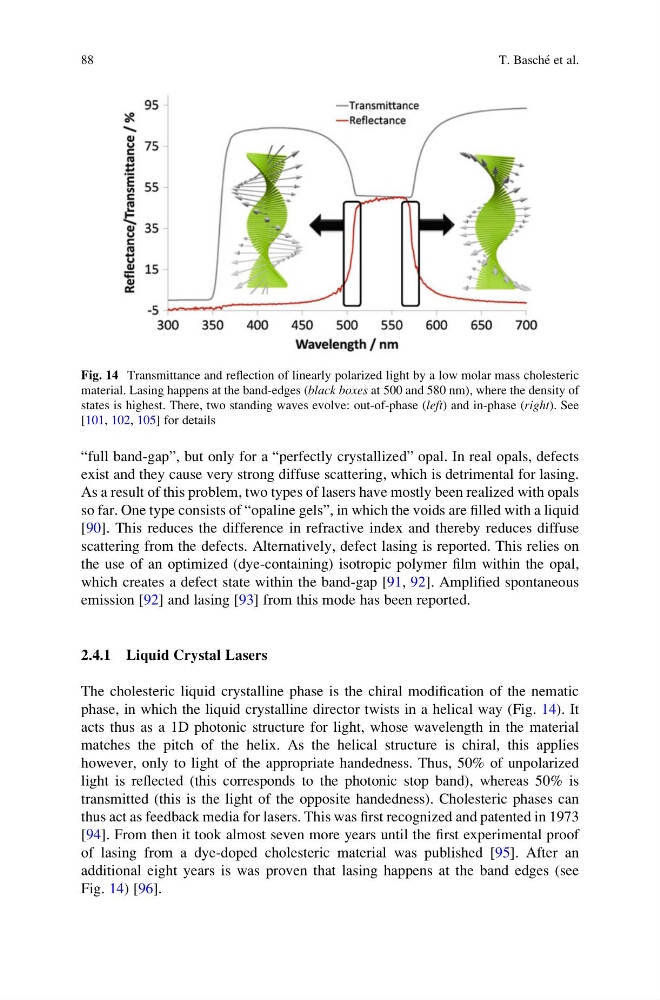
phase, in which the liquid crystalline director twists in a helical way (Fig. 14). It
acts thus as a 1D photonic structure for light, whose wavelength in the material
matches the pitch of the helix. As the helical structure is chiral, this applies
however, only to light of the appropriate handedness. Thus, 50% of unpolarized
light is reflected (this corresponds to the photonic stop band), whereas 50% is
transmitted (this is the light of the opposite handedness). Cholesteric phases can
thus act as feedback media for lasers. This was first recognized and patented in 1973
[94]. From then it took almost seven more years until the first experimental proof
of lasing from a dye-doped cholesteric material was published [95]. After an
additional eight years is was proven that lasing happens at the band edges (see
Fig. 14) [96].
Fig. 14 Transmittance and reflection of linearly polarized light by a low molar mass cholesteric
material. Lasing happens at the band-edges (black boxes at 500 and 580 nm), where the density of
states is highest. There, two standing waves evolve: out-of-phase (left) and in-phase (right). See
[101, 102, 105] for details
88
T. Basche ´ et al.
exist and they cause very strong diffuse scattering, which is detrimental for lasing.
As a result of this problem, two types of lasers have mostly been realized with opals
so far. One type consists of “opaline gels”, in which the voids are filled with a liquid
[90]. This reduces the difference in refractive index and thereby reduces diffuse
scattering from the defects. Alternatively, defect lasing is reported. This relies on
the use of an optimized (dye-containing) isotropic polymer film within the opal,
which creates a defect state within the band-gap [91, 92]. Amplified spontaneous
emission [92] and lasing [93] from this mode has been reported.
2.4.1 Liquid Crystal Lasers
The cholesteric liquid crystalline phase is the chiral modification of the nematic
phase, in which the liquid crystalline director twists in a helical way (Fig. 14). It
acts thus as a 1D photonic structure for light, whose wavelength in the material
matches the pitch of the helix. As the helical structure is chiral, this applies
however, only to light of the appropriate handedness. Thus, 50% of unpolarized
light is reflected (this corresponds to the photonic stop band), whereas 50% is
transmitted (this is the light of the opposite handedness). Cholesteric phases can
thus act as feedback media for lasers. This was first recognized and patented in 1973
[94]. From then it took almost seven more years until the first experimental proof
of lasing from a dye-doped cholesteric material was published [95]. After an
additional eight years is was proven that lasing happens at the band edges (see
Fig. 14) [96].
Fig. 14 Transmittance and reflection of linearly polarized light by a low molar mass cholesteric
material. Lasing happens at the band-edges (black boxes at 500 and 580 nm), where the density of
states is highest. There, two standing waves evolve: out-of-phase (left) and in-phase (right). See
[101, 102, 105] for details
88
T. Basche ´ et al.