

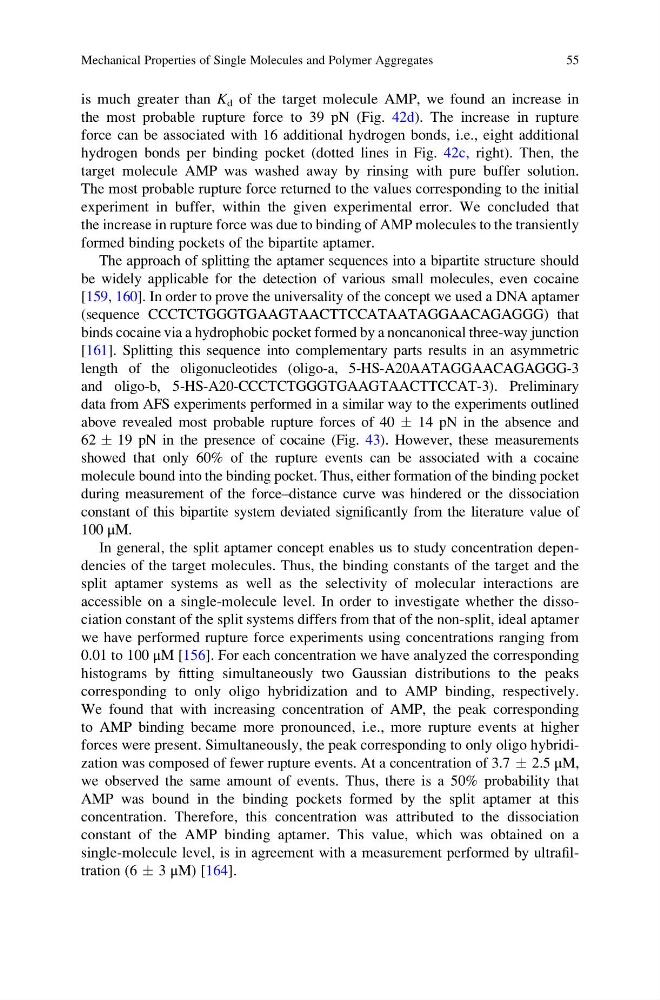
is much greater than K d of the target molecule AMP, we found an increase in
the most probable rupture force to 39 pN (Fig. 42d). The increase in rupture
force can be associated with 16 additional hydrogen bonds, i.e., eight additional
hydrogen bonds per binding pocket (dotted lines in Fig. 42c, right). Then, the
target molecule AMP was washed away by rinsing with pure buffer solution.
The most probable rupture force returned to the values corresponding to the initial
experiment in buffer, within the given experimental error. We concluded that
the increase in rupture force was due to binding of AMP molecules to the transiently
formed binding pockets of the bipartite aptamer.
The approach of splitting the aptamer sequences into a bipartite structure should
be widely applicable for the detection of various small molecules, even cocaine
[159, 160]. In order to prove the universality of the concept we used a DNA aptamer
(sequence CCCTCTGGGTGAAGTAACTTCCATAATAGGAACAGAGGG) that
binds cocaine via a hydrophobic pocket formed by a noncanonical three-way junction
[161]. Splitting this sequence into complementary parts results in an asymmetric
length of the oligonucleotides (oligo-a, 5-HS-A20AATAGGAACAGAGGG-3
and oligo-b, 5-HS-A20-CCCTCTGGGTGAAGTAACTTCCAT-3). Preliminary
data from AFS experiments performed in a similar way to the experiments outlined
above revealed most probable rupture forces of 40 Æ 14 pN in the absence and
62 Æ 19 pN in the presence of cocaine (Fig. 43). However, these measurements
showed that only 60% of the rupture events can be associated with a cocaine
molecule bound into the binding pocket. Thus, either formation of the binding pocket
during measurement of the force–distance curve was hindered or the dissociation
constant of this bipartite system deviated significantly from the literature value of
100 μM.
In general, the split aptamer concept enables us to study concentration dependencies of the target molecules. Thus, the binding constants of the target and the
split aptamer systems as well as the selectivity of molecular interactions are
accessible on a single-molecule level. In order to investigate whether the dissociation constant of the split systems differs from that of the non-split, ideal aptamer
we have performed rupture force experiments using concentrations ranging from
0.01 to 100 μM [156]. For each concentration we have analyzed the corresponding
histograms by fitting simultaneously two Gaussian distributions to the peaks
corresponding to only oligo hybridization and to AMP binding, respectively.
We found that with increasing concentration of AMP, the peak corresponding
to AMP binding became more pronounced, i.e., more rupture events at higher
forces were present. Simultaneously, the peak corresponding to only oligo hybridization was composed of fewer rupture events. At a concentration of 3.7 Æ 2.5 μM,
we observed the same amount of events. Thus, there is a 50% probability that
AMP was bound in the binding pockets formed by the split aptamer at this
concentration. Therefore, this concentration was attributed to the dissociation
constant of the AMP binding aptamer. This value, which was obtained on a
single-molecule level, is in agreement with a measurement performed by ultrafiltration (6 Æ 3 μM) [164].
Mechanical Properties of Single Molecules and Polymer Aggregates
55
the most probable rupture force to 39 pN (Fig. 42d). The increase in rupture
force can be associated with 16 additional hydrogen bonds, i.e., eight additional
hydrogen bonds per binding pocket (dotted lines in Fig. 42c, right). Then, the
target molecule AMP was washed away by rinsing with pure buffer solution.
The most probable rupture force returned to the values corresponding to the initial
experiment in buffer, within the given experimental error. We concluded that
the increase in rupture force was due to binding of AMP molecules to the transiently
formed binding pockets of the bipartite aptamer.
The approach of splitting the aptamer sequences into a bipartite structure should
be widely applicable for the detection of various small molecules, even cocaine
[159, 160]. In order to prove the universality of the concept we used a DNA aptamer
(sequence CCCTCTGGGTGAAGTAACTTCCATAATAGGAACAGAGGG) that
binds cocaine via a hydrophobic pocket formed by a noncanonical three-way junction
[161]. Splitting this sequence into complementary parts results in an asymmetric
length of the oligonucleotides (oligo-a, 5-HS-A20AATAGGAACAGAGGG-3
and oligo-b, 5-HS-A20-CCCTCTGGGTGAAGTAACTTCCAT-3). Preliminary
data from AFS experiments performed in a similar way to the experiments outlined
above revealed most probable rupture forces of 40 Æ 14 pN in the absence and
62 Æ 19 pN in the presence of cocaine (Fig. 43). However, these measurements
showed that only 60% of the rupture events can be associated with a cocaine
molecule bound into the binding pocket. Thus, either formation of the binding pocket
during measurement of the force–distance curve was hindered or the dissociation
constant of this bipartite system deviated significantly from the literature value of
100 μM.
In general, the split aptamer concept enables us to study concentration dependencies of the target molecules. Thus, the binding constants of the target and the
split aptamer systems as well as the selectivity of molecular interactions are
accessible on a single-molecule level. In order to investigate whether the dissociation constant of the split systems differs from that of the non-split, ideal aptamer
we have performed rupture force experiments using concentrations ranging from
0.01 to 100 μM [156]. For each concentration we have analyzed the corresponding
histograms by fitting simultaneously two Gaussian distributions to the peaks
corresponding to only oligo hybridization and to AMP binding, respectively.
We found that with increasing concentration of AMP, the peak corresponding
to AMP binding became more pronounced, i.e., more rupture events at higher
forces were present. Simultaneously, the peak corresponding to only oligo hybridization was composed of fewer rupture events. At a concentration of 3.7 Æ 2.5 μM,
we observed the same amount of events. Thus, there is a 50% probability that
AMP was bound in the binding pockets formed by the split aptamer at this
concentration. Therefore, this concentration was attributed to the dissociation
constant of the AMP binding aptamer. This value, which was obtained on a
single-molecule level, is in agreement with a measurement performed by ultrafiltration (6 Æ 3 μM) [164].
Mechanical Properties of Single Molecules and Polymer Aggregates
55