

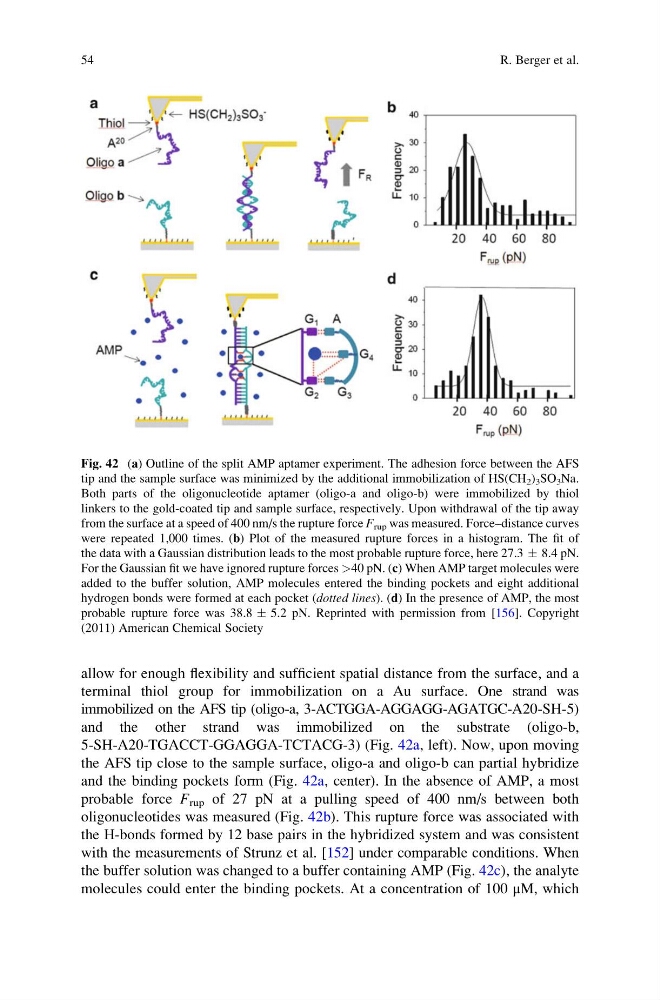
allow for enough flexibility and sufficient spatial distance from the surface, and a
terminal thiol group for immobilization on a Au surface. One strand was
immobilized on the AFS tip (oligo-a, 3-ACTGGA-AGGAGG-AGATGC-A20-SH-5)
and the other strand was immobilized on the substrate (oligo-b,
5-SH-A20-TGACCT-GGAGGA-TCTACG-3) (Fig. 42a, left). Now, upon moving
the AFS tip close to the sample surface, oligo-a and oligo-b can partial hybridize
and the binding pockets form (Fig. 42a, center). In the absence of AMP, a most
probable force F rup of 27 pN at a pulling speed of 400 nm/s between both
oligonucleotides was measured (Fig. 42b). This rupture force was associated with
the H-bonds formed by 12 base pairs in the hybridized system and was consistent
with the measurements of Strunz et al. [152] under comparable conditions. When
the buffer solution was changed to a buffer containing AMP (Fig. 42c), the analyte
molecules could enter the binding pockets. At a concentration of 100 μM, which
Fig. 42 (a) Outline of the split AMP aptamer experiment. The adhesion force between the AFS
tip and the sample surface was minimized by the additional immobilization of HS(CH 2 ) 3 SO 3 Na.
Both parts of the oligonucleotide aptamer (oligo-a and oligo-b) were immobilized by thiol
linkers to the gold-coated tip and sample surface, respectively. Upon withdrawal of the tip away
from the surface at a speed of 400 nm/s the rupture force F rup was measured. Force–distance curves
were repeated 1,000 times. (b) Plot of the measured rupture forces in a histogram. The fit of
the data with a Gaussian distribution leads to the most probable rupture force, here 27.3 Æ 8.4 pN.
For the Gaussian fit we have ignored rupture forces >40 pN. (c) When AMP target molecules were
added to the buffer solution, AMP molecules entered the binding pockets and eight additional
hydrogen bonds were formed at each pocket (dotted lines). (d) In the presence of AMP, the most
probable rupture force was 38.8 Æ 5.2 pN. Reprinted with permission from [156]. Copyright
(2011) American Chemical Society
54
R. Berger et al.
terminal thiol group for immobilization on a Au surface. One strand was
immobilized on the AFS tip (oligo-a, 3-ACTGGA-AGGAGG-AGATGC-A20-SH-5)
and the other strand was immobilized on the substrate (oligo-b,
5-SH-A20-TGACCT-GGAGGA-TCTACG-3) (Fig. 42a, left). Now, upon moving
the AFS tip close to the sample surface, oligo-a and oligo-b can partial hybridize
and the binding pockets form (Fig. 42a, center). In the absence of AMP, a most
probable force F rup of 27 pN at a pulling speed of 400 nm/s between both
oligonucleotides was measured (Fig. 42b). This rupture force was associated with
the H-bonds formed by 12 base pairs in the hybridized system and was consistent
with the measurements of Strunz et al. [152] under comparable conditions. When
the buffer solution was changed to a buffer containing AMP (Fig. 42c), the analyte
molecules could enter the binding pockets. At a concentration of 100 μM, which
Fig. 42 (a) Outline of the split AMP aptamer experiment. The adhesion force between the AFS
tip and the sample surface was minimized by the additional immobilization of HS(CH 2 ) 3 SO 3 Na.
Both parts of the oligonucleotide aptamer (oligo-a and oligo-b) were immobilized by thiol
linkers to the gold-coated tip and sample surface, respectively. Upon withdrawal of the tip away
from the surface at a speed of 400 nm/s the rupture force F rup was measured. Force–distance curves
were repeated 1,000 times. (b) Plot of the measured rupture forces in a histogram. The fit of
the data with a Gaussian distribution leads to the most probable rupture force, here 27.3 Æ 8.4 pN.
For the Gaussian fit we have ignored rupture forces >40 pN. (c) When AMP target molecules were
added to the buffer solution, AMP molecules entered the binding pockets and eight additional
hydrogen bonds were formed at each pocket (dotted lines). (d) In the presence of AMP, the most
probable rupture force was 38.8 Æ 5.2 pN. Reprinted with permission from [156]. Copyright
(2011) American Chemical Society
54
R. Berger et al.