

In summary, our approach has established a number of highly interesting
new findings for DNA aptamers. In addition to the proof-of-principle demonstration
that binding of single analyte molecules alters the force spectra of split aptamers
to a significant degree, we have developed the split aptamer concept into a generally
applicable tool. Interesting open questions include the expansion to the RNA world
with its huge variety of different and more complex three-dimensional structures.
Investigation of the RNA aptamer, optimized for tetracycline binding [165], would
be the first step into transferring the knowledge we acquired.
References
1. Lavery R, Lebrun A, Allemand J-F, Bensimon D, Croquette V (2002) J Phys Condens Matter
14:R383
2. Strick TR, Dessinges M-N, Charvin G, Dekker NH, Allemand J-F, Bensimon D, Croquette V
(2003) Rep Prog Phys 66:1–45
3. Gallyamov MO (2011) Macromol Rapid Comm 32:1210
4. Binder K, Paul W, Strauch T, Rampf F, Ivanov V, Luettmer-Strathmann J (2008) J Phys
Condens Matter 20:494215
5. Luettmer-Strathmann J, Rampf F, Paul W, Binder K (2008) J Chem Phys 128:064903
6. Rampf F, Paul W, Binder K (2005) Europhys Lett 70:628
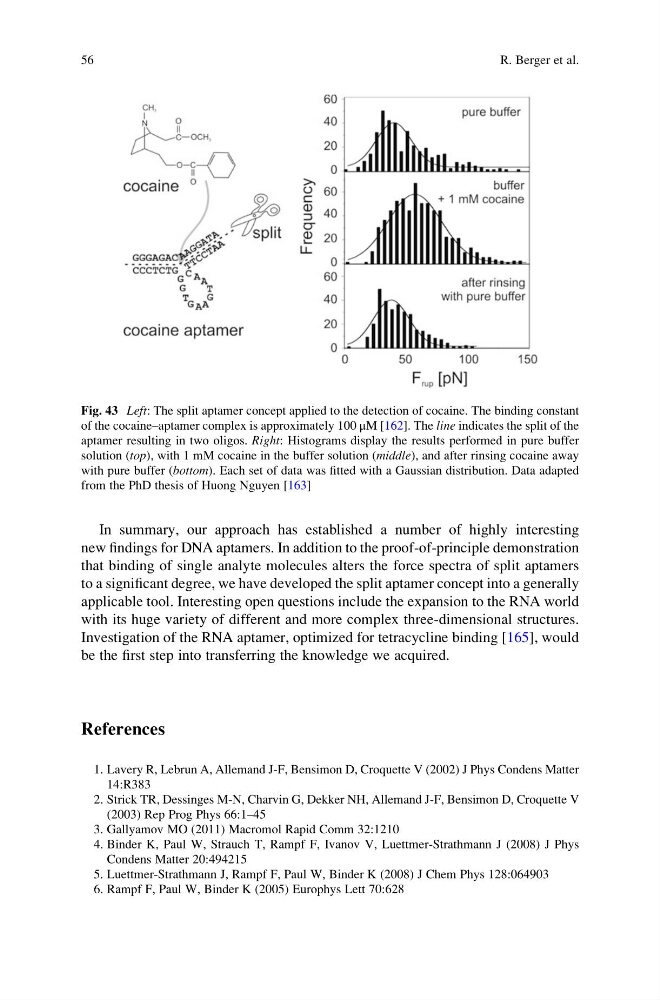
Fig. 43 Left: The split aptamer concept applied to the detection of cocaine. The binding constant
of the cocaine–aptamer complex is approximately 100 μM [162]. The line indicates the split of the
aptamer resulting in two oligos. Right: Histograms display the results performed in pure buffer
solution (top), with 1 mM cocaine in the buffer solution (middle), and after rinsing cocaine away
with pure buffer (bottom). Each set of data was fitted with a Gaussian distribution. Data adapted
from the PhD thesis of Huong Nguyen [163]
56
R. Berger et al.
new findings for DNA aptamers. In addition to the proof-of-principle demonstration
that binding of single analyte molecules alters the force spectra of split aptamers
to a significant degree, we have developed the split aptamer concept into a generally
applicable tool. Interesting open questions include the expansion to the RNA world
with its huge variety of different and more complex three-dimensional structures.
Investigation of the RNA aptamer, optimized for tetracycline binding [165], would
be the first step into transferring the knowledge we acquired.
References
1. Lavery R, Lebrun A, Allemand J-F, Bensimon D, Croquette V (2002) J Phys Condens Matter
14:R383
2. Strick TR, Dessinges M-N, Charvin G, Dekker NH, Allemand J-F, Bensimon D, Croquette V
(2003) Rep Prog Phys 66:1–45
3. Gallyamov MO (2011) Macromol Rapid Comm 32:1210
4. Binder K, Paul W, Strauch T, Rampf F, Ivanov V, Luettmer-Strathmann J (2008) J Phys
Condens Matter 20:494215
5. Luettmer-Strathmann J, Rampf F, Paul W, Binder K (2008) J Chem Phys 128:064903
6. Rampf F, Paul W, Binder K (2005) Europhys Lett 70:628
Fig. 43 Left: The split aptamer concept applied to the detection of cocaine. The binding constant
of the cocaine–aptamer complex is approximately 100 μM [162]. The line indicates the split of the
aptamer resulting in two oligos. Right: Histograms display the results performed in pure buffer
solution (top), with 1 mM cocaine in the buffer solution (middle), and after rinsing cocaine away
with pure buffer (bottom). Each set of data was fitted with a Gaussian distribution. Data adapted
from the PhD thesis of Huong Nguyen [163]
56
R. Berger et al.