

Impact of the Solvent on Rupture Forces
All force–distance experiments were conducted in mesitylene (1,3,5-trimethylbenzene)
solution. Mesitylene is a good solvent for calixarenes and has a high boiling point,
which is desirable for single-molecule experiments. The dimeric calixarene capsules
have a cavity size suitable for the inclusion of solvent molecules such as mesitylene.
Because hydrogen bridges inside the capsules can be influenced by the dielectric
permittivity of the guest molecules, it is important to test whether impurities of the
solvent may affect the experimental result. Toluene is probably the most likely
contamination. Control experiments were conducted with 5 vol% toluene as an
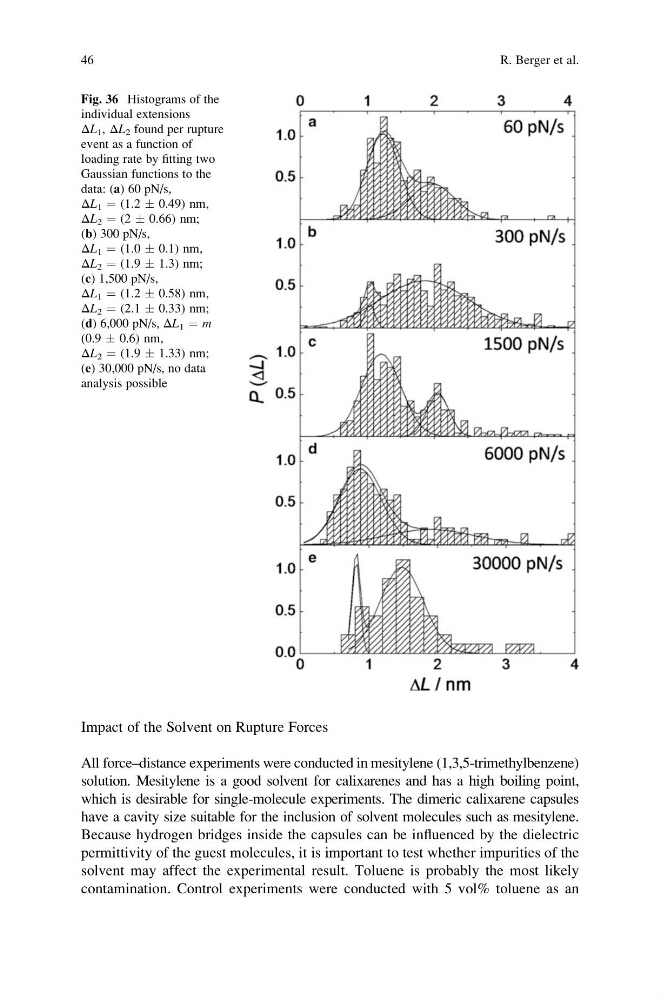
Fig. 36 Histograms of the
individual extensions
ΔL 1 , ΔL 2 found per rupture
event as a function of
loading rate by fitting two
Gaussian functions to the
data: (a) 60 pN/s,
ΔL 1 ¼ (1.2 Æ 0.49) nm,
ΔL 2 ¼ (2 Æ 0.66) nm;
(b) 300 pN/s,
ΔL 1 ¼ (1.0 Æ 0.1) nm,
ΔL 2 ¼ (1.9 Æ 1.3) nm;
(c) 1,500 pN/s,
ΔL 1 ¼ (1.2 Æ 0.58) nm,
ΔL 2 ¼ (2.1 Æ 0.33) nm;
(d) 6,000 pN/s, ΔL 1 ¼ m
(0.9 Æ 0.6) nm,
ΔL 2 ¼ (1.9 Æ 1.33) nm;
(e) 30,000 pN/s, no data
analysis possible
46
R. Berger et al.
All force–distance experiments were conducted in mesitylene (1,3,5-trimethylbenzene)
solution. Mesitylene is a good solvent for calixarenes and has a high boiling point,
which is desirable for single-molecule experiments. The dimeric calixarene capsules
have a cavity size suitable for the inclusion of solvent molecules such as mesitylene.
Because hydrogen bridges inside the capsules can be influenced by the dielectric
permittivity of the guest molecules, it is important to test whether impurities of the
solvent may affect the experimental result. Toluene is probably the most likely
contamination. Control experiments were conducted with 5 vol% toluene as an
Fig. 36 Histograms of the
individual extensions
ΔL 1 , ΔL 2 found per rupture
event as a function of
loading rate by fitting two
Gaussian functions to the
data: (a) 60 pN/s,
ΔL 1 ¼ (1.2 Æ 0.49) nm,
ΔL 2 ¼ (2 Æ 0.66) nm;
(b) 300 pN/s,
ΔL 1 ¼ (1.0 Æ 0.1) nm,
ΔL 2 ¼ (1.9 Æ 1.3) nm;
(c) 1,500 pN/s,
ΔL 1 ¼ (1.2 Æ 0.58) nm,
ΔL 2 ¼ (2.1 Æ 0.33) nm;
(d) 6,000 pN/s, ΔL 1 ¼ m
(0.9 Æ 0.6) nm,
ΔL 2 ¼ (1.9 Æ 1.33) nm;
(e) 30,000 pN/s, no data
analysis possible
46
R. Berger et al.