

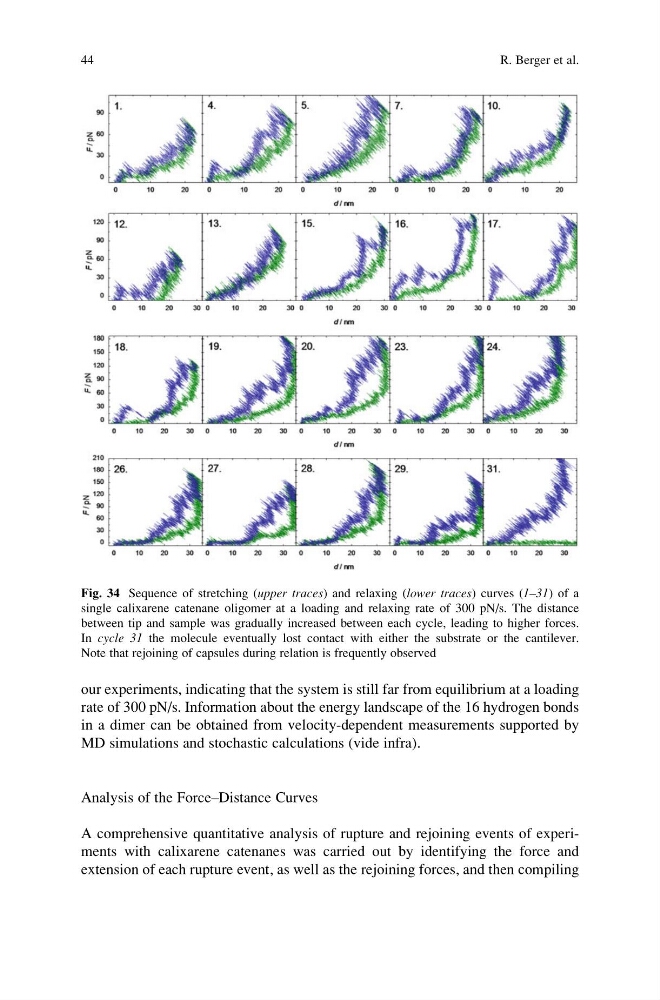
our experiments, indicating that the system is still far from equilibrium at a loading
rate of 300 pN/s. Information about the energy landscape of the 16 hydrogen bonds
in a dimer can be obtained from velocity-dependent measurements supported by
MD simulations and stochastic calculations (vide infra).
Analysis of the Force–Distance Curves
A comprehensive quantitative analysis of rupture and rejoining events of experiments with calixarene catenanes was carried out by identifying the force and
extension of each rupture event, as well as the rejoining forces, and then compiling
Fig. 34 Sequence of stretching (upper traces) and relaxing (lower traces) curves (1–31) of a
single calixarene catenane oligomer at a loading and relaxing rate of 300 pN/s. The distance
between tip and sample was gradually increased between each cycle, leading to higher forces.
In cycle 31 the molecule eventually lost contact with either the substrate or the cantilever.
Note that rejoining of capsules during relation is frequently observed
44
R. Berger et al.
rate of 300 pN/s. Information about the energy landscape of the 16 hydrogen bonds
in a dimer can be obtained from velocity-dependent measurements supported by
MD simulations and stochastic calculations (vide infra).
Analysis of the Force–Distance Curves
A comprehensive quantitative analysis of rupture and rejoining events of experiments with calixarene catenanes was carried out by identifying the force and
extension of each rupture event, as well as the rejoining forces, and then compiling
Fig. 34 Sequence of stretching (upper traces) and relaxing (lower traces) curves (1–31) of a
single calixarene catenane oligomer at a loading and relaxing rate of 300 pN/s. The distance
between tip and sample was gradually increased between each cycle, leading to higher forces.
In cycle 31 the molecule eventually lost contact with either the substrate or the cantilever.
Note that rejoining of capsules during relation is frequently observed
44
R. Berger et al.