

Reversibility of Pulling Experiments
Due to the mechanical lock provided by two entangled loops, the opening of the
nanocapsules can be reversed because the two binding partners are not separated
“infinitely” as in many other experiments involving single-molecule pulling.
In contrast, the mechanical lock keeps the two capsules close together so that
rebinding is a likely scenario. Thus, re-formation of hydrogen bridges is possible
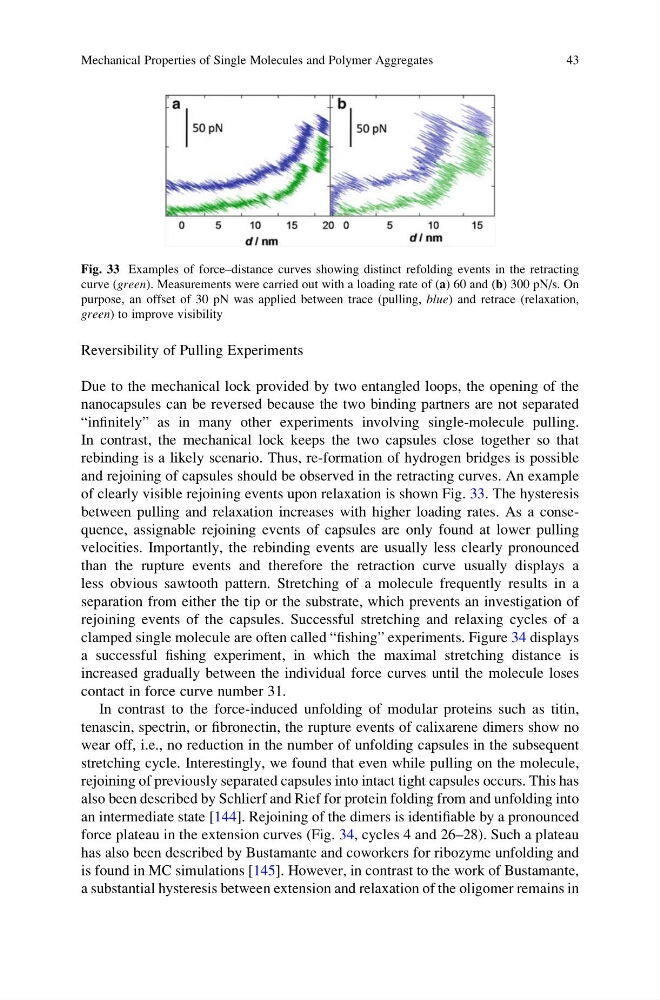
and rejoining of capsules should be observed in the retracting curves. An example
of clearly visible rejoining events upon relaxation is shown Fig. 33. The hysteresis
between pulling and relaxation increases with higher loading rates. As a consequence, assignable rejoining events of capsules are only found at lower pulling
velocities. Importantly, the rebinding events are usually less clearly pronounced
than the rupture events and therefore the retraction curve usually displays a
less obvious sawtooth pattern. Stretching of a molecule frequently results in a
separation from either the tip or the substrate, which prevents an investigation of
rejoining events of the capsules. Successful stretching and relaxing cycles of a
clamped single molecule are often called “fishing” experiments. Figure 34 displays
a successful fishing experiment, in which the maximal stretching distance is
increased gradually between the individual force curves until the molecule loses
contact in force curve number 31.
In contrast to the force-induced unfolding of modular proteins such as titin,
tenascin, spectrin, or fibronectin, the rupture events of calixarene dimers show no
wear off, i.e., no reduction in the number of unfolding capsules in the subsequent
stretching cycle. Interestingly, we found that even while pulling on the molecule,
rejoining of previously separated capsules into intact tight capsules occurs. This has
also been described by Schlierf and Rief for protein folding from and unfolding into
an intermediate state [144]. Rejoining of the dimers is identifiable by a pronounced
force plateau in the extension curves (Fig. 34, cycles 4 and 26–28). Such a plateau
has also been described by Bustamante and coworkers for ribozyme unfolding and
is found in MC simulations [145]. However, in contrast to the work of Bustamante,
a substantial hysteresis between extension and relaxation of the oligomer remains in
Fig. 33 Examples of force–distance curves showing distinct refolding events in the retracting
curve (green). Measurements were carried out with a loading rate of (a) 60 and (b) 300 pN/s. On
purpose, an offset of 30 pN was applied between trace (pulling, blue) and retrace (relaxation,
green) to improve visibility
Mechanical Properties of Single Molecules and Polymer Aggregates
43
Due to the mechanical lock provided by two entangled loops, the opening of the
nanocapsules can be reversed because the two binding partners are not separated
“infinitely” as in many other experiments involving single-molecule pulling.
In contrast, the mechanical lock keeps the two capsules close together so that
rebinding is a likely scenario. Thus, re-formation of hydrogen bridges is possible
and rejoining of capsules should be observed in the retracting curves. An example
of clearly visible rejoining events upon relaxation is shown Fig. 33. The hysteresis
between pulling and relaxation increases with higher loading rates. As a consequence, assignable rejoining events of capsules are only found at lower pulling
velocities. Importantly, the rebinding events are usually less clearly pronounced
than the rupture events and therefore the retraction curve usually displays a
less obvious sawtooth pattern. Stretching of a molecule frequently results in a
separation from either the tip or the substrate, which prevents an investigation of
rejoining events of the capsules. Successful stretching and relaxing cycles of a
clamped single molecule are often called “fishing” experiments. Figure 34 displays
a successful fishing experiment, in which the maximal stretching distance is
increased gradually between the individual force curves until the molecule loses
contact in force curve number 31.
In contrast to the force-induced unfolding of modular proteins such as titin,
tenascin, spectrin, or fibronectin, the rupture events of calixarene dimers show no
wear off, i.e., no reduction in the number of unfolding capsules in the subsequent
stretching cycle. Interestingly, we found that even while pulling on the molecule,
rejoining of previously separated capsules into intact tight capsules occurs. This has
also been described by Schlierf and Rief for protein folding from and unfolding into
an intermediate state [144]. Rejoining of the dimers is identifiable by a pronounced
force plateau in the extension curves (Fig. 34, cycles 4 and 26–28). Such a plateau
has also been described by Bustamante and coworkers for ribozyme unfolding and
is found in MC simulations [145]. However, in contrast to the work of Bustamante,
a substantial hysteresis between extension and relaxation of the oligomer remains in
Fig. 33 Examples of force–distance curves showing distinct refolding events in the retracting
curve (green). Measurements were carried out with a loading rate of (a) 60 and (b) 300 pN/s. On
purpose, an offset of 30 pN was applied between trace (pulling, blue) and retrace (relaxation,
green) to improve visibility
Mechanical Properties of Single Molecules and Polymer Aggregates
43