

mirror independent breaking of individual capsules, similar to observations in
the case of fibronectin. During a pulling experiment, the tension inside a longchain molecule is identical throughout the entire contour length. An abrupt
extension of the chain caused, e.g., by a sudden opening of one of its nanocapsules,
leads to a rapid drop in tension. This release in tension is detected by the cantilever,
which shows a sudden drop in deflection. The probability of capsule opening
depends on the number n of available closed capsules prior to pulling and therefore
decreases after elongation of each capsule. As a consequence, the subsequent
rupture event occurs at larger force, as observed for unfolding of fibronectin or
titin [123, 127]. The force of each subsequent rupture event rises with a factor of
f β /n, where f β is the thermal activation parameter and n represents the number
of previous ruptured bonds [132].
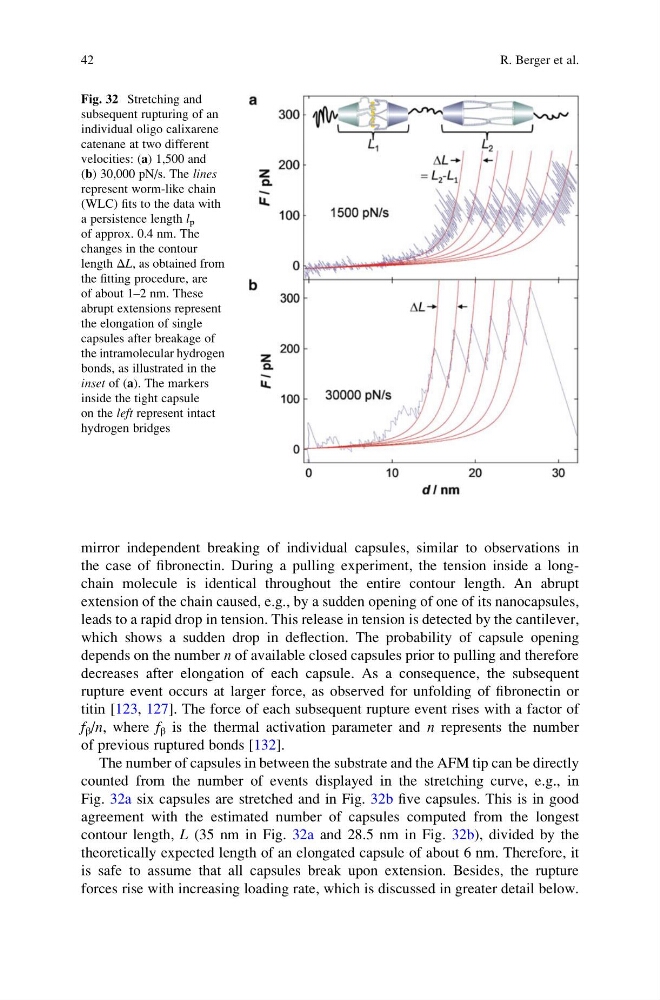
The number of capsules in between the substrate and the AFM tip can be directly
counted from the number of events displayed in the stretching curve, e.g., in
Fig. 32a six capsules are stretched and in Fig. 32b five capsules. This is in good
agreement with the estimated number of capsules computed from the longest
contour length, L (35 nm in Fig. 32a and 28.5 nm in Fig. 32b), divided by the
theoretically expected length of an elongated capsule of about 6 nm. Therefore, it
is safe to assume that all capsules break upon extension. Besides, the rupture
forces rise with increasing loading rate, which is discussed in greater detail below.
Fig. 32 Stretching and
subsequent rupturing of an
individual oligo calixarene
catenane at two different
velocities: (a) 1,500 and
(b) 30,000 pN/s. The lines
represent worm-like chain
(WLC) fits to the data with
a persistence length l p
of approx. 0.4 nm. The
changes in the contour
length ΔL, as obtained from
the fitting procedure, are
of about 1–2 nm. These
abrupt extensions represent
the elongation of single
capsules after breakage of
the intramolecular hydrogen
bonds, as illustrated in the
inset of (a). The markers
inside the tight capsule
on the left represent intact
hydrogen bridges
42
R. Berger et al.
the case of fibronectin. During a pulling experiment, the tension inside a longchain molecule is identical throughout the entire contour length. An abrupt
extension of the chain caused, e.g., by a sudden opening of one of its nanocapsules,
leads to a rapid drop in tension. This release in tension is detected by the cantilever,
which shows a sudden drop in deflection. The probability of capsule opening
depends on the number n of available closed capsules prior to pulling and therefore
decreases after elongation of each capsule. As a consequence, the subsequent
rupture event occurs at larger force, as observed for unfolding of fibronectin or
titin [123, 127]. The force of each subsequent rupture event rises with a factor of
f β /n, where f β is the thermal activation parameter and n represents the number
of previous ruptured bonds [132].
The number of capsules in between the substrate and the AFM tip can be directly
counted from the number of events displayed in the stretching curve, e.g., in
Fig. 32a six capsules are stretched and in Fig. 32b five capsules. This is in good
agreement with the estimated number of capsules computed from the longest
contour length, L (35 nm in Fig. 32a and 28.5 nm in Fig. 32b), divided by the
theoretically expected length of an elongated capsule of about 6 nm. Therefore, it
is safe to assume that all capsules break upon extension. Besides, the rupture
forces rise with increasing loading rate, which is discussed in greater detail below.
Fig. 32 Stretching and
subsequent rupturing of an
individual oligo calixarene
catenane at two different
velocities: (a) 1,500 and
(b) 30,000 pN/s. The lines
represent worm-like chain
(WLC) fits to the data with
a persistence length l p
of approx. 0.4 nm. The
changes in the contour
length ΔL, as obtained from
the fitting procedure, are
of about 1–2 nm. These
abrupt extensions represent
the elongation of single
capsules after breakage of
the intramolecular hydrogen
bonds, as illustrated in the
inset of (a). The markers
inside the tight capsule
on the left represent intact
hydrogen bridges
42
R. Berger et al.