

groups, forming amide bonds located at the terminus of each spacer, resulting
in long-chain molecules with four to six connected capsules on average. The
relevant force scale in these experiments usually ranges between 10 and 150 pN.
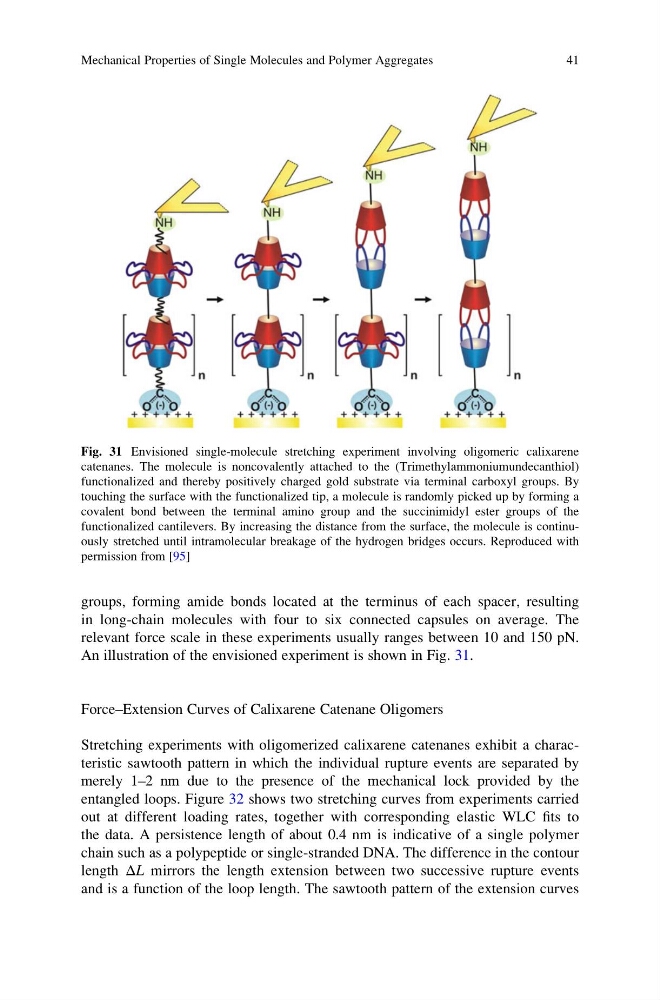
An illustration of the envisioned experiment is shown in Fig. 31.
Force–Extension Curves of Calixarene Catenane Oligomers
Stretching experiments with oligomerized calixarene catenanes exhibit a characteristic sawtooth pattern in which the individual rupture events are separated by
merely 1–2 nm due to the presence of the mechanical lock provided by the
entangled loops. Figure 32 shows two stretching curves from experiments carried
out at different loading rates, together with corresponding elastic WLC fits to
the data. A persistence length of about 0.4 nm is indicative of a single polymer
chain such as a polypeptide or single-stranded DNA. The difference in the contour
length ΔL mirrors the length extension between two successive rupture events
and is a function of the loop length. The sawtooth pattern of the extension curves
Fig. 31 Envisioned single-molecule stretching experiment involving oligomeric calixarene
catenanes. The molecule is noncovalently attached to the (Trimethylammoniumundecanthiol)
functionalized and thereby positively charged gold substrate via terminal carboxyl groups. By
touching the surface with the functionalized tip, a molecule is randomly picked up by forming a
covalent bond between the terminal amino group and the succinimidyl ester groups of the
functionalized cantilevers. By increasing the distance from the surface, the molecule is continuously stretched until intramolecular breakage of the hydrogen bridges occurs. Reproduced with
permission from [95]
Mechanical Properties of Single Molecules and Polymer Aggregates
41
in long-chain molecules with four to six connected capsules on average. The
relevant force scale in these experiments usually ranges between 10 and 150 pN.
An illustration of the envisioned experiment is shown in Fig. 31.
Force–Extension Curves of Calixarene Catenane Oligomers
Stretching experiments with oligomerized calixarene catenanes exhibit a characteristic sawtooth pattern in which the individual rupture events are separated by
merely 1–2 nm due to the presence of the mechanical lock provided by the
entangled loops. Figure 32 shows two stretching curves from experiments carried
out at different loading rates, together with corresponding elastic WLC fits to
the data. A persistence length of about 0.4 nm is indicative of a single polymer
chain such as a polypeptide or single-stranded DNA. The difference in the contour
length ΔL mirrors the length extension between two successive rupture events
and is a function of the loop length. The sawtooth pattern of the extension curves
Fig. 31 Envisioned single-molecule stretching experiment involving oligomeric calixarene
catenanes. The molecule is noncovalently attached to the (Trimethylammoniumundecanthiol)
functionalized and thereby positively charged gold substrate via terminal carboxyl groups. By
touching the surface with the functionalized tip, a molecule is randomly picked up by forming a
covalent bond between the terminal amino group and the succinimidyl ester groups of the
functionalized cantilevers. By increasing the distance from the surface, the molecule is continuously stretched until intramolecular breakage of the hydrogen bridges occurs. Reproduced with
permission from [95]
Mechanical Properties of Single Molecules and Polymer Aggregates
41