

the rebinding probability especially at low loading rates. Re-formation of dimeric
capsules is observed even during separation. Oligomerization of the dimeric calix[4]
arene catenanes provides an intrinsic control that single molecules have indeed been
extended and that the observed rupture events correspond to individual breakage of
the calixarene capsules. Essentially, we found that calixarene dimers separate under
an external force ramp independently, but stochastically generate a characteristic
sawtooth pattern. The rupture forces are velocity dependent and re-formation of
hydrogen bonds is observable at low loading and relaxation rates. MD simulations
in conjunction with stochastic modeling suggests that an intermediate structure arises
due to steric reasons (vide infra).
3.2.1 Force Spectroscopy of Single bis-Loop Tetra-Urea Calix[4]arene
Catenanes
Modular long-chain molecules can be stretched with different loading rates to
study the unfolding and refolding of intramolecular hydrogen bonds in entangled
bis-loop tetra-urea calix[4]arene catenanes.
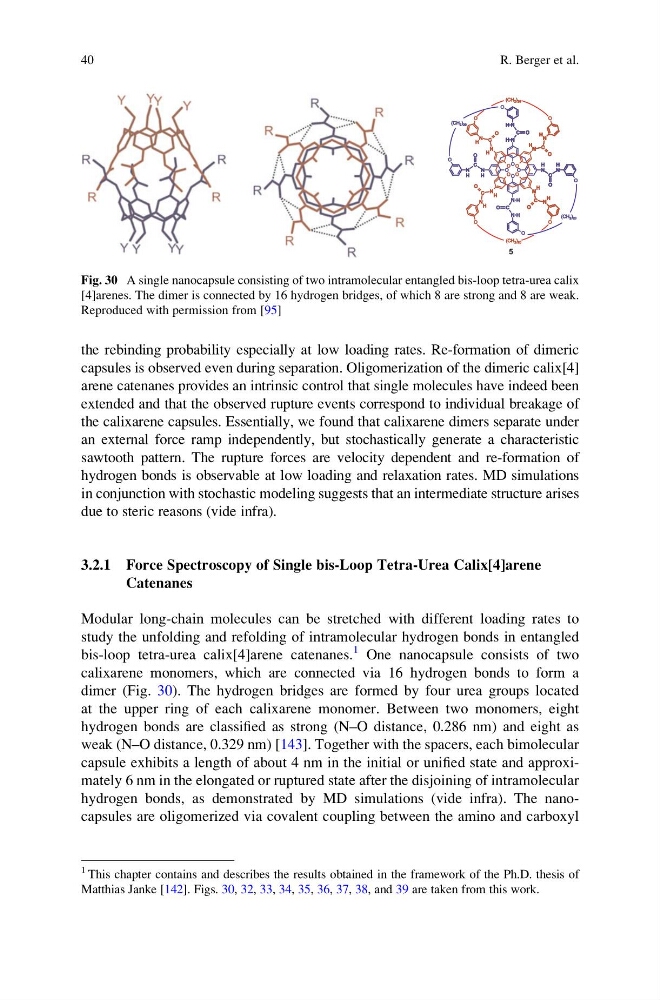
1 One nanocapsule consists of two
calixarene monomers, which are connected via 16 hydrogen bonds to form a
dimer (Fig. 30). The hydrogen bridges are formed by four urea groups located
at the upper ring of each calixarene monomer. Between two monomers, eight
hydrogen bonds are classified as strong (N–O distance, 0.286 nm) and eight as
weak (N–O distance, 0.329 nm) [143]. Together with the spacers, each bimolecular
capsule exhibits a length of about 4 nm in the initial or unified state and approximately 6 nm in the elongated or ruptured state after the disjoining of intramolecular
hydrogen bonds, as demonstrated by MD simulations (vide infra). The nanocapsules are oligomerized via covalent coupling between the amino and carboxyl
O
O
O
O
N
C
O
N
H
H
N
C
O
N
H
H
N
C
O
N
H
H
N
C
O
N
H
H
N
C
O
N
H
H
N
C
O
N
H
H
N
C O
N
H
H N
C O
N
H
H
N
C
O
N H
H
N
C O
N
H
H N
C O
N
H
H
N
C
O
N H
H
O
O
O
O
(CH2)20
(CH2)20
O
O O
O
N
C
O
N H
H
N
C
O
N H
H
N
C
O
N
H
H
N
C
O
N H
H
N
C
O
N H
H
N
C
O
N
H
H
N C
O
N
H
H
N C
O
N
H
H
N
C
O
N
H
H
N C
O
N
H
H
N C
O
N
H
H
N
C
O
N
H
H
O
O
O
O
(CH2)20
(CH2)20
5
Fig. 30 A single nanocapsule consisting of two intramolecular entangled bis-loop tetra-urea calix
[4]arenes. The dimer is connected by 16 hydrogen bridges, of which 8 are strong and 8 are weak.
Reproduced with permission from [95]
1 This chapter contains and describes the results obtained in the framework of the Ph.D. thesis of
Matthias Janke [142]. Figs. 30, 32, 33, 34, 35, 36, 37, 38, and 39 are taken from this work.
40
R. Berger et al.
capsules is observed even during separation. Oligomerization of the dimeric calix[4]
arene catenanes provides an intrinsic control that single molecules have indeed been
extended and that the observed rupture events correspond to individual breakage of
the calixarene capsules. Essentially, we found that calixarene dimers separate under
an external force ramp independently, but stochastically generate a characteristic
sawtooth pattern. The rupture forces are velocity dependent and re-formation of
hydrogen bonds is observable at low loading and relaxation rates. MD simulations
in conjunction with stochastic modeling suggests that an intermediate structure arises
due to steric reasons (vide infra).
3.2.1 Force Spectroscopy of Single bis-Loop Tetra-Urea Calix[4]arene
Catenanes
Modular long-chain molecules can be stretched with different loading rates to
study the unfolding and refolding of intramolecular hydrogen bonds in entangled
bis-loop tetra-urea calix[4]arene catenanes.
1 One nanocapsule consists of two
calixarene monomers, which are connected via 16 hydrogen bonds to form a
dimer (Fig. 30). The hydrogen bridges are formed by four urea groups located
at the upper ring of each calixarene monomer. Between two monomers, eight
hydrogen bonds are classified as strong (N–O distance, 0.286 nm) and eight as
weak (N–O distance, 0.329 nm) [143]. Together with the spacers, each bimolecular
capsule exhibits a length of about 4 nm in the initial or unified state and approximately 6 nm in the elongated or ruptured state after the disjoining of intramolecular
hydrogen bonds, as demonstrated by MD simulations (vide infra). The nanocapsules are oligomerized via covalent coupling between the amino and carboxyl
O
O
O
O
N
C
O
N
H
H
N
C
O
N
H
H
N
C
O
N
H
H
N
C
O
N
H
H
N
C
O
N
H
H
N
C
O
N
H
H
N
C O
N
H
H N
C O
N
H
H
N
C
O
N H
H
N
C O
N
H
H N
C O
N
H
H
N
C
O
N H
H
O
O
O
O
(CH2)20
(CH2)20
O
O O
O
N
C
O
N H
H
N
C
O
N H
H
N
C
O
N
H
H
N
C
O
N H
H
N
C
O
N H
H
N
C
O
N
H
H
N C
O
N
H
H
N C
O
N
H
H
N
C
O
N
H
H
N C
O
N
H
H
N C
O
N
H
H
N
C
O
N
H
H
O
O
O
O
(CH2)20
(CH2)20
5
Fig. 30 A single nanocapsule consisting of two intramolecular entangled bis-loop tetra-urea calix
[4]arenes. The dimer is connected by 16 hydrogen bridges, of which 8 are strong and 8 are weak.
Reproduced with permission from [95]
1 This chapter contains and describes the results obtained in the framework of the Ph.D. thesis of
Matthias Janke [142]. Figs. 30, 32, 33, 34, 35, 36, 37, 38, and 39 are taken from this work.
40
R. Berger et al.