

find a distribution showing three maxima. Fitting of three Gaussian curves to the
histogram data (Fig. 27b) results in domain lengthening corresponding well to
the expected changes in contour length for FN-I, FN-II, and FN-III domains.
Influence of Ectoine on the Unfolding Force of FN-III
The major question was whether bacterial osmolytes increase the stability of proteins
and nucleic acids by preferential exclusion of ectoine from the interface. First, we
investigated the influence of the presence of ectoine and sarcosine on the unfolding
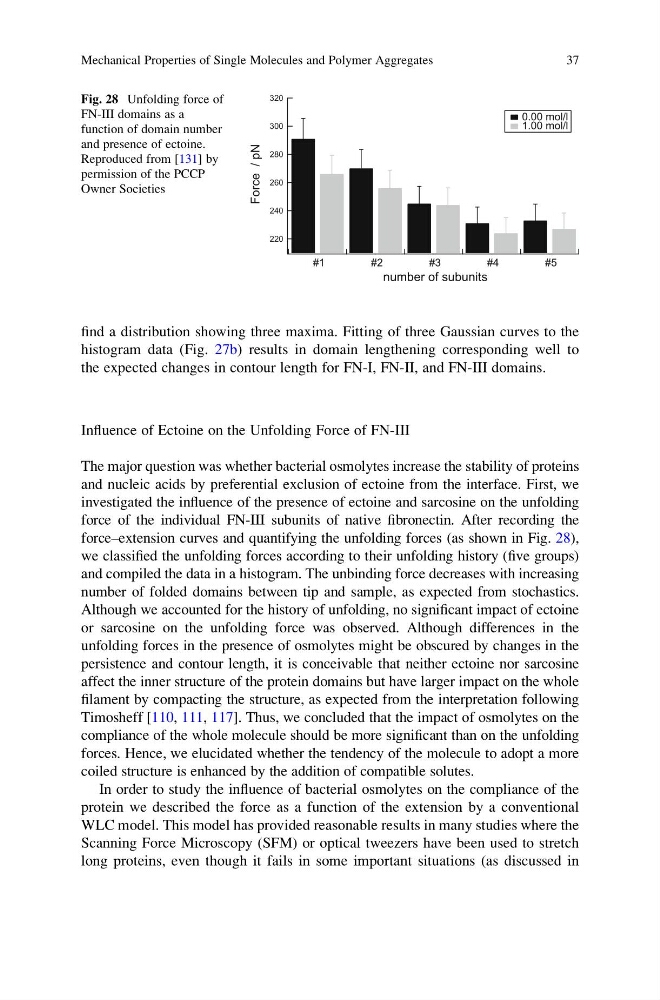
force of the individual FN-III subunits of native fibronectin. After recording the
force–extension curves and quantifying the unfolding forces (as shown in Fig. 28),
we classified the unfolding forces according to their unfolding history (five groups)
and compiled the data in a histogram. The unbinding force decreases with increasing
number of folded domains between tip and sample, as expected from stochastics.
Although we accounted for the history of unfolding, no significant impact of ectoine
or sarcosine on the unfolding force was observed. Although differences in the
unfolding forces in the presence of osmolytes might be obscured by changes in the
persistence and contour length, it is conceivable that neither ectoine nor sarcosine
affect the inner structure of the protein domains but have larger impact on the whole
filament by compacting the structure, as expected from the interpretation following
Timosheff [110, 111, 117]. Thus, we concluded that the impact of osmolytes on the
compliance of the whole molecule should be more significant than on the unfolding
forces. Hence, we elucidated whether the tendency of the molecule to adopt a more
coiled structure is enhanced by the addition of compatible solutes.
In order to study the influence of bacterial osmolytes on the compliance of the
protein we described the force as a function of the extension by a conventional
WLC model. This model has provided reasonable results in many studies where the
Scanning Force Microscopy (SFM) or optical tweezers have been used to stretch
long proteins, even though it fails in some important situations (as discussed in
320
300
280
260
240
220
Force / pN
#1
#2
#3
#4
#5
number of subunits
0.00 mol/l
1.00 mol/l
Fig. 28 Unfolding force of
FN-III domains as a
function of domain number
and presence of ectoine.
Reproduced from [131] by
permission of the PCCP
Owner Societies
Mechanical Properties of Single Molecules and Polymer Aggregates
37
histogram data (Fig. 27b) results in domain lengthening corresponding well to
the expected changes in contour length for FN-I, FN-II, and FN-III domains.
Influence of Ectoine on the Unfolding Force of FN-III
The major question was whether bacterial osmolytes increase the stability of proteins
and nucleic acids by preferential exclusion of ectoine from the interface. First, we
investigated the influence of the presence of ectoine and sarcosine on the unfolding
force of the individual FN-III subunits of native fibronectin. After recording the
force–extension curves and quantifying the unfolding forces (as shown in Fig. 28),
we classified the unfolding forces according to their unfolding history (five groups)
and compiled the data in a histogram. The unbinding force decreases with increasing
number of folded domains between tip and sample, as expected from stochastics.
Although we accounted for the history of unfolding, no significant impact of ectoine
or sarcosine on the unfolding force was observed. Although differences in the
unfolding forces in the presence of osmolytes might be obscured by changes in the
persistence and contour length, it is conceivable that neither ectoine nor sarcosine
affect the inner structure of the protein domains but have larger impact on the whole
filament by compacting the structure, as expected from the interpretation following
Timosheff [110, 111, 117]. Thus, we concluded that the impact of osmolytes on the
compliance of the whole molecule should be more significant than on the unfolding
forces. Hence, we elucidated whether the tendency of the molecule to adopt a more
coiled structure is enhanced by the addition of compatible solutes.
In order to study the influence of bacterial osmolytes on the compliance of the
protein we described the force as a function of the extension by a conventional
WLC model. This model has provided reasonable results in many studies where the
Scanning Force Microscopy (SFM) or optical tweezers have been used to stretch
long proteins, even though it fails in some important situations (as discussed in
320
300
280
260
240
220
Force / pN
#1
#2
#3
#4
#5
number of subunits
0.00 mol/l
1.00 mol/l
Fig. 28 Unfolding force of
FN-III domains as a
function of domain number
and presence of ectoine.
Reproduced from [131] by
permission of the PCCP
Owner Societies
Mechanical Properties of Single Molecules and Polymer Aggregates
37