

Sect. 1). Nevertheless, systematic shifts in molecular properties determined with
the help of the WLC model remain correct, although the absolute values might be
erroneous. The force is given by rearranging Eq. (2):
f ¼
k B T
l p
1
4
1 À
x
L
À2 þ
x
L
À
1
4
!
ð8Þ
The parameter of interest in the context of preferential exclusion is the
persistence length l p as a measure for the elasticity of the protein. Note that for
a worm-like polymer l p $ κR
4 , with κ being the bending modulus and R the
radius of the cross-section of the filament. Higher values indicate a tendency to
form more extended rod-like structures. For instance, the persistence length
of double-stranded DNA is about 50 nm, whereas the persistence length of
a single-stranded DNA or polypeptide is only about 0.5–1 nm. WLC fits were
carried out for a large number of fibronectin molecules under different conditions.
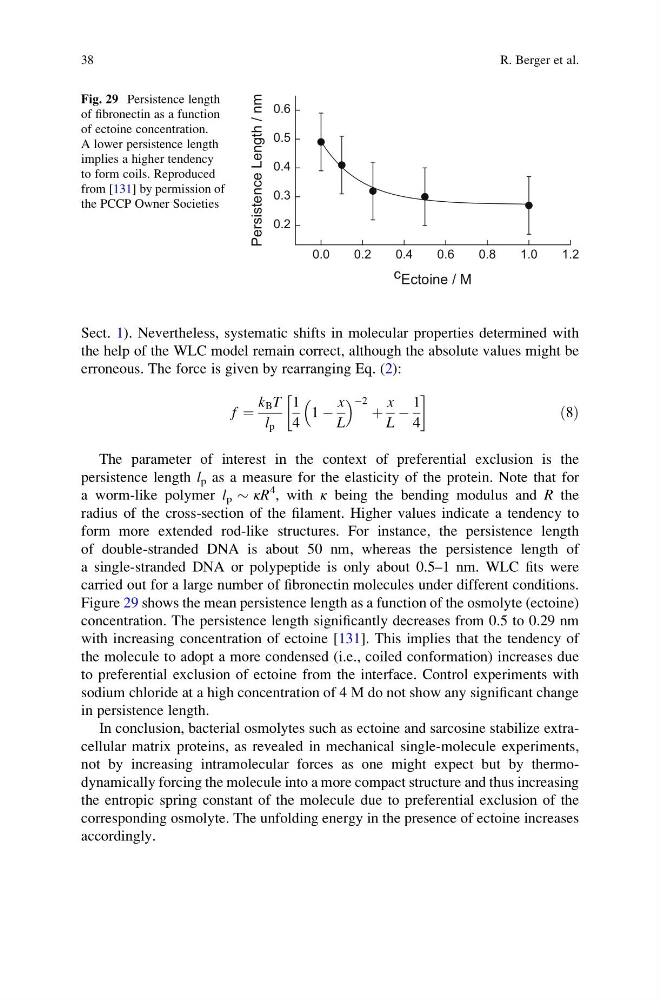
Figure 29 shows the mean persistence length as a function of the osmolyte (ectoine)
concentration. The persistence length significantly decreases from 0.5 to 0.29 nm
with increasing concentration of ectoine [131]. This implies that the tendency of
the molecule to adopt a more condensed (i.e., coiled conformation) increases due
to preferential exclusion of ectoine from the interface. Control experiments with
sodium chloride at a high concentration of 4 M do not show any significant change
in persistence length.
In conclusion, bacterial osmolytes such as ectoine and sarcosine stabilize extracellular matrix proteins, as revealed in mechanical single-molecule experiments,
not by increasing intramolecular forces as one might expect but by thermodynamically forcing the molecule into a more compact structure and thus increasing
the entropic spring constant of the molecule due to preferential exclusion of the
corresponding osmolyte. The unfolding energy in the presence of ectoine increases
accordingly.
0.6
0.5
0.4
0.3
0.2
Persistence Length / nm
1.2
1.0
0.8
0.6
0.4
0.2
0.0
c Ectoine / M
Fig. 29 Persistence length
of fibronectin as a function
of ectoine concentration.
A lower persistence length
implies a higher tendency
to form coils. Reproduced
from [131] by permission of
the PCCP Owner Societies
38
R. Berger et al.
the help of the WLC model remain correct, although the absolute values might be
erroneous. The force is given by rearranging Eq. (2):
f ¼
k B T
l p
1
4
1 À
x
L
À2 þ
x
L
À
1
4
!
ð8Þ
The parameter of interest in the context of preferential exclusion is the
persistence length l p as a measure for the elasticity of the protein. Note that for
a worm-like polymer l p $ κR
4 , with κ being the bending modulus and R the
radius of the cross-section of the filament. Higher values indicate a tendency to
form more extended rod-like structures. For instance, the persistence length
of double-stranded DNA is about 50 nm, whereas the persistence length of
a single-stranded DNA or polypeptide is only about 0.5–1 nm. WLC fits were
carried out for a large number of fibronectin molecules under different conditions.
Figure 29 shows the mean persistence length as a function of the osmolyte (ectoine)
concentration. The persistence length significantly decreases from 0.5 to 0.29 nm
with increasing concentration of ectoine [131]. This implies that the tendency of
the molecule to adopt a more condensed (i.e., coiled conformation) increases due
to preferential exclusion of ectoine from the interface. Control experiments with
sodium chloride at a high concentration of 4 M do not show any significant change
in persistence length.
In conclusion, bacterial osmolytes such as ectoine and sarcosine stabilize extracellular matrix proteins, as revealed in mechanical single-molecule experiments,
not by increasing intramolecular forces as one might expect but by thermodynamically forcing the molecule into a more compact structure and thus increasing
the entropic spring constant of the molecule due to preferential exclusion of the
corresponding osmolyte. The unfolding energy in the presence of ectoine increases
accordingly.
0.6
0.5
0.4
0.3
0.2
Persistence Length / nm
1.2
1.0
0.8
0.6
0.4
0.2
0.0
c Ectoine / M
Fig. 29 Persistence length
of fibronectin as a function
of ectoine concentration.
A lower persistence length
implies a higher tendency
to form coils. Reproduced
from [131] by permission of
the PCCP Owner Societies
38
R. Berger et al.