

Of the three different domains, the FN-I domains possess the least amount of
amino acids and hydrogen bonds and thus exhibit generally lower unfolding forces
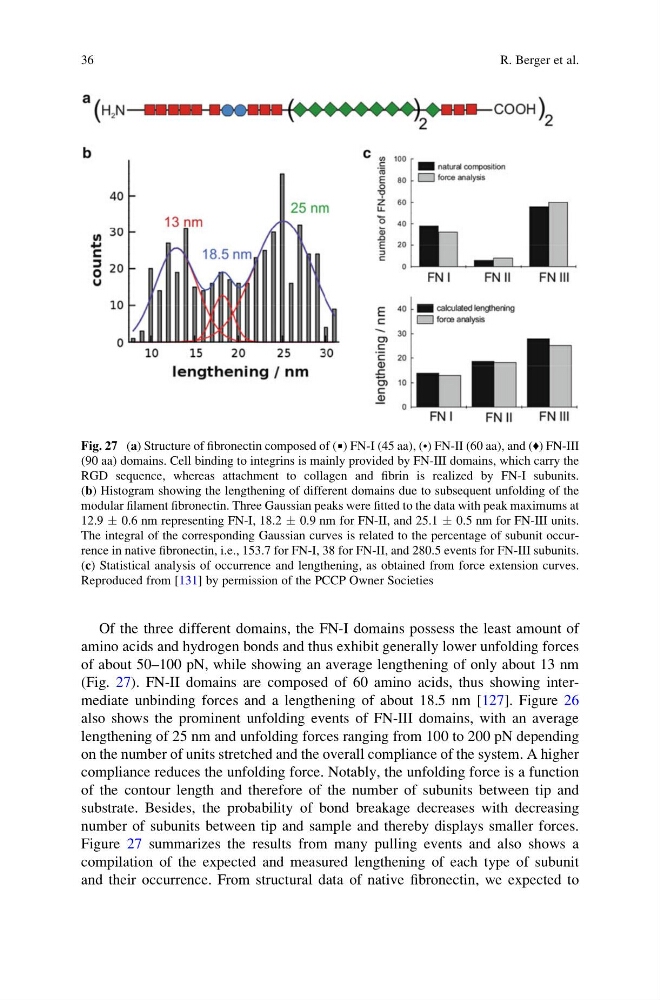
of about 50–100 pN, while showing an average lengthening of only about 13 nm
(Fig. 27). FN-II domains are composed of 60 amino acids, thus showing intermediate unbinding forces and a lengthening of about 18.5 nm [127]. Figure 26
also shows the prominent unfolding events of FN-III domains, with an average
lengthening of 25 nm and unfolding forces ranging from 100 to 200 pN depending
on the number of units stretched and the overall compliance of the system. A higher
compliance reduces the unfolding force. Notably, the unfolding force is a function
of the contour length and therefore of the number of subunits between tip and
substrate. Besides, the probability of bond breakage decreases with decreasing
number of subunits between tip and sample and thereby displays smaller forces.
Figure 27 summarizes the results from many pulling events and also shows a
compilation of the expected and measured lengthening of each type of subunit
and their occurrence. From structural data of native fibronectin, we expected to
Fig. 27 (a) Structure of fibronectin composed of (▪) FN-I (45 aa), (•) FN-II (60 aa), and (♦) FN-III
(90 aa) domains. Cell binding to integrins is mainly provided by FN-III domains, which carry the
RGD sequence, whereas attachment to collagen and fibrin is realized by FN-I subunits.
(b) Histogram showing the lengthening of different domains due to subsequent unfolding of the
modular filament fibronectin. Three Gaussian peaks were fitted to the data with peak maximums at
12.9 Æ 0.6 nm representing FN-I, 18.2 Æ 0.9 nm for FN-II, and 25.1 Æ 0.5 nm for FN-III units.
The integral of the corresponding Gaussian curves is related to the percentage of subunit occurrence in native fibronectin, i.e., 153.7 for FN-I, 38 for FN-II, and 280.5 events for FN-III subunits.
(c) Statistical analysis of occurrence and lengthening, as obtained from force extension curves.
Reproduced from [131] by permission of the PCCP Owner Societies
36
R. Berger et al.
amino acids and hydrogen bonds and thus exhibit generally lower unfolding forces
of about 50–100 pN, while showing an average lengthening of only about 13 nm
(Fig. 27). FN-II domains are composed of 60 amino acids, thus showing intermediate unbinding forces and a lengthening of about 18.5 nm [127]. Figure 26
also shows the prominent unfolding events of FN-III domains, with an average
lengthening of 25 nm and unfolding forces ranging from 100 to 200 pN depending
on the number of units stretched and the overall compliance of the system. A higher
compliance reduces the unfolding force. Notably, the unfolding force is a function
of the contour length and therefore of the number of subunits between tip and
substrate. Besides, the probability of bond breakage decreases with decreasing
number of subunits between tip and sample and thereby displays smaller forces.
Figure 27 summarizes the results from many pulling events and also shows a
compilation of the expected and measured lengthening of each type of subunit
and their occurrence. From structural data of native fibronectin, we expected to
Fig. 27 (a) Structure of fibronectin composed of (▪) FN-I (45 aa), (•) FN-II (60 aa), and (♦) FN-III
(90 aa) domains. Cell binding to integrins is mainly provided by FN-III domains, which carry the
RGD sequence, whereas attachment to collagen and fibrin is realized by FN-I subunits.
(b) Histogram showing the lengthening of different domains due to subsequent unfolding of the
modular filament fibronectin. Three Gaussian peaks were fitted to the data with peak maximums at
12.9 Æ 0.6 nm representing FN-I, 18.2 Æ 0.9 nm for FN-II, and 25.1 Æ 0.5 nm for FN-III units.
The integral of the corresponding Gaussian curves is related to the percentage of subunit occurrence in native fibronectin, i.e., 153.7 for FN-I, 38 for FN-II, and 280.5 events for FN-III subunits.
(c) Statistical analysis of occurrence and lengthening, as obtained from force extension curves.
Reproduced from [131] by permission of the PCCP Owner Societies
36
R. Berger et al.