

velocities v that are not too large. This is exemplified in Fig. 21, which shows typical
force versus extension curves for the tetra-loop system calculated for different pulling
velocities. The hysteresis hallmarking the nonequilibrium nature of the simulations is
evident immediately. From the dependence of the hysteresis on the pulling velocity it
becomes clear that the system will not rebind for large v if the force is relaxed after the
opening transition. Thus, if one considers the time scale set by v, the system appears
irreversible on a fast time scale and reversible on a slower time scale.
Because the rupture event is a stochastic process, the rupture forces are distributed in a certain range. Therefore, as in the experimental studies, we performed a
large number of simulations and analyzed the rupture force distributions and the
rejoin force distributions. The mean values as a function of the pulling velocity
represent the so-called force spectrum. Experimentally, often a logarithmic dependence of the mean rupture force on v is observed, but the data collected by Schlesier
et al. [98] allow no definite conclusion regarding this dependence.
As mentioned above, we also performed simulations on a bis-loop system
undergoing two transitions. The first transition is from a compact, closed structure
stabilized by a maximum of 16 UU-bonds to an intermediate reminiscent of the
open structure of the tetra-loop system. In the second transition, this UE-stabilized
structure opens upon further increase of the external force and an open structure
a
b
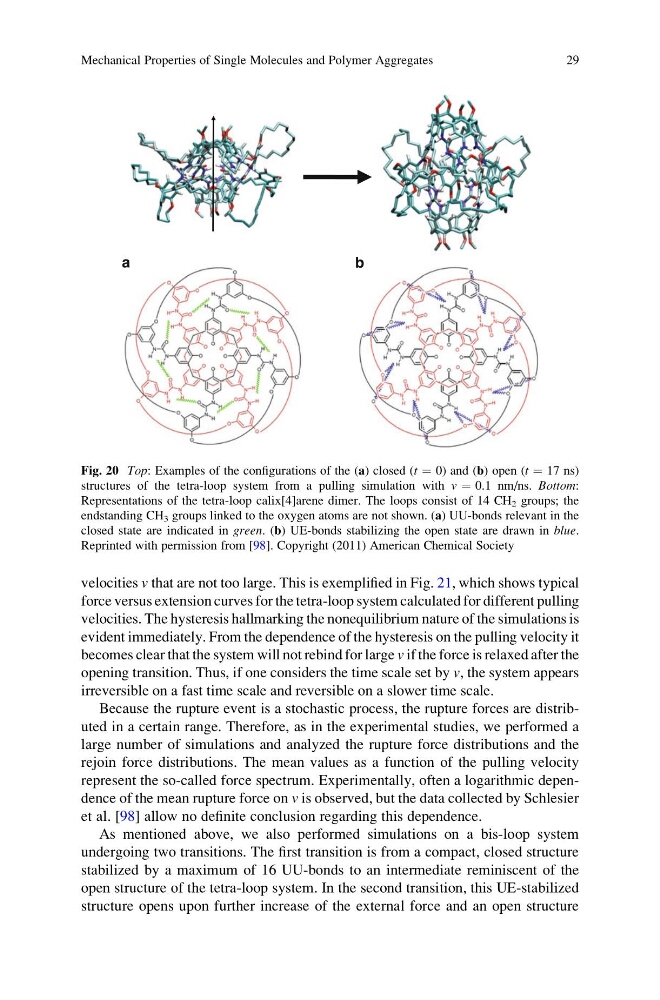
Fig. 20 Top: Examples of the configurations of the (a) closed (t ¼ 0) and (b) open (t ¼ 17 ns)
structures of the tetra-loop system from a pulling simulation with v ¼ 0.1 nm/ns. Bottom:
Representations of the tetra-loop calix[4]arene dimer. The loops consist of 14 CH 2 groups; the
endstanding CH 3 groups linked to the oxygen atoms are not shown. (a) UU-bonds relevant in the
closed state are indicated in green. (b) UE-bonds stabilizing the open state are drawn in blue.
Reprinted with permission from [98]. Copyright (2011) American Chemical Society
Mechanical Properties of Single Molecules and Polymer Aggregates
29
force versus extension curves for the tetra-loop system calculated for different pulling
velocities. The hysteresis hallmarking the nonequilibrium nature of the simulations is
evident immediately. From the dependence of the hysteresis on the pulling velocity it
becomes clear that the system will not rebind for large v if the force is relaxed after the
opening transition. Thus, if one considers the time scale set by v, the system appears
irreversible on a fast time scale and reversible on a slower time scale.
Because the rupture event is a stochastic process, the rupture forces are distributed in a certain range. Therefore, as in the experimental studies, we performed a
large number of simulations and analyzed the rupture force distributions and the
rejoin force distributions. The mean values as a function of the pulling velocity
represent the so-called force spectrum. Experimentally, often a logarithmic dependence of the mean rupture force on v is observed, but the data collected by Schlesier
et al. [98] allow no definite conclusion regarding this dependence.
As mentioned above, we also performed simulations on a bis-loop system
undergoing two transitions. The first transition is from a compact, closed structure
stabilized by a maximum of 16 UU-bonds to an intermediate reminiscent of the
open structure of the tetra-loop system. In the second transition, this UE-stabilized
structure opens upon further increase of the external force and an open structure
a
b
Fig. 20 Top: Examples of the configurations of the (a) closed (t ¼ 0) and (b) open (t ¼ 17 ns)
structures of the tetra-loop system from a pulling simulation with v ¼ 0.1 nm/ns. Bottom:
Representations of the tetra-loop calix[4]arene dimer. The loops consist of 14 CH 2 groups; the
endstanding CH 3 groups linked to the oxygen atoms are not shown. (a) UU-bonds relevant in the
closed state are indicated in green. (b) UE-bonds stabilizing the open state are drawn in blue.
Reprinted with permission from [98]. Copyright (2011) American Chemical Society
Mechanical Properties of Single Molecules and Polymer Aggregates
29