

2.1 Force Probe MD Simulations of Calix[4]arene
Catenanes
Catenanes constitute a family of molecules that are interesting because of their
potential incorporation into molecular motors or switches [96] and, in particular,
the specially designed calix[4]arene catenanes that have been synthesized recently
have interesting properties [97]. We have investigated exactly the same systems
that are also the subject of experimental DFS investigations reviewed in Sect. 3,
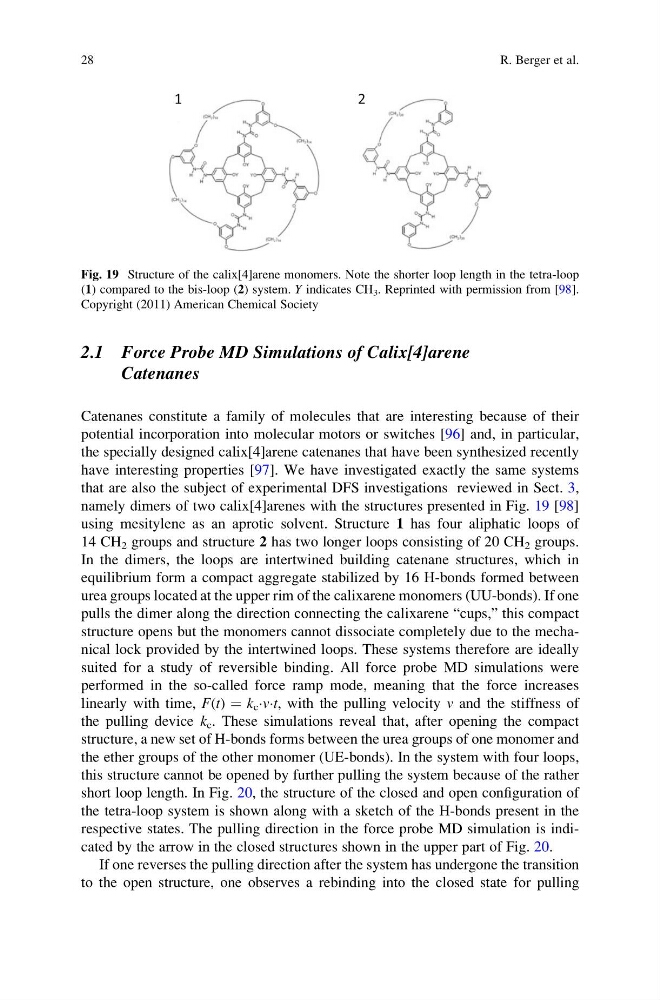
namely dimers of two calix[4]arenes with the structures presented in Fig. 19 [98]
using mesitylene as an aprotic solvent. Structure 1 has four aliphatic loops of
14 CH 2 groups and structure 2 has two longer loops consisting of 20 CH 2 groups.
In the dimers, the loops are intertwined building catenane structures, which in
equilibrium form a compact aggregate stabilized by 16 H-bonds formed between
urea groups located at the upper rim of the calixarene monomers (UU-bonds). If one
pulls the dimer along the direction connecting the calixarene “cups,” this compact
structure opens but the monomers cannot dissociate completely due to the mechanical lock provided by the intertwined loops. These systems therefore are ideally
suited for a study of reversible binding. All force probe MD simulations were
performed in the so-called force ramp mode, meaning that the force increases
linearly with time, F(t) ¼ k c ÁvÁt, with the pulling velocity v and the stiffness of
the pulling device k c . These simulations reveal that, after opening the compact
structure, a new set of H-bonds forms between the urea groups of one monomer and
the ether groups of the other monomer (UE-bonds). In the system with four loops,
this structure cannot be opened by further pulling the system because of the rather
short loop length. In Fig. 20, the structure of the closed and open configuration of
the tetra-loop system is shown along with a sketch of the H-bonds present in the
respective states. The pulling direction in the force probe MD simulation is indicated by the arrow in the closed structures shown in the upper part of Fig. 20.
If one reverses the pulling direction after the system has undergone the transition
to the open structure, one observes a rebinding into the closed state for pulling
Fig. 19 Structure of the calix[4]arene monomers. Note the shorter loop length in the tetra-loop
(1) compared to the bis-loop (2) system. Y indicates CH 3 . Reprinted with permission from [98].
Copyright (2011) American Chemical Society
28
R. Berger et al.
Catenanes
Catenanes constitute a family of molecules that are interesting because of their
potential incorporation into molecular motors or switches [96] and, in particular,
the specially designed calix[4]arene catenanes that have been synthesized recently
have interesting properties [97]. We have investigated exactly the same systems
that are also the subject of experimental DFS investigations reviewed in Sect. 3,
namely dimers of two calix[4]arenes with the structures presented in Fig. 19 [98]
using mesitylene as an aprotic solvent. Structure 1 has four aliphatic loops of
14 CH 2 groups and structure 2 has two longer loops consisting of 20 CH 2 groups.
In the dimers, the loops are intertwined building catenane structures, which in
equilibrium form a compact aggregate stabilized by 16 H-bonds formed between
urea groups located at the upper rim of the calixarene monomers (UU-bonds). If one
pulls the dimer along the direction connecting the calixarene “cups,” this compact
structure opens but the monomers cannot dissociate completely due to the mechanical lock provided by the intertwined loops. These systems therefore are ideally
suited for a study of reversible binding. All force probe MD simulations were
performed in the so-called force ramp mode, meaning that the force increases
linearly with time, F(t) ¼ k c ÁvÁt, with the pulling velocity v and the stiffness of
the pulling device k c . These simulations reveal that, after opening the compact
structure, a new set of H-bonds forms between the urea groups of one monomer and
the ether groups of the other monomer (UE-bonds). In the system with four loops,
this structure cannot be opened by further pulling the system because of the rather
short loop length. In Fig. 20, the structure of the closed and open configuration of
the tetra-loop system is shown along with a sketch of the H-bonds present in the
respective states. The pulling direction in the force probe MD simulation is indicated by the arrow in the closed structures shown in the upper part of Fig. 20.
If one reverses the pulling direction after the system has undergone the transition
to the open structure, one observes a rebinding into the closed state for pulling
Fig. 19 Structure of the calix[4]arene monomers. Note the shorter loop length in the tetra-loop
(1) compared to the bis-loop (2) system. Y indicates CH 3 . Reprinted with permission from [98].
Copyright (2011) American Chemical Society
28
R. Berger et al.