

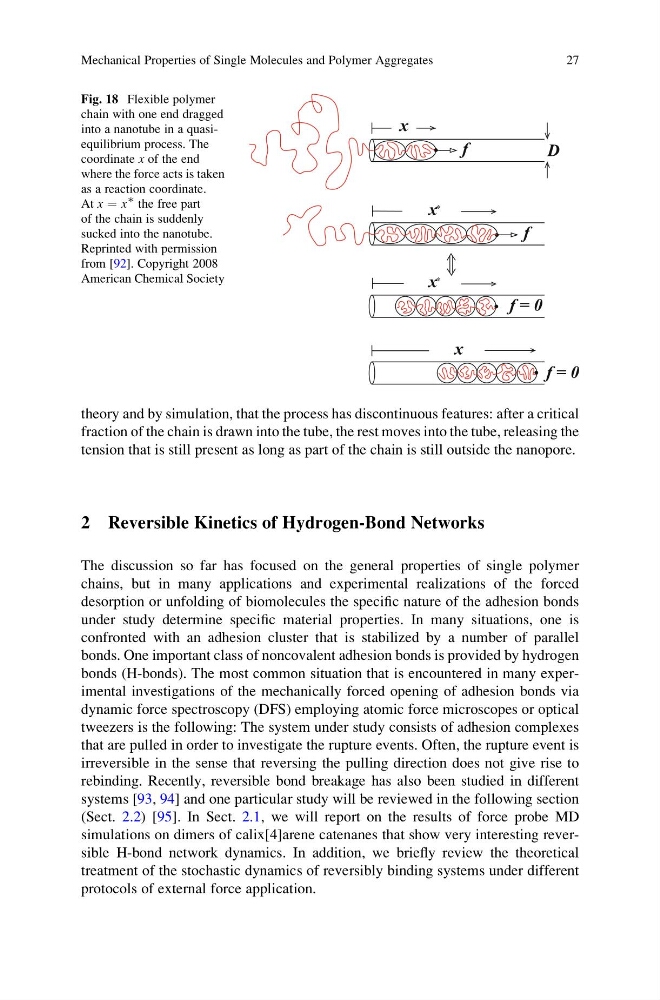
theory and by simulation, that the process has discontinuous features: after a critical
fraction of the chain is drawn into the tube, the rest moves into the tube, releasing the
tension that is still present as long as part of the chain is still outside the nanopore.
2 Reversible Kinetics of Hydrogen-Bond Networks
The discussion so far has focused on the general properties of single polymer
chains, but in many applications and experimental realizations of the forced
desorption or unfolding of biomolecules the specific nature of the adhesion bonds
under study determine specific material properties. In many situations, one is
confronted with an adhesion cluster that is stabilized by a number of parallel
bonds. One important class of noncovalent adhesion bonds is provided by hydrogen
bonds (H-bonds). The most common situation that is encountered in many experimental investigations of the mechanically forced opening of adhesion bonds via
dynamic force spectroscopy (DFS) employing atomic force microscopes or optical
tweezers is the following: The system under study consists of adhesion complexes
that are pulled in order to investigate the rupture events. Often, the rupture event is
irreversible in the sense that reversing the pulling direction does not give rise to
rebinding. Recently, reversible bond breakage has also been studied in different
systems [93, 94] and one particular study will be reviewed in the following section
(Sect. 2.2) [95]. In Sect. 2.1, we will report on the results of force probe MD
simulations on dimers of calix[4]arene catenanes that show very interesting reversible H-bond network dynamics. In addition, we briefly review the theoretical
treatment of the stochastic dynamics of reversibly binding systems under different
protocols of external force application.
x *
x *
f
f
D
x
f = 0
f = 0
x
Fig. 18 Flexible polymer
chain with one end dragged
into a nanotube in a quasiequilibrium process. The
coordinate x of the end
where the force acts is taken
as a reaction coordinate.
At x ¼ x
∗ the free part
of the chain is suddenly
sucked into the nanotube.
Reprinted with permission
from [92]. Copyright 2008
American Chemical Society
Mechanical Properties of Single Molecules and Polymer Aggregates
27
fraction of the chain is drawn into the tube, the rest moves into the tube, releasing the
tension that is still present as long as part of the chain is still outside the nanopore.
2 Reversible Kinetics of Hydrogen-Bond Networks
The discussion so far has focused on the general properties of single polymer
chains, but in many applications and experimental realizations of the forced
desorption or unfolding of biomolecules the specific nature of the adhesion bonds
under study determine specific material properties. In many situations, one is
confronted with an adhesion cluster that is stabilized by a number of parallel
bonds. One important class of noncovalent adhesion bonds is provided by hydrogen
bonds (H-bonds). The most common situation that is encountered in many experimental investigations of the mechanically forced opening of adhesion bonds via
dynamic force spectroscopy (DFS) employing atomic force microscopes or optical
tweezers is the following: The system under study consists of adhesion complexes
that are pulled in order to investigate the rupture events. Often, the rupture event is
irreversible in the sense that reversing the pulling direction does not give rise to
rebinding. Recently, reversible bond breakage has also been studied in different
systems [93, 94] and one particular study will be reviewed in the following section
(Sect. 2.2) [95]. In Sect. 2.1, we will report on the results of force probe MD
simulations on dimers of calix[4]arene catenanes that show very interesting reversible H-bond network dynamics. In addition, we briefly review the theoretical
treatment of the stochastic dynamics of reversibly binding systems under different
protocols of external force application.
x *
x *
f
f
D
x
f = 0
f = 0
x
Fig. 18 Flexible polymer
chain with one end dragged
into a nanotube in a quasiequilibrium process. The
coordinate x of the end
where the force acts is taken
as a reaction coordinate.
At x ¼ x
∗ the free part
of the chain is suddenly
sucked into the nanotube.
Reprinted with permission
from [92]. Copyright 2008
American Chemical Society
Mechanical Properties of Single Molecules and Polymer Aggregates
27