

one should not be surprised that different models produce different estimates of ϕ in
this interval.
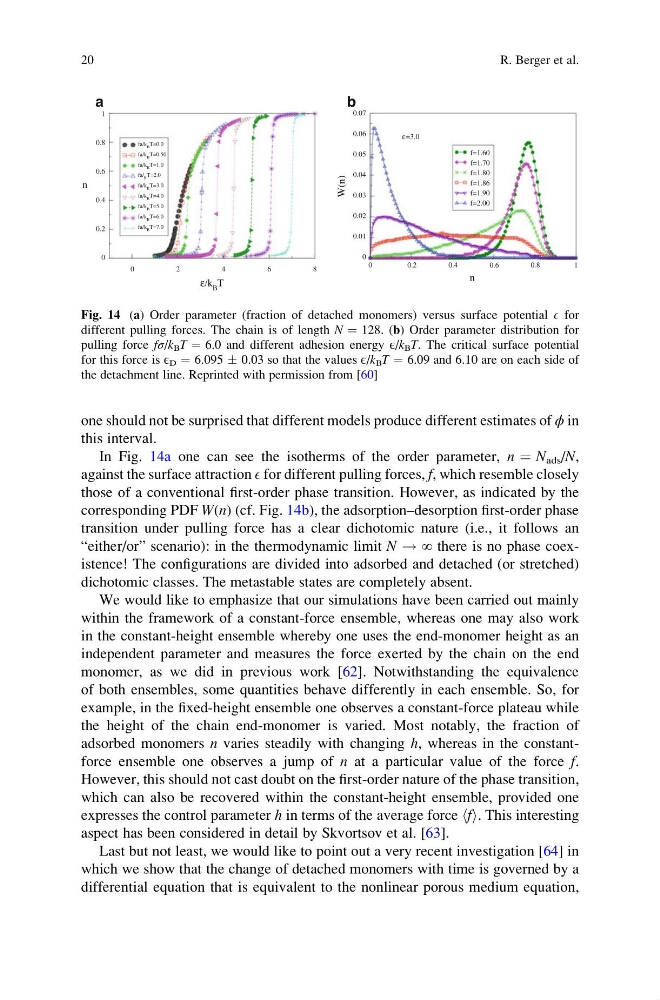
In Fig. 14a one can see the isotherms of the order parameter, n ¼ N ads /N,
against the surface attraction E for different pulling forces, f, which resemble closely
those of a conventional first-order phase transition. However, as indicated by the
corresponding PDF W(n) (cf. Fig. 14b), the adsorption–desorption first-order phase
transition under pulling force has a clear dichotomic nature (i.e., it follows an
“either/or” scenario): in the thermodynamic limit N ! ∞ there is no phase coexistence! The configurations are divided into adsorbed and detached (or stretched)
dichotomic classes. The metastable states are completely absent.
We would like to emphasize that our simulations have been carried out mainly
within the framework of a constant-force ensemble, whereas one may also work
in the constant-height ensemble whereby one uses the end-monomer height as an
independent parameter and measures the force exerted by the chain on the end
monomer, as we did in previous work [62]. Notwithstanding the equivalence
of both ensembles, some quantities behave differently in each ensemble. So, for
example, in the fixed-height ensemble one observes a constant-force plateau while
the height of the chain end-monomer is varied. Most notably, the fraction of
adsorbed monomers n varies steadily with changing h, whereas in the constantforce ensemble one observes a jump of n at a particular value of the force f.
However, this should not cast doubt on the first-order nature of the phase transition,
which can also be recovered within the constant-height ensemble, provided one
expresses the control parameter h in terms of the average force hfi. This interesting
aspect has been considered in detail by Skvortsov et al. [63].
Last but not least, we would like to point out a very recent investigation [64] in
which we show that the change of detached monomers with time is governed by a
differential equation that is equivalent to the nonlinear porous medium equation,
0
2
4
6
8
ε/k B T
0
0.2
0.4
0.6
0.8
1
n
fa/k B T=0.0
fa/k B T=0.50
fa/k B T=1.0
fa/ B T=2.0
fa/k B T=3.0
fa/k B T=4.0
fa/k B T=5.0
fa/k B T=6.0
fa/k B T=7.0
0
0.2
0.4
0.6
0.8
1
n
0
0.01
0.02
0.03
0.04
0.05
0.06
0.07
W(n)
f=1.60
f=1.70
f=1.80
f=1.86
f=1.90
f=2.00
ε=3.0
a
b
Fig. 14 (a) Order parameter (fraction of detached monomers) versus surface potential E for
different pulling forces. The chain is of length N ¼ 128. (b) Order parameter distribution for
pulling force fσ/k B T ¼ 6.0 and different adhesion energy E/k B T. The critical surface potential
for this force is E D ¼ 6.095 Æ 0.03 so that the values E/k B T ¼ 6.09 and 6.10 are on each side of
the detachment line. Reprinted with permission from [60]
20
R. Berger et al.
this interval.
In Fig. 14a one can see the isotherms of the order parameter, n ¼ N ads /N,
against the surface attraction E for different pulling forces, f, which resemble closely
those of a conventional first-order phase transition. However, as indicated by the
corresponding PDF W(n) (cf. Fig. 14b), the adsorption–desorption first-order phase
transition under pulling force has a clear dichotomic nature (i.e., it follows an
“either/or” scenario): in the thermodynamic limit N ! ∞ there is no phase coexistence! The configurations are divided into adsorbed and detached (or stretched)
dichotomic classes. The metastable states are completely absent.
We would like to emphasize that our simulations have been carried out mainly
within the framework of a constant-force ensemble, whereas one may also work
in the constant-height ensemble whereby one uses the end-monomer height as an
independent parameter and measures the force exerted by the chain on the end
monomer, as we did in previous work [62]. Notwithstanding the equivalence
of both ensembles, some quantities behave differently in each ensemble. So, for
example, in the fixed-height ensemble one observes a constant-force plateau while
the height of the chain end-monomer is varied. Most notably, the fraction of
adsorbed monomers n varies steadily with changing h, whereas in the constantforce ensemble one observes a jump of n at a particular value of the force f.
However, this should not cast doubt on the first-order nature of the phase transition,
which can also be recovered within the constant-height ensemble, provided one
expresses the control parameter h in terms of the average force hfi. This interesting
aspect has been considered in detail by Skvortsov et al. [63].
Last but not least, we would like to point out a very recent investigation [64] in
which we show that the change of detached monomers with time is governed by a
differential equation that is equivalent to the nonlinear porous medium equation,
0
2
4
6
8
ε/k B T
0
0.2
0.4
0.6
0.8
1
n
fa/k B T=0.0
fa/k B T=0.50
fa/k B T=1.0
fa/ B T=2.0
fa/k B T=3.0
fa/k B T=4.0
fa/k B T=5.0
fa/k B T=6.0
fa/k B T=7.0
0
0.2
0.4
0.6
0.8
1
n
0
0.01
0.02
0.03
0.04
0.05
0.06
0.07
W(n)
f=1.60
f=1.70
f=1.80
f=1.86
f=1.90
f=2.00
ε=3.0
a
b
Fig. 14 (a) Order parameter (fraction of detached monomers) versus surface potential E for
different pulling forces. The chain is of length N ¼ 128. (b) Order parameter distribution for
pulling force fσ/k B T ¼ 6.0 and different adhesion energy E/k B T. The critical surface potential
for this force is E D ¼ 6.095 Æ 0.03 so that the values E/k B T ¼ 6.09 and 6.10 are on each side of
the detachment line. Reprinted with permission from [60]
20
R. Berger et al.